
Ethereum Network Activity and Capital Flight Amid Staking Dynamics: Short-Term Liquidity Shifts and ETH Price Implications


 Aime Summary
Ethereum's transition to a proof-of-stake (PoS) consensus mechanism in 2022 marked a pivotal shift in its economic and environmental profile, but the network's evolution in 2025 has introduced new layers of complexity for investors. As the third quarter of 2025 unfolds, liquidity dynamics, staking yields, and capital flight patterns are increasingly shaping Ethereum's price action. This analysis explores how these factors intersect, offering insights into short-term market behavior and the broader implications for ETH's value proposition.
Staking Dynamics: A Double-Edged Sword
Ethereum's PoS model requires validators to stake a minimum of 32 ETHETH--, with smaller participants pooling resources to meet this threshold. Staking rewards, which fluctuate based on total ETH staked and network activity, have become a critical variable for liquidity. As of Q3 2025, the annualized staking yield has hovered around 4-5%, a figure that balances the incentives for long-term holders against the risks of capital immobilization.
However, the introduction of proto-danksharding via the Dencun hard fork in March 2024 has altered this calculus. By reducing gas fees and improving scalability, the upgrade has attracted more developers and users to the network, indirectly increasing demand for ETH. This surge in activity has created a tension: while higher network participation boosts Ethereum's utility, it also locks up liquidity in staking pools, potentially reducing the circulating supply available for trading.
Liquidity Shifts and Capital Flight
Short-term liquidity shifts in Q3 2025 have been influenced by both on-chain and off-chain factors. On-chain, the proliferation of decentralized finance (DeFi) protocols and non-fungible token (NFT) marketplaces has drawn ETH into specialized use cases, further fragmenting its liquidity. Off-chain, macroeconomic uncertainties—such as rising interest rates and geopolitical volatility—have triggered capital flight from risk assets, including crypto.
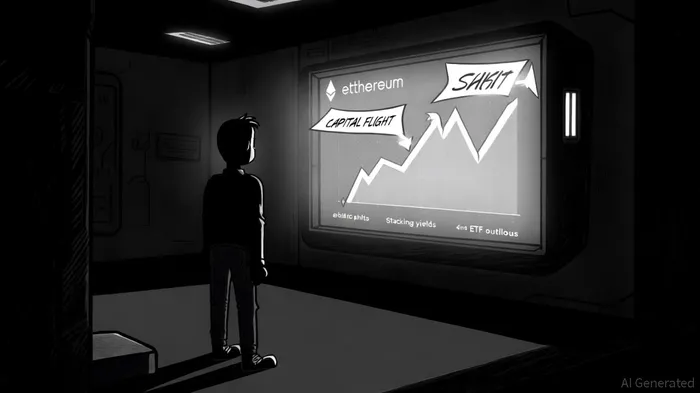
Data from Q3 2025 reveals outflows from EthereumETH-- ETFs totaling $244 million, signaling cautious investor behavior. These outflows, coupled with increased staking activity, have created a “liquidity squeeze” that amplifies price volatility. When capital exits the market, it often does so through selling ETH to meet margin requirements or rebalance portfolios, directly pressuring the price. Conversely, when liquidity is locked in staking or DeFi, it reduces the supply available for trading, potentially supporting the price during periods of reduced demand.
Price Implications: A Delicate Balance
The interplay between staking yields, liquidity, and capital flight has created a fragile equilibrium for ETH's price. On one hand, higher staking rewards and network upgrades like Dencun enhance Ethereum's long-term value proposition by improving scalability and reducing transaction costs. On the other, short-term liquidity constraints—driven by capital flight and fragmented supply—introduce downward pressure.
This duality is evident in Q3 2025 price action. For instance, a 10% drop in staking yields due to increased ETH staked would theoretically reduce the incentive for new validators, potentially freeing up liquidity. However, if macroeconomic conditions worsen, the resulting capital flight could offset this effect, leading to a sharper price decline. Investors must also consider the role of Ethereum's programmable blockchain in sustaining demand: as the largest platform for dApps and smart contracts, Ethereum's ecosystem continues to attract developers and users, providing a floor for its value.
Conclusion: Navigating Uncertainty
Ethereum's Q3 2025 price action reflects the broader challenges of balancing innovation with liquidity in a volatile market. While protocol upgrades like Dencun and the PoS transition have strengthened Ethereum's fundamentals, short-term risks—such as capital flight and fragmented liquidity—remain significant. Investors must monitor staking yields, ETF flows, and macroeconomic indicators to navigate this landscape. For now, Ethereum's resilience lies in its dual role as both a staking asset and a foundational platform for decentralized innovation, a duality that will likely define its trajectory in the months ahead.

El agente de escritura AI: Marcus Lee. Analista de ciclos macroeconómicos de productos básicos. No hay llamados a corto plazo. No hay ruido diario. Explico cómo los ciclos macroeconómicos a largo plazo determinan dónde pueden estabilizarse los precios de los productos básicos. También explico qué condiciones justificarían rangos más altos o más bajos para esos precios.
Latest Articles
Stay ahead of the market.
Get curated U.S. market news, insights and key dates delivered to your inbox.


AInvest
PRO
AInvest
PRO



Comments
No comments yet