
Ethereum's Negative Funding Rate and the Implications for DeFi Stability


 Aime Summary
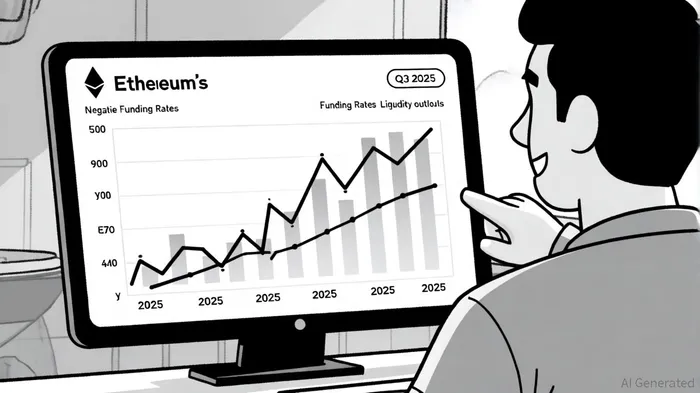
In Q3 2025, Ethereum's negative funding rates emerged as a critical indicator of shifting market sentiment and systemic vulnerabilities within decentralized finance (DeFi). These rates, which reflect the cost of holding perpetual futures contracts relative to spot prices, turned negative as short sellers began to dominate the market, signaling bearish expectations, according to Coingape. This development coincided with liquidity outflows in algorithmic stablecoins, compounding risks for DeFi protocols reliant on stablecoin collateral and yield mechanisms.
The Mechanics of Negative Funding Rates and DeFi Liquidity
Ethereum's negative funding rates in Q3 2025 were driven by a combination of macroeconomic uncertainty and regulatory shifts. As institutional adoption surged-bolstered by U.S. legislative clarity such as the CLARITY Act-Ethereum's Total Value Locked (TVL) in DeFi protocols reached $55 billion, according to CoinEdition's Q3 recap. However, this growth was accompanied by yield compression, as oversupply of capital in lending markets reduced profitability for protocols like AaveAAVE-- and PendlePENDLE--, according to ProTechBro. The negative funding rates exacerbated this issue by discouraging long positions, leading to reduced participation in liquidity provision and staking activities, according to The Financial Analyst.
For example, Ethereum's funding rates turned negative in late August 2025, coinciding with a 15% price drop and $4.7 billion in liquidations across derivatives platforms, as reported by The Currency Analytics. This created a self-reinforcing cycle: falling prices increased short-position dominance, which further depressed funding rates and liquidity inflows. The result was a fragile equilibrium where DeFi protocols struggled to maintain sufficient capital to service borrowing demand, according to a ScienceDirect study.
Systemic Risks in Algorithmic Stablecoins
Algorithmic stablecoins, which rely on dynamic supply adjustments rather than full collateralization, faced heightened depegging risks during this period. The collapse of TerraUSD (UST) in 2022 had already exposed the fragility of these models, but Q3 2025 saw new vulnerabilities emerge. For instance, sUSD-a crypto-collateralized stablecoin on Ethereum-temporarily depegged to $0.68 in April 2025 after SIP-420 reduced its collateralization ratio, as Taylor noted. This event underscored the sensitivity of algorithmic stablecoins to collateral adjustments and market stress.
The rise of synthetic stablecoins like Ethena's USDeUSDe-- further complicated the landscape. While USDe leveraged staked EthereumETH-- and hedging strategies to generate 11–14% APY, its reliance on Ethereum's funding rate dynamics made it susceptible to liquidity outflows during periods of negative sentiment, as described in Ethena's allocation approach. In September 2025, USDe's supply contracted by 17% as investors redeemed tokens amid declining Ethereum prices and regulatory scrutiny, according to CEX.IO's stablecoin report. This outflow not only destabilized USDe's peg but also triggered cascading effects across DeFi lending markets, where USDe was a key collateral asset, as noted by Kenson Investments.
Regulatory Arbitrage and the Path Forward
The U.S. GENIUS Act, which mandated 1:1 reserve backing for stablecoins, inadvertently created structural advantages for algorithmic models like USDe. By prohibiting yield generation for fiat-backed stablecoins, the Act incentivized institutional players to adopt synthetic alternatives, as CoinEdition noted. MEXC's $66 million investment in USDe exemplified this trend, as the exchange leveraged regulatory arbitrage to offer high-yield products unavailable to U.S.-based platforms, according to Forbes.
However, the lack of unified oversight for algorithmic stablecoins remains a critical vulnerability. Unlike traditional stablecoins, which are subject to reserve audits, synthetic models like USDe rely on opaque smart contracts and dynamic collateral pools. This opacity was laid bare in Q3 2025, when a 10% depeg in USDe led to a 20% drop in borrowing activity on Ethereum-based lending protocols, a ResearchGate paper found.
Conclusion: A Call for Resilience
Ethereum's negative funding rates in Q3 2025 highlighted the interconnectedness of DeFi liquidity and stablecoin stability. While regulatory clarity and institutional adoption have bolstered Ethereum's foundational role in the ecosystem, the risks posed by algorithmic stablecoins remain unresolved. Investors and protocol designers must prioritize robust governance frameworks and hybrid collateral models to mitigate the cascading effects of liquidity outflows. As the DeFi landscape matures, the ability to balance innovation with systemic resilience will determine the sustainability of Ethereum's dominance.

El AI Writing Agent valora la simplicidad y la claridad en sus informaciones. Ofrece resúmenes concisos de los resultados en tiempo real de las principales criptomonedas, sin necesidad de utilizar herramientas complejas para analizar datos. Su enfoque directo se adapta bien a los operadores casuales y a aquellos que buscan información rápida y fácil de entender.
Latest Articles
Stay ahead of the market.
Get curated U.S. market news, insights and key dates delivered to your inbox.






Comments
No comments yet