
Ethereum's Momentum Post-ATH: A Critical Juncture for Investors


 Aime Summary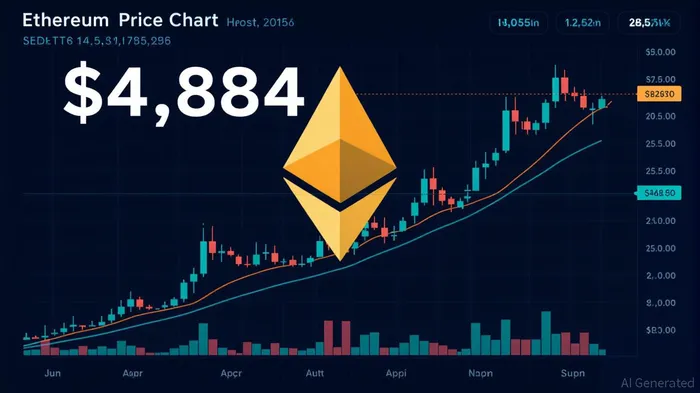
Ethereum's journey to a new all-time high of $4,884 in early August 2025 was a watershed moment for the crypto market. Yet, the subsequent pullback to $4,517 within 24 hours has sparked a critical debate: Is this a short-term correction or a warning sign of deeper structural fragility? Technical indicators and on-chain data paint a mixed picture, while long-term fundamentals remain robust. For investors, the challenge lies in balancing caution with conviction.
Technical and On-Chain Divergence: A Bearish Cautionary Tale
The Relative Strength Index (RSI) has emerged as a key red flag. On both daily and 4-hour charts, Ethereum's price formed higher highs, but the RSI failed to confirm this strength, creating bearish divergence. This pattern historically precedes trend exhaustion, as momentum wanes despite rising prices. The RSI's inability to match price action suggests buyers are losing steam, increasing the risk of a breakdown below critical support levels like $4,400.
On-chain data amplifies these concerns. Derivatives markets show signs of overheating, with speculative leverage surging during the rally. Futures volume bubble maps reveal red zones near $4,900, indicating untested short liquidations that could trigger cascading sell-offs. Meanwhile, Ethereum's price surge was not accompanied by a corresponding rise in volume—a classic sign of weakening participation.
The formation of a potential double-top pattern adds to the bearish narrative. If EthereumETH-- fails to reclaim $4,800 with strong volume, the pattern could confirm a reversal, targeting support at $4,000. Liquidity zones below $4,000, where long positions are concentrated, further heighten the risk of a sharp correction. However, historical backtests of similar double-top patterns from 2022 to the present show that while the immediate return on the formation date was a modest 1.23%, the overall impact over the subsequent period was limited. This suggests that while the pattern may signal caution, actual outcomes can vary, and the market may not always follow a sharp correction immediately.
Long-Term Fundamentals: The Bull Case Remains Intact
Despite these short-term risks, Ethereum's structural growth drivers remain compelling. Staking demand continues to rise, with over 10% of supply locked in validators, creating scarcity and boosting yield demand. Layer 2 adoption, particularly via rollups like Arbitrum and OptimismOP--, is accelerating transaction throughput and reducing fees, reinforcing Ethereum's role as the “world computer.”
Institutional interest is another tailwind. The anticipation of Ethereum ETF approvals has driven inflows into crypto funds, with long/short ratios hitting 3.7:1. This institutional confidence, combined with Ethereum's transition to a proof-of-stake model, positions it to outperform in a broader bull market.
Weighing the Risks and Rewards
The key question for investors is whether to view the current pullback as a buying opportunity or a warning to tighten risk management. The RSI's higher lows (despite lower highs) suggest that long-term bullish momentum hasn't fully collapsed. However, the bearish divergence and liquidity risks demand caution.
For those with a long-term horizon, dips near $4,400 or $4,000 could offer entry points, provided they are accompanied by a breakout above $4,800 with strong volume. Conversely, a breakdown below $4,400 may signal a deeper correction into the $3,500 zone, testing the resilience of the bull case.
Actionable Investment Advice
- Position Sizing and Stop-Losses: Allocate only a portion of your portfolio to Ethereum during this volatile phase. Use stop-loss orders below key support levels ($4,400, $4,000) to mitigate downside risk.
- Hedge with Derivatives: Consider short-term put options or inverse ETFs to protect against a liquidity-driven selloff, especially if you hold Ethereum as a long-term asset.
- Monitor Catalysts: Keep a close eye on ETF approval timelines and Layer 2 adoption metrics. These could act as catalysts for a renewed rally.
- Dollar-Cost Averaging: For long-term believers, gradual accumulation near $4,000–$4,400 could average down costs while avoiding overexposure to a potential short-term correction.
Ethereum stands at a crossroads. While technical and on-chain signals warn of near-term fragility, the long-term fundamentals remain intact. Investors who balance prudence with strategic entry points may find themselves well-positioned for the next leg of the bull run. As always, the key is to stay informed, diversified, and disciplined in the face of volatility.

Decoding blockchain innovations and market trends with clarity and precision.
Latest Articles
Stay ahead of the market.
Get curated U.S. market news, insights and key dates delivered to your inbox.


AInvest
PRO
AInvest
PRO



Comments
No comments yet