
Ethereum's Market Bottom and the Road to Recovery: Timing the Bull Run with Institutional Confidence


 Aime Summary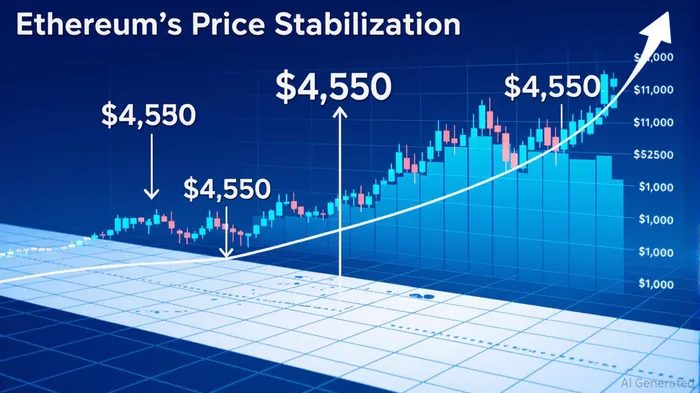
In the volatile landscape of 2025, EthereumETH-- (ETH) has emerged as a focal point for investors seeking to capitalize on a market bottom that appears to have been confirmed by both technical precision and institutional conviction. Tom Lee, a prominent voice in crypto analysis, predicted in late August 2025 that Ethereum would find its near-term bottom "within the next few hours" as the asset dipped to $4,341. This forecast, rooted in technical indicators and institutional activity, proved accurate as ETH stabilized above $4,300 and began a recovery. The event underscores a critical juncture for investors: a confluence of timing, macroeconomic catalysts, and on-chain strength that may signal the start of a new bull phase.
Timing the Bottom: Technical Precision and Institutional Validation
Lee's prediction was not a shot in the dark. It was supported by Mark Newton, Fundstrat's technical strategist, who identified $4,300 as a key support level. The price's subsequent defense of this level validated a bullish reversal, with Ethereum rebounding to $4,550 within hours. This rapid capitulation and recovery were amplified by institutional buying, most notably BitMine ImmersionBMNR-- Technologies' $21.28 million ETH purchase. BitMine's total holdings now stand at 1.72 million ETH ($7.65 billion), making it the second-largest crypto treasury after MicroStrategy. Such accumulation by major players signals a strategic bet on Ethereum's long-term value, even amid short-term volatility.
For investors, this timing aligns with a critical entry window. Technical indicators like the Ichimoku cloud and RSI suggest Ethereum is transitioning from a neutral to bullish phase, with key resistance levels at $4,447.86 and $5,100–$5,450. If Ethereum maintains support above $4,300, the path to $6,290—a long-term target—becomes increasingly plausible.
Catalysts for Recovery: Institutional Adoption and Regulatory Tailwinds
Ethereum's recovery is not merely a function of timing but also a response to structural catalysts. On-chain metrics reveal a network in robust health:
- Transaction Volume: A 43.83% year-over-year increase, with daily transactions averaging 1.74 million.
- Gas Efficiency: Layer 2 solutions like Arbitrum and zkSync now handle 60% of Ethereum's volume, reducing fees to $3.78 from $18 in 2022.
- Staking Participation: 29.6% of ETH is staked, with institutional investors controlling 7% of the supply. Staking derivatives like stETH and cbETH offer 3–14% annualized returns, outperforming Bitcoin's zero-yield model.
Regulatory clarity has further accelerated adoption. The U.S. SEC's reclassification of Ethereum as a utility token in 2025 unlocked institutional access to staking and DeFi, with Ethereum ETFs attracting $9.4 billion in inflows by July 2025—compared to just $548 million for BitcoinBTC--. Protocols like Lido and EigenLayer now manage $43.7 billion in staked assets, offering institutional-grade liquidity.
Strategic Entry Points: Balancing Risk and Reward
While Ethereum's fundamentals are compelling, investors must navigate macroeconomic headwinds. The NVT (Network Value to Transactions) ratio of 37 suggests the network is undervalued relative to its utility, but short-term risks—such as potential U.S. interest rate hikes—could trigger ETF outflows. However, Ethereum's deflationary model, driven by EIP-1559's 0.5% annual supply burn, creates a scarcity narrative that could offset these pressures.
For strategic entry, consider the following:
1. Dollar-Cost Averaging (DCA): Given Ethereum's volatility, a DCA strategy from $4,300 to $4,600 allows investors to accumulate at varying price points.
2. Layer 2 Exposure: Allocate a portion of capital to Ethereum-based Layer 2 solutions like Arbitrum (ARB) and zkSync, which offer scalability and lower fees.
3. Staking Derivatives: Utilize stETH or cbETH to generate yield while holding ETH, capitalizing on the 3–14% annualized returns.
The Road to $15,000: A Long-Term Thesis
Tom Lee's $15,000 price target for Ethereum by the end of 2025 may seem ambitious, but it is grounded in the asset's expanding role as the "internet of finance." Ethereum now hosts 53% of tokenized real-world assets (RWAs), 50% of the $400 billion stablecoin market, and 4,000+ decentralized applications. Its dominance in DeFi and institutional adoption—exemplified by BitMine's 40% share of corporate-held ETH—positions it as the backbone of the next financial infrastructure wave.
Conclusion: Positioning for the Bull Phase
Ethereum's August 2025 market bottom, confirmed by institutional buying and technical support, marks a pivotal moment for investors. The asset's on-chain strength, regulatory tailwinds, and growing institutional adoption create a compelling case for a sustained bull run. While macroeconomic risks persist, Ethereum's deflationary model and utility-driven demand suggest that the recovery is not a fleeting rebound but the start of a new era. For those willing to navigate the volatility, now may be the optimal time to position for Ethereum's next chapter.


Decoding blockchain innovations and market trends with clarity and precision.
Latest Articles
Stay ahead of the market.
Get curated U.S. market news, insights and key dates delivered to your inbox.
AInvest
PRO
AInvest
PRO



Comments
No comments yet