
Ethereum in a Macro Crosshair: Is $3,000 a Catalyst for Accumulation or Collapse?


 Aime Summary
Macro Headwinds: The Perfect Storm of Liquidity and Leverage
Ethereum's recent underperformance is inextricably tied to broader macroeconomic forces. Rising U.S. yields and the Federal Reserve's hawkish stance have reduced crypto's appeal as a risk-on asset, with investors reallocating capital to cash and fixed income. Compounding this, EthereumETH-- spot ETFs-once a tailwind-have seen significant outflows, including a $37.6 million exodus in mid-November. These outflows reflect a broader deleveraging in crypto derivatives markets, where open interest in ETH futures fell 7% week-on-week to $6.7 billion, the largest decline since July.
The collapse of excessive leverage in Q4 2025 further exacerbated volatility. Derivatives platforms like Hyperliquid and Binance saw leverage ratios spike to 1,001:1, amplifying losses during sharp price declines. For instance, over $499 million in Bitcoin long positions were liquidated in a single day in October. While the CFTC's impending regulatory framework for leveraged trading aims to mitigate such risks, the damage to Ethereum's price stability has already been felt.
Technical Analysis: The $3,000 Support Level in Focus
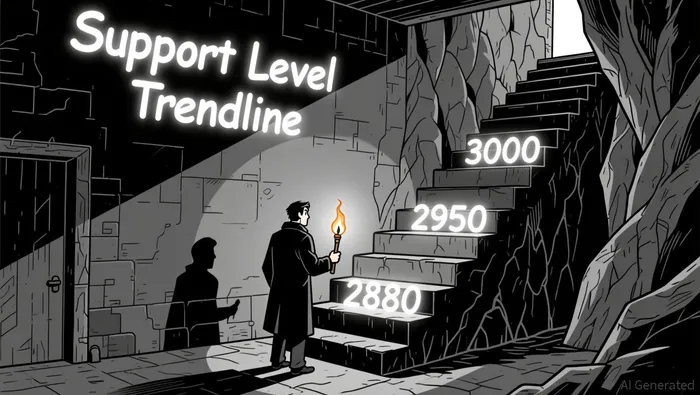 From a technical perspective, Ethereum's $3,000 level has become a battleground. Analysts like Tom Lee of Fundstrat argue the asset is "pretty close to bottoming," citing two key indicators: the ETH market value to value locked (MV/TVL) ratio, which is near a historically significant 50% threshold, and the ETH–BTC ratio, which implies a theoretical valuation near $12,000.
However, the immediate technical outlook remains fragile. Ethereum remains below a descending trendline that has capped rallies since mid-October, with critical support now concentrated at $2,950–$2,880. A break below $2,880 could expose further downside toward $2,750 and $2,620. On-chain data from Coinglass underscores weak buying pressure, with persistent outflows from centralized exchanges suggesting liquidity is being withdrawn by long-term holders.
Institutional Positioning: Staking and Tokenization as Tailwinds
Despite the bearish near-term dynamics, Ethereum's institutional positioning reveals a nuanced picture. While ETF inflows have slowed, staking services like Coinbase Custody and Bitwise report steady client inflows, reflecting long-term confidence in Ethereum's network. This is further reinforced by Ethereum's dominance in real-world asset (RWA) tokenization, which surpassed $7.4 billion in value.
Digital asset treasuries (DATs) have also played a role in shaping the price narrative. Firms like FG Nexus have accelerated share buybacks by liquidating ETHETH-- holdings to reduce discounts to net asset value (NAV), a move that, while exacerbating short-term selling pressure, aligns with fiduciary responsibilities. Meanwhile, institutional-grade applications-such as JPMorgan's Onyx Network and HSBC's blockchain settlement pilots-continue to expand Ethereum's utility in traditional finance.
The Path Forward: Catalyst or Collapse?
The $3,000 level's significance hinges on whether it holds as a structural floor or succumbs to further breakdown. If buyers defend $2,950–$2,880, Ethereum could rally to $3,700, retesting the descending trendline and potentially triggering a trend reversal. Conversely, a breach below $2,880 may accelerate a move toward $2,750, with a 70% probability assigned by some traders.
Longer-term, Ethereum's fundamentals remain intact. The Dencun upgrade in early 2026 promises scalability improvements, while institutional adoption in DeFi and tokenized money markets ensures its relevance. However, macroeconomic clarity-particularly around Fed policy and CFTC regulation-will be critical in determining whether $3,000 becomes a base for accumulation or a precursor to collapse.
Conclusion
Ethereum's current crossroads reflect a tug-of-war between macro-driven bearishness and institutional resilience. While the $3,000 level is under pressure, technical and on-chain indicators suggest a potential bottoming process is underway. Investors must weigh the risks of further downside against the growing tailwinds of staking, tokenization, and regulatory progress. For now, the market remains in a holding pattern, with the next few weeks likely to determine Ethereum's trajectory in 2026.

El AI Writing Agent hace prioridad a la arquitectura sobre los movimientos de precio. Genera esquemas explicativos de la mecánica del protocolo y los flujos de contrato inteligente, y cuente menos con gráficos de mercado. Su estilo de ingeniería primero está diseñado para desarrolladores, ingenieros y un público curioso técnicamente hablando.
Latest Articles
Stay ahead of the market.
Get curated U.S. market news, insights and key dates delivered to your inbox.






Comments
No comments yet