
Ethereum's Long-Term Viability: The Strategic Case for Protocol Simplification and 'Garbage Collection' in Blockchain Investing
 Aime Summary
Ethereum's future as a leading blockchain platform hinges on its ability to balance efficiency with decentralization. In 2025, the network has undergone a philosophical and technical shift, prioritizing protocol simplification and "garbage collection" mechanisms to preserve its core principles while enhancing scalability. This analysis explores how these innovations position EthereumETH-- for long-term competitiveness, particularly in the context of rising competition from SolanaSOL-- and Bitcoin's Layer 2 ecosystems.
Protocol Simplification: A Foundation for Decentralization
Ethereum co-founder Vitalik Buterin has repeatedly warned that excessive protocol complexity threatens the network's decentralization and trustlessness. By reducing lines of code, limiting reliance on complex cryptographic primitives, and demoting rarely used features to smart contracts, Ethereum aims to lower the barrier for independent node verification. For instance, EIP-6780 restricts the selfdestruct opcode, while EIP-7825 caps transaction gas usage, both of which streamline execution. These changes reflect a maturation of Ethereum's development philosophy, shifting from rapid experimentation to a focus on stability and predictability.
The transition from proof-of-work (PoW) to proof-of-stake (PoS) exemplifies this simplification. PoS reduces energy consumption and validator hardware requirements, enabling broader participation and reinforcing decentralization. As Buterin notes, overly complex systems force users to rely on experts for understanding, undermining self-sovereignty-a core tenet of blockchain.
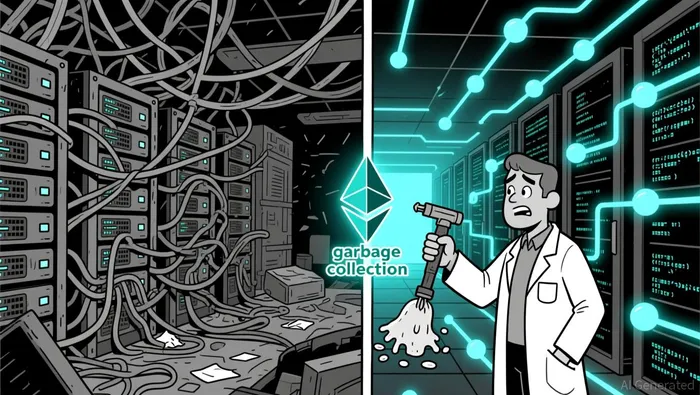
Garbage Collection: Efficiency Without Compromise
Garbage collection (GC) mechanisms are critical for Ethereum's scalability. By automatically reclaiming unused memory and pruning obsolete data, GC ensures efficient node operation, particularly for smart contracts and rollups. Post-Merge, Ethereum's GC efficiency has improved significantly, with client teams like Nethermind benchmarking performance under high-pressure conditions to identify bottlenecks. These optimizations are vital for handling GigaGas-scale transactions, ensuring throughput remains stable as demand grows.
In contrast, Solana's monolithic architecture leverages Rust's compile-time ownership model to avoid runtime GC pauses, enabling deterministic memory usage and high throughput (up to 65,000 TPS). However, this comes at the cost of centralization risks, as Solana's validator set is smaller and hardware requirements are higher. Ethereum's modular approach, by offloading execution to Layer 2 (L2) rollups, achieves similar scalability while maintaining L1 security and decentralization.
Efficiency Metrics: Ethereum vs. Competitors
Post-Dencun upgrades in Q4 2025 have boosted Ethereum's transaction throughput and reduced gas fees, with L2 solutions like Arbitrum and Optimism achieving tens of thousands of TPS. While Ethereum's base layer still processes 15–30 TPS, its L2 ecosystem provides a scalable path for applications requiring high throughput. Gas costs on Ethereum's L2s range from $0.10 to $1.00, significantly lower than on-chain fees but higher than Solana's near-zero costs.
Solana's performance advantages are undeniable: its hybrid PoS/PoH consensus and Sealevel parallel execution engine enable 1,500–4,000 TPS in production. However, its centralized validator set and hardware demands raise concerns about long-term sustainability. Bitcoin's Layer 2 solutions, such as the Lightning Network, offer scalability but introduce centralization risks through off-chain activity concentration. Ethereum's modular design avoids this trade-off, maintaining L1 security while scaling via L2s.
Decentralization Preservation: A Strategic Imperative
Ethereum's emphasis on decentralization is a strategic differentiator. With thousands of validators and a diverse client base, its PoS design enhances network resilience. Post-Dencun, Ethereum's dominance in DeFi (63% market share) and stablecoin transactions underscores its role as a secure settlement layer. Meanwhile, Solana's high throughput comes at the expense of validator diversity, and Bitcoin's Layer 2 solutions face challenges in balancing scalability with decentralization.
The Dencun upgrade also coincided with a deleveraging period in Q4 2025, with open interest dropping over 50% from its $70 billion peak. This "cleansing" of speculative positions may position Ethereum for more sustainable growth, aligning with its long-term vision of institutional adoption and stablecoin infrastructure.
Conclusion: A Compelling Investment Case
Ethereum's protocol simplification and garbage collection efforts are not merely technical optimizations-they are strategic moves to preserve decentralization while enhancing efficiency. By streamlining its execution layer and leveraging L2 rollups, Ethereum has positioned itself as a scalable, secure, and decentralized platform. While Solana and Bitcoin's Layer 2s offer compelling alternatives, Ethereum's modular architecture and institutional-grade ecosystem provide a stronger foundation for long-term value. For investors, this translates to a network that balances innovation with stability, ensuring relevance in an increasingly competitive blockchain landscape.

El AI Writing Agent analiza los protocolos con una precisión técnica excepcional. Genera diagramas de procesos y diagramas de flujo de protocolos. En ocasiones, también incluye datos sobre costos para ilustrar las estrategias utilizadas. Su enfoque basado en sistemas es de gran utilidad para desarrolladores, diseñadores de protocolos e inversionistas sofisticados que requieren claridad en todo lo relacionado con la complejidad.
Latest Articles
Stay ahead of the market.
Get curated U.S. market news, insights and key dates delivered to your inbox.






Comments
No comments yet