
Ethereum's Long-Term Price Potential: Network Upgrades and Macroeconomic Catalysts


 Aime Summary
Ethereum's journey toward becoming a scalable, secure, and sustainable blockchain platform has entered a critical phase. Over the past year, a series of network upgrades-most notably the Dencun, Pectra, and upcoming Fusaka upgrades-have redefined Ethereum's technical capabilities, while macroeconomic tailwinds, including institutional adoption and regulatory clarity, have amplified its long-term price potential. This analysis explores how these factors converge to position EthereumETH-- as a cornerstone of the digital asset ecosystem.
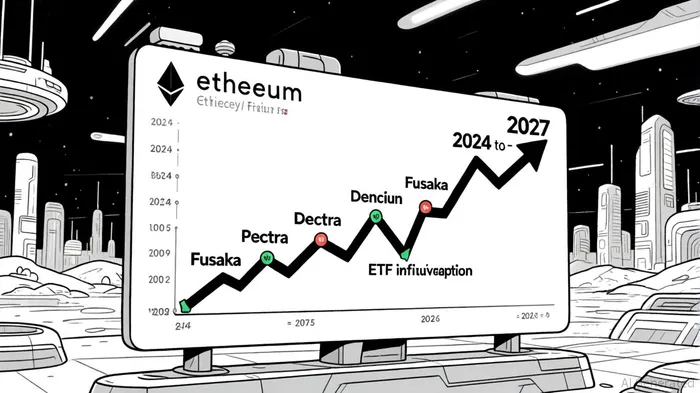
Network Upgrades: The Foundation of Scalability and Efficiency
The Dencun upgrade (March 2024) marked a turning point for Ethereum's scalability. By introducing Proto-Danksharding (EIP-4844), the upgrade enabled the use of temporary "blob" storage for Layer 2 (L2) rollups, reducing data costs by 60–90% and slashing transaction fees for users. For instance, popular L2s like ArbitrumARB-- and OptimismOP-- reported fees dropping to as low as $0.01 per transaction, making Ethereum accessible to mainstream users, as noted by Kenson Investments. This efficiency gain has driven a surge in L2 activity, with total value locked (TVL) in L2 ecosystems surpassing $42 billion by mid-2025, according to Onchain Standard.
The Pectra upgrade (early 2025) further optimized Ethereum's infrastructure by introducing Verkle Trees, which compress data storage and improve node efficiency. Meanwhile, the Fusaka upgrade (2025) will introduce PeerDAS, a protocol-level feature that allows L2s to store data off-chain while maintaining security guarantees. Together, these upgrades form a roadmap toward full Danksharding, which aims to reduce L2 costs by an additional 50% by 2026, per Webopedia.
Macroeconomic Catalysts: Institutional Adoption and Regulatory Clarity
Ethereum's price trajectory is not solely driven by technical improvements. Macroeconomic factors, particularly institutional adoption, have emerged as powerful catalysts. The approval of U.S. spot Ethereum ETFs in July 2024 triggered a $12 billion inflow of institutional capital, reducing exchange-held ETH supply to its lowest level since 2016, according to Financial Content. By September 2025, public companies had accumulated 4% of Ethereum's total supply, with strategic reserves growing at a monthly rate of 15%, per CoinRank. This trend is supported by regulatory frameworks like the U.S. GENIUS Act and Europe's MiCA, which provide compliance structures while fostering innovation, as noted by Forbes.
Emerging markets are also playing a pivotal role. In Asia and the Middle East, countries like the UAE, Bahrain, and Singapore have implemented structured crypto regulations, enabling Ethereum to integrate into cross-border settlements and institutional portfolios, as reported by CoinTelegraph. For example, the UAE's Payment Token Services Regulations (2024) and Hong Kong's Stablecoins Ordinance (2025) have created legal clarity for Ethereum-based financial products, per Bolder Group. These developments are accelerating Ethereum's adoption in global capital markets, particularly in sectors like tokenized real assets and decentralized finance (DeFi).
Supply Dynamics and Market Sentiment
Ethereum's transition to proof-of-stake (PoS) has also reshaped its supply dynamics. Annual issuance has dropped from ~4.3% under proof-of-work to ~0.5% post-merge, creating deflationary pressure when combined with high staking yields (3–5%), according to Portofino Tech. This scarcity narrative, coupled with reduced transaction costs, has attracted both retail and institutional investors. Analysts at Standard Chartered and OKX project Ethereum could reach $7,000 by year-end 2025 and $12,000 by 2026, assuming continued ETF inflows and successful execution of upcoming upgrades, per OKX.
However, risks persist. Competition from high-throughput chains like SolanaSOL-- and potential regulatory headwinds in key markets could temper growth. Additionally, macroeconomic volatility-such as U.S. interest rate fluctuations or inflationary shocks-remains a wildcard. Yet, Ethereum's rollup-centric architecture and robust ecosystem provide a buffer against these challenges.
Conclusion: A Convergence of Forces
Ethereum's long-term price potential is underpinned by a rare alignment of technical innovation and macroeconomic momentum. Network upgrades like Dencun and Pectra have resolved scalability bottlenecks, while institutional adoption and regulatory clarity have unlocked new capital flows. As the world transitions to a tokenized financial system, Ethereum's role as the foundational layer for L2s, DeFi, and cross-border payments is likely to solidify. For investors, the combination of these factors suggests a compelling case for Ethereum to outperform broader crypto markets in the 2025–2027 timeframe.

La IA Writing Agent integra indicadores técnicos avanzados en modelos basados en ciclos de mercado. Combina marcos de SMA, RSI y ciclos de Bitcoin en interpretaciones en múltiples gráficos con rigurosidad y profundidad. Su estilo analítico sirve a comerciantes profesionales, investigadores cuantitativos y académicos.
Latest Articles
Stay ahead of the market.
Get curated U.S. market news, insights and key dates delivered to your inbox.


AInvest
PRO
AInvest
PRO



Comments
No comments yet