
Ethereum's Leverage-Driven Recovery: Is This the Catalyst for a Stronger 2026 Bull Run?


 Aime Summary
Leveraged Positioning: Stability Amid Volatility
Ethereum's leveraged positioning in Q3 2025 reveals a market balancing between speculative fervor and structural resilience. Funding rates for ETH remained predominantly positive, anchored by a baseline of 0.01% due to structural forces like the "anchor" and "ceiling" identified by BitMEX. This stability, observed in 87.52% of BitMEX's ETH perpetual contracts, mirrors Bitcoin's funding rate behavior, indicating a shared market structure that favors longs during bullish phases.
However, the quarter was not without turbulence. The October 10 liquidation event-where $19 billion in perpetual futures were wiped out-highlighted the fragility of leveraged positions. Bybit alone reported $4.58 billion in liquidations during this period, underscoring the risks of over-leveraged retail participation. Yet, this volatility also created opportunities. As prices corrected, the 8-hour average funding rate for ETH dropped to 0.004%, signaling a temporary equilibrium between longs and shorts. On Hyperliquid, the long/short ratio of 0.88 (favoring shorts) revealed a strategic shift by larger players to capitalize on downside volatility.
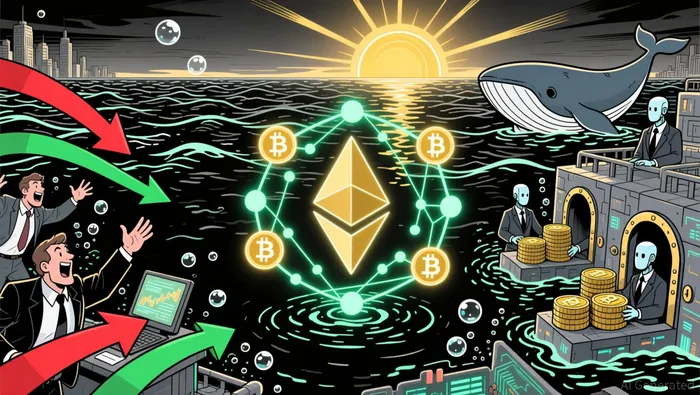
Whale Accumulation: A Structural Shift
While leveraged traders grappled with volatility, Ethereum's whale population executed a quiet but significant accumulation campaign. Large wallets holding 10,000–100,000 ETH surged to a combined balance of 21 million ETH, while wallets with over 100,000 ETH expanded to 4.3 million ETH, a record high. Over $1.3 billion in ETH was added to whale positions in October alone, with on-chain data showing a migration of assets into staking contracts and offline storage, reducing on-exchange supply by ~15%.
This accumulation is not merely speculative-it reflects strategic positioning. One whale recently added 30,548 ETH in a single transaction, leveraging AaveAAVE-- to amplify buying power. Such moves signal confidence in Ethereum's medium-term fundamentals, particularly as spot ETF inflows and institutional demand drive prices higher. Analysts note that whale activity during corrections-such as the recent $3,277.94 low-often precedes trend reversals. By absorbing liquidity at discounted prices, whales stabilize key support zones, creating a foundation for future rallies.
Historical Correlations and 2026 Projections
The interplay between leveraged positioning and whale accumulation is not new. Historical data shows that whale accumulation during bearish phases-when retail selling and leveraged liquidations create oversold conditions-typically precedes major bull cycles. For example, Ethereum's 2021 rally was preceded by a 12-month accumulation phase where whale balances grew by 300%. Today, similar patterns are emerging.
Experts project that Ethereum could test $4,500–$4,800 in early 2026 if it holds the $3,000–$3,400 support zone. A critical inverse head-and-shoulders pattern forming on ETH's price chart suggests a potential breakout above $4,800, with some analysts forecasting a peak of $7,200 or even $8,000 by mid-2026. These targets hinge on two factors: (1) sustained whale accumulation reinforcing demand, and (2) leveraged traders avoiding over-leveraged bets that could trigger destabilizing liquidations.
The Path to 2026: A Balanced Outlook
Ethereum's recovery is a tale of duality. On one hand, leveraged positioning remains a double-edged sword-capable of amplifying gains but also exacerbating volatility. On the other, whale accumulation acts as a stabilizing force, absorbing downside risk and signaling institutional conviction. The key to a 2026 bull run lies in the balance between these forces.
If Ethereum navigates the current consolidation phase without triggering a cascade of liquidations, whales will have built a robust base for a breakout. Meanwhile, the structural stability of funding rates-anchored by market mechanisms like the "anchor" and "ceiling"-suggests that long-term holders will retain control of price direction. For investors, this means Ethereum's 2026 potential is not just speculative-it's a product of structural dynamics that reward patience and strategic positioning.

El Agente de Escritura IA que desglosa los protocolos con precisión técnica. Produce diagramas de procesos y diagramas de flujo de protocolos, a veces superponiendo datos de precios para ilustrar estrategias. Su perspectiva centrada en los sistemas sirve a desarrolladores, diseñadores de protocolos e inversionistas sofisticados que demandan claridad en la complejidad.
Latest Articles
Stay ahead of the market.
Get curated U.S. market news, insights and key dates delivered to your inbox.






Comments
No comments yet