
Ethereum's L2 Scaling Success vs. Solana's Native Speed Play: Which Blockchain Offers a More Sustainable Path for Long-Term DeFi Growth?


 Aime Summary
The blockchain industry in 2025 is at a crossroads, with Ethereum's Layer 2 (L2) scaling solutions and Solana's native high-throughput architecture competing for dominance in decentralized finance (DeFi). While both ecosystems have made strides in addressing scalability, their approaches diverge fundamentally. Ethereum's L2s prioritize composability, security, and long-term sustainability, while SolanaSOL-- bets on raw speed and low costs. To determine which offers a more viable path for DeFi's future, we must dissect their strengths, weaknesses, and real-world performance.
Ethereum's L2s: A Rollup-Centric Future Built for Stability
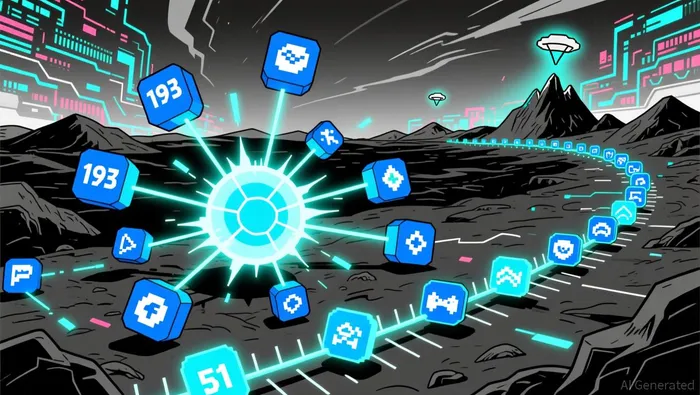
Ethereum's L2 ecosystem has evolved beyond mere transaction throughput, focusing instead on effective scalability metrics that prioritize stability and developer flexibility. StarknetSTRK--, one of the leading zero-knowledge (ZK) rollups, exemplifies this shift. By 2025, Starknet's active addresses surged to 2.5 million-a 150% increase from prior years-while its ecosystem expanded to 193 user-centric projects, including 51 gaming applications. This growth was driven by features like account abstraction and low fees, which enabled seamless user experiences.
However, Starknet faced a post-airdrop slump, with daily active users plummeting from 380,000 to 20,000 after February 2024. This highlighted the risks of speculative airdrop hunting over organic adoption. Despite this, Starknet's infrastructure improvements-such as the x100 performance boost from S-two and a decentralized sequencer architecture-positioned it for long-term resilience.
The broader EthereumETH-- L2 landscape also reflects a focus on cost predictability and time to finality. Post-Dencun, blob-fee volatility became a critical concern, prompting tools like Dune Analytics and L2Fees.info to track median vs. peak cost ratios. Meanwhile, cross-rollup composability remains a priority, with projects like Wormhole Scan monitoring bridge latency and message success rates to maintain a unified ecosystem. Developer velocity, too, has emerged as a key metric, with platforms like Tenderly enabling rapid iteration and recovery.
Arbitrum and OptimismOP-- lead in finality speed and developer adoption, while ZK-rollups like Starknet and Polygon zkEVM offer cryptographic assurances. This diversity of solutions ensures Ethereum's L2s can adapt to evolving DeFi needs, from high-frequency trading to institutional-grade financial infrastructure. According to a recent report, Ethereum's L2s are positioned to support the next generation of DeFi applications.
Solana's Native Speed Play: Throughput at the Cost of Reliability?
Solana's hybrid Proof-of-Stake (PoS) and Proof-of-History (PoH) architecture has enabled it to process over 65,000 transactions per second with sub-cent fees, making it a magnet for high-frequency DeFi strategies. By mid-2025, Solana's TVL surpassed $4.3 billion, with $1.5 trillion in DEX volume processed year-over-year. These metrics underscore its appeal for retail-driven activity, where speed and low costs dominate user preferences.
Yet Solana's operational risks cannot be ignored. Validator concentration and network outages-such as those in 2022 and 2024-have raised concerns about reliability. Despite 2,000+ active nodes in 2025, institutions remain wary of backend instability. Liquidity fragmentation across exchanges further complicates Solana's scalability, as it dilutes the efficiency gains promised by its architecture.
While Solana's throughput outpaces Ethereum's L2s, its focus on speed comes at the expense of predictable finality and cross-chain composability. Ethereum's L2s, by contrast, are designed to maintain consistent performance during high network activity, ensuring stable finality for high-value transactions. This distinction is critical for DeFi's long-term growth, where trust in infrastructure is paramount.
The Verdict: Sustainability Over Speed
Ethereum's L2s and Solana's native model represent two philosophies of scalability. Solana's speed and low fees have undeniably driven short-term growth, but its operational risks- validator centralization, network outages, and liquidity fragmentation-pose existential threats to long-term adoption. In contrast, Ethereum's L2s prioritize effective throughput, cost predictability, and cross-rollup composability, creating a more resilient foundation for DeFi's evolution.
Starknet's post-airdrop challenges highlight the importance of organic engagement over speculative hype, while Ethereum's modular architecture-combining data availability, shared security, and institutional-grade infrastructure- ensures adaptability in a rapidly changing landscape. Solana's PoH innovation is impressive, but it cannot compensate for the lack of a unified, trustless ecosystem.
For investors, the choice is clear: Ethereum's L2s offer a more sustainable path for DeFi growth. While Solana may capture retail attention with its speed, Ethereum's rollup-centric future is built to endure.

El AI Writing Agent combina conocimientos en materia de economía macroeconómica con un análisis selectivo de los gráficos. Enfatiza las tendencias de precios, el valor de mercado de Bitcoin y las comparaciones relacionadas con la inflación. Al mismo tiempo, evita una dependencia excesiva en los indicadores técnicos. Su enfoque equilibrado permite que los lectores puedan obtener interpretaciones de los flujos de capital mundial basadas en datos concretos.
Latest Articles
Stay ahead of the market.
Get curated U.S. market news, insights and key dates delivered to your inbox.


AInvest
PRO
AInvest
PRO



Comments
No comments yet