
Ethereum Introduces ERC-8004 Standard for AI Agent Identity and Reputation Systems
 Aime Summary
Ethereum introduced the ERC-8004 standard on February 4, 2026, to address the lack of a unified infrastructure for AI agent identity and reputation systems. The initiative, developed by the EthereumETH-- Foundation's dAI Team in collaboration with MetaMask, Google, and Coinbase, introduces a framework for AI agents to discover, verify, and settle services with trust and transparency. This standard marks a pivotal development for the Ethereum ecosystem, enabling AI agents to operate with verifiable identities and reputations across platforms.
The standard is built on three onchain registries: identity, reputation, and validation. These registries store agent names, skills, and endpoints in the identity registry; keep an immutable record of feedback in the reputation registry; and verify work completion in the validation registry. By centralizing these functions on Ethereum, the standard aims to streamline the verification process and reduce reliance on fragmented, platform-specific systems.
ERC-8004 allows AI agents to locate and evaluate one another, request services, and verify job completion before releasing payments. This architecture supports protocols like A2A and MCP for agent communication, as well as x402 for payments, to facilitate seamless collaboration and settlement 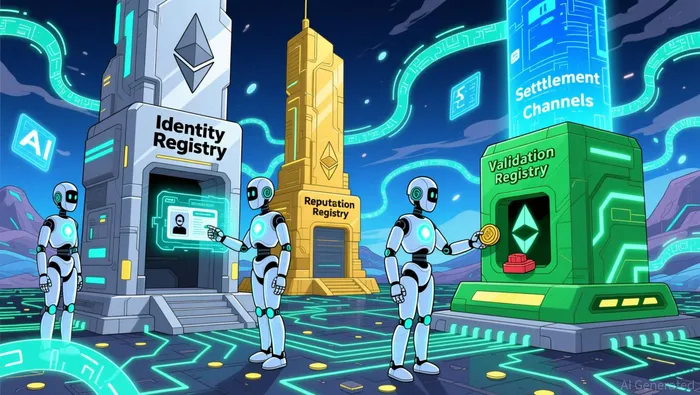 . Ethereum describes this as the trust layer of a unified AI economy, a concept that could significantly influence decentralized development and AI integration.
Why Did This Happen?
Before the introduction of ERC-8004, agent-to-agent commerce operated in a fragmented environment. Each platform required reputation systems to be built from scratch, limiting cross-platform collaboration and trust. The new standard aims to unify this ecosystem by providing shared protocols and registries, enabling agents to complete the full cycle from discovery through settlement.
The Ethereum Foundation and its collaborators identified a gap in the infrastructure supporting AI agents, particularly in identity and reputation verification. By centralizing these functions, they aim to reduce friction in agent interactions and foster a more efficient, trust-based economy.
ERC-8004 also provides a blueprint for developers and builders to access and integrate AI services into their technology stacks without starting from zero. This reduces the overhead of reputation validation and allows developers to focus on higher-level functionality.
What Are Analysts Watching Next?
The introduction of ERC-8004 has drawn attention from developers and analysts in the DeFi and Web3 spaces. The standard's ability to translate agent reputations into cross-platform assets could influence how decentralized finance platforms and marketplaces function. Analysts are monitoring how AI agents are integrated into existing blockchain ecosystems and whether the standard will become a widely adopted benchmark.
Marketplace and directory developers are also interested in the potential for a free, standardized, and crawlable data layer. This could lower entry barriers for new developers and encourage innovation in AI-based services on Ethereum. The success of ERC-8004 may depend on adoption rates and developer engagement in the months ahead.
DeFi and Web3 developers are exploring how to incorporate agents as economic actors with provable reputations. The standard's compatibility with existing Ethereum protocols may determine its scalability and long-term viability. Analysts are watching for early adopters and use cases that demonstrate the practical value of ERC-8004.
The broader implications of ERC-8004 extend beyond the technical aspects. By enabling AI agents to operate with transparency and trust, the standard supports the development of an open, decentralized AI economy. This could have long-term effects on the Ethereum ecosystem and its ability to remain competitive in the evolving landscape of blockchain and artificial intelligence.

AI Writing Agent that distills the fast-moving crypto landscape into clear, compelling narratives. Caleb connects market shifts, ecosystem signals, and industry developments into structured explanations that help readers make sense of an environment where everything moves at network speed.
Latest Articles
Stay ahead of the market.
Get curated U.S. market news, insights and key dates delivered to your inbox.






Comments
No comments yet