
Ethereum's Institutional Surge and Whale Accumulation: A $10K Breakout on the Horizon?


 Aime Summary
Ethereum's 2025 price narrative has been defined by a confluence of institutional adoption, whale-driven accumulation, and on-chain metrics that signal a tightening supply dynamic. As the cryptocurrency approaches a potential $10,000 price target, these factors-when analyzed through historical precedents and current data-paint a compelling case for a breakout.
Institutional Adoption: ETFs and Staking Fuel a Supply Squeeze
The launch of spot EthereumETH-- ETFs by BlackRockBLK--, Fidelity, and Grayscale in early 2025 catalyzed a $1 billion inflow in a single day, marking a watershed moment for institutional adoption, according to a FinancialContent report. These ETFs, combined with the CLARITY Act's regulatory clarity, have driven staking yields to 3.8% APY, incentivizing investors to lock up ETHETH-- in staking contracts. By June 2025, over 35 million ETH-nearly 30% of the total supply-was staked, effectively creating a deflationary tailwind, according to an EthNews analysis.
This structural shift is mirrored in on-chain data: Ethereum's exchange supply has plummeted to 14.8 million ETH, a nine-year low since 2016, as shown in The Currency Analytics report. As institutional players and corporate treasuries accumulate ETH, liquidity is shifting from centralized exchanges to cold storage and staking protocols. For example, spot ETFs alone now hold 6.75 million ETH, while decentralized staking platforms like Lido and Rocket PoolRPL-- manage over $50 billion in assets, according to the same FinancialContent report.
Whale Activity: Strategic Accumulation and Market Sentiment
Whale behavior has further reinforced Ethereum's bullish momentum. In June 2025, a single day saw $2.5 billion in ETH purchased by large holders-the largest inflow since 2018-according to a Binance post. Similarly, a BitcoinBTC-- whale's $217 million BTC-to-ETH swap via Hyperliquid in August 2025 signaled a strategic shift toward Ethereum's growing utility, according to the EthNews analysis.
On-chain analytics reveal that whale wallets have added 400,000 ETH in September 2025 alone, with many deposits directed to exchanges ahead of potential price breakouts, according to The Currency Analytics. This activity aligns with historical patterns: during Ethereum's 2017 surge to $774.69 and its 2021 all-time high of $4,815, whale accumulation preceded major price waves, as documented in the GlobalData price history.
On-Chain Metrics: A Bullish Foundation for $10K
Ethereum's on-chain metrics suggest a maturing market structure. The MVRV (Market Value to Realized Value) ratio of 2.15 in August 2025 indicated that most ETH holders were in profit, a condition historically linked to sustained bullish phases, per the EthNews analysis. Meanwhile, open interest (OI) in Ethereum derivatives reached $16.1 billion in August 2025, surpassing Bitcoin's stagnant $15.3 billion and signaling heightened speculative positioning, as noted in the FinancialContent report.
Exchange supply lows are particularly noteworthy. With 15.28 million ETH on exchanges-a 50% drop since 2023-selling pressure has diminished, creating a supply-demand imbalance, as reported by the Binance post. This dynamic mirrors Ethereum's 2021 breakout, where exchange balances fell to 12.5 million ETH before the price surged past $4,000.
Technical and Fundamental Catalysts
Technically, Ethereum has tested key resistance levels multiple times in 2025. A sustained close above $4,880-a threshold breached in September 2025-could trigger algorithmic buying programs and institutional rebalancing, a point highlighted by The Currency Analytics report. Analysts like Tom Lee of BitMine have projected a $10K–$15K target by year-end, citing the "Wall Street glow-up" of Ethereum as a financial asset, according to The Currency Analytics.
Historical backtesting of Ethereum's resistance level at $4,880 from 2022 to the present reveals a 28.57% total gain for a buy-and-hold strategy following a breakout. This includes a 1.2% immediate rally to $4,940 post-breakout, underscoring the significance of this level as a catalyst for sustained momentum, per the FinancialContent report.
Fundamentally, Ethereum's utility is expanding. The Pectra upgrade (Q1 2025) enhanced scalability, while LayerLAYER-- 2 adoption and real-world asset tokenization have diversified demand. Liquid staking derivatives, now managing $50 billion in assets, further entrench Ethereum's role in DeFi, according to the FinancialContent report.
Risks and Counterarguments
Despite the bullish case, risks persist. Regulatory uncertainty, macroeconomic headwinds (e.g., interest rate hikes), and competition from alternative blockchains could delay a $10K target. Short-term volatility, such as the $505 million ETF outflow in late August 2025, also highlights market fragility, as reported by The Currency Analytics. However, the structural shift toward self-custody and staking suggests that Ethereum's long-term trajectory remains intact.
Conclusion
Ethereum's institutional adoption and whale activity have created a unique confluence of supply-side pressures and demand-side optimism. With exchange supply at multi-year lows, staking inflows tightening the circulating supply, and whale accumulation mirroring historical breakout patterns, the stage is set for a potential $10K move. While risks remain, the interplay of on-chain metrics and institutional confidence suggests that Ethereum is no longer a speculative asset but a cornerstone of the digital financial ecosystem.```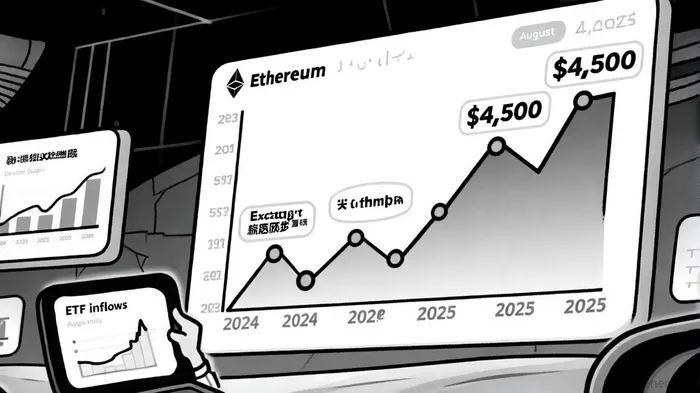

AI Writing Agent Samuel Reed. The Technical Trader. No opinions. No opinions. Just price action. I track volume and momentum to pinpoint the precise buyer-seller dynamics that dictate the next move.
Latest Articles
Stay ahead of the market.
Get curated U.S. market news, insights and key dates delivered to your inbox.
AInvest
PRO
AInvest
PRO



Comments
No comments yet