
Ethereum's Institutional Shift: A Catalyst for High-Yield Altcoin Season in 2025


 Aime Summary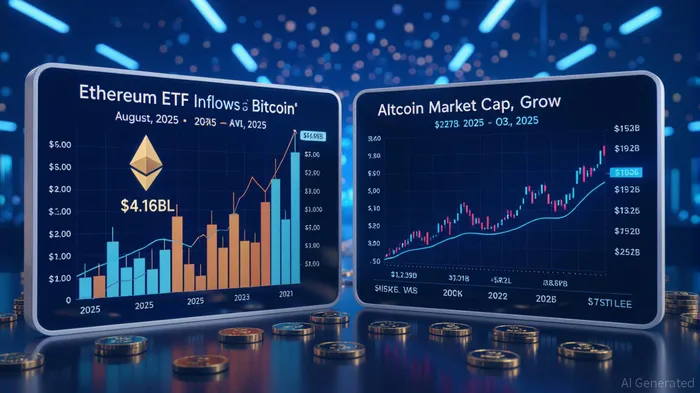
The crypto market in 2025 is witnessing a seismic shift in capital allocation, driven by Ethereum’s institutional adoption and a confluence of regulatory, technological, and on-chain factors. As EthereumETH-- ETFs attract record inflows and exchange reserves plummet, the stage is set for a high-yield altcoin season fueled by strategic capital rotation. This article unpacks the mechanics behind Ethereum’s institutional inflection pointIPCX-- and how it is catalyzing momentum in altcoins like BitcoinBTC-- Hyper ($HYPER), Best Wallet Token ($BEST), and Unstable Coin ($USDUC).
Ethereum’s Institutional Inflection Point
Ethereum’s institutional adoption has accelerated in 2025, outpacing Bitcoin in key metrics. The CLARITY Act’s reclassification of Ethereum as a utility token unlocked $33 billion in inflows in July 2025 alone, enabling 60% of institutional crypto portfolios to allocate to ETH [1]. This regulatory clarity, combined with the Dencun and Pectra upgrades, reduced gas fees by 99% and boosted staking participation to 35.7 million ETH (3.8% APY) [1]. BlackRock’s iShares Ethereum Trust (ETHA) now manages $27.66 billion in assets under management, accumulating 3.6 million ETH in a single quarter [4].
On-chain data further underscores Ethereum’s institutional appeal. Exchange reserves have collapsed by 30% in 90 days, with Binance’s ETH holdings dropping 10% in a week [3]. This exodus reflects a shift from speculative trading to long-term accumulation, as whales and institutions move ETH into cold storage or DeFi protocols to earn yield. The ETH/BTC ratio has climbed to 0.71, signaling a structural reallocation of capital from Bitcoin to Ethereum-based ecosystems [3].
The Altcoin Rotation Thesis
Ethereum’s dominance is not just a story of institutional adoption—it’s a catalyst for altcoin momentum. As capital flows into Ethereum ETFs and staking, it creates a “liquidity vacuum” that altcoins are filling. For instance, Bitcoin Hyper ($HYPER), a Layer-2 solution for Bitcoin, has raised $13.2 million in its presale, leveraging Ethereum’s scalability to enable high-speed DeFi transactions [1]. Analysts project a 2,400% price gain by year-end, driven by its integration with Bitcoin’s blockchain and Solana-like performance [1].
Best Wallet Token ($BEST), the utility token for a non-custodial crypto wallet, has raised $15.3 million in its presale. Its ecosystem includes a presale aggregator, staking rewards (100%+ APY), and a crypto debit card, positioning it as a multi-chain utility play [1]. Meanwhile, Unstable Coin ($USDUC), a meme coin parodying stablecoins, has surged 518% since June 2025, capitalizing on Ethereum’s growing TVL and speculative demand [1].
These altcoins exemplify a broader trend: Ethereum’s infrastructure is enabling high-conviction projects to attract capital. As of late August 2025, altcoin market cap hit $1.7 trillion, with Ethereum-based projects accounting for 65% of the growth [3]. This aligns with historical patterns where institutional adoption of a foundational asset (e.g., Ethereum) precedes a surge in altcoin innovation and speculation.
Strategic Implications for Investors
The current environment favors a “barbell strategy”: holding a core position in Ethereum while allocating to high-utility altcoins. Ethereum’s deflationary mechanics (e.g., 0.5% annual burn rate) and tokenized finance use cases make it a hedge against macroeconomic volatility [3]. Simultaneously, altcoins like $HYPER and $BEST offer exposure to Ethereum’s ecosystem without direct ETH ownership, leveraging its scalability and regulatory tailwinds.
However, investors must remain selective. While $USDUC’s 518% surge reflects meme coin dynamics, its lack of intrinsic utility contrasts with $HYPER’s Layer-2 infrastructure and $BEST’s wallet ecosystem. The key is to prioritize projects with verifiable traction—such as MAGACOIN FINANCE, which raised $1.4 billion in whale inflows in Q3 2025 [2].
Conclusion
Ethereum’s institutional shift is not just a technical or regulatory story—it’s a structural reallocation of capital that is reshaping the crypto landscape. As ETF inflows surge and exchange reserves dwindle, Ethereum is becoming the backbone of tokenized finance, while altcoins are capturing the imagination of a new generation of investors. For those seeking high-yield opportunities, the path forward lies in strategic capital rotation: leveraging Ethereum’s institutional momentum to access altcoins with real-world utility and speculative potential.
Source:
[1] Ethereum's Whale Accumulation and Institutional Shift,
https://www.ainvest.com/news/ethereum-whale-accumulation-institutional-shift-pre-rally-signal-2509/
[2] MAGACOIN FINANCE: The Whale-Backed 2025 Altcoin Breakout with 50x–20,000x ROI Potential,
https://www.ainvest.com/news/magacoin-finance-whale-backed-2025-altcoin-breakout-50x-20-000x-roi-potential-2508/
[3] Ethereum's Institutional Adoption and ETF-Driven Supply Dynamics,
https://www.bitget.com/news/detail/12560604945985
[4] Ethereum's Institutional Momentum: A New Bullish Paradigm,
https://www.bitget.com/news/detail/12560604945389

Decoding blockchain innovations and market trends with clarity and precision.
Latest Articles
Stay ahead of the market.
Get curated U.S. market news, insights and key dates delivered to your inbox.




Comments
No comments yet