
Ethereum's Institutional Revolution: Redefining Risk and Return in Digital Asset Portfolios


 Aime Summary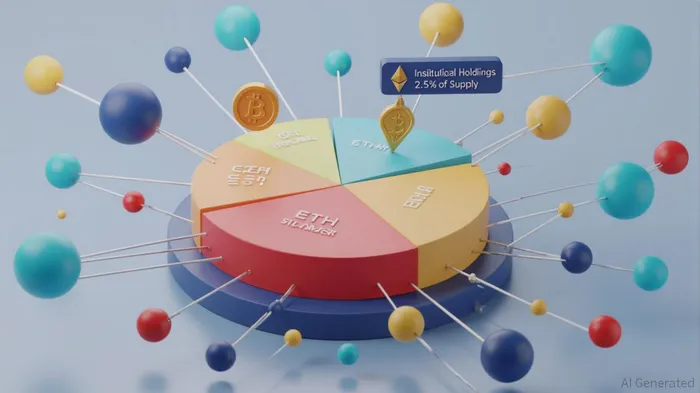
In 2025, EthereumETH-- has emerged as a linchpin of institutional investing, reshaping the risk-return calculus of digital assets. The approval of Ethereum ETFs in July 2024 catalyzed a surge in institutional capital, with over $12 billion in inflows by August 2025. This shift is not merely speculative—it reflects a structural reclassification of Ethereum as an infrastructure-grade asset, blending yield generation, regulatory alignment, and utility-driven growth.
The Staking Yield Advantage
Ethereum's staking model has become a cornerstone of its institutional appeal. By Q2 2025, 29% of the total supply was staked, with validators achieving a 99.9% participation rate. Staking yields of 4–6% annually provide a compelling alternative to traditional fixed-income assets, particularly in a low-yield environment. For example, BlackRock's ETHAETHA-- ETF (0.25% fee) and Franklin Templeton's EZET (0.19% fee) have attracted institutional allocations by compounding staking rewards alongside capital appreciation. This dual-income stream mirrors dividend-paying equities or high-yield bonds, offering a hedge against inflation while generating active returns.
Regulatory Clarity and Risk Mitigation
The U.S. SEC's Project Crypto initiative and the reclassification of Ethereum as a digital commodity under the CLARITY and GENIUS Acts have reduced compliance burdens for institutional investors. These frameworks enable SEC-compliant staking and liquid staking derivatives (LSTs), minimizing taxable events and operational complexity. Meanwhile, the EU's MiCA framework has harmonized global standards, attracting cross-border capital. This regulatory tailwind has transformed Ethereum from a speculative asset into a strategic holding, competing directly with traditional treasuries.
Risk-Return Metrics: A New Benchmark
Ethereum ETFs now outperform traditional benchmarks in risk-adjusted returns. By August 2025, the iShares Ethereum Trust (ETHA) boasted a Sharpe ratio of 1.15 and a Sortino ratio of 1.88—surpassing the S&P 500's 0.85 and 1.27, respectively. While Ethereum's 95% 30-day volatility remains higher than Bitcoin's 72%, its utility-driven infrastructure and deflationary supply dynamics (0.32% annual contraction) offset volatility risks. Institutional investors are leveraging Ethereum's programmable nature to deploy innovative strategies, such as liquidity provision in DeFi protocols, which are inaccessible in conventional portfolios.
Technological Upgrades and Market Infrastructure
Ethereum's Pectra and Dencun/Verge upgrades have reduced gas fees by 90%, enabling scalable DeFi and enterprise applications. These advancements, coupled with in-kind creation/redemption mechanisms for ETFs, have improved liquidity and reduced transaction costs. For instance, layer 2 solutions like Arbitrum and OptimismOP-- now handle 85% of tokenized U.S. Treasuries, offering faster settlements and programmable smart contracts. This infrastructure has attracted institutional-grade alternatives, such as BlackRock's BUIDL fund and Apollo's ACRED private credit fund, which leverage Ethereum's ecosystem for yield generation.
Strategic Allocation and Future Outlook
Institutional treasuries now hold 2.5% of Ethereum's total supply, with corporate entities like Goldman SachsGS-- and Jane Street allocating billions to Ethereum ETFs. The asset's deflationary supply model—contracting by 0.5% annually—creates a valuation floor absent in Bitcoin's fixed supply. Meanwhile, Ethereum's dominance in tokenized real-world assets (RWAs) and its role in tokenized U.S. Treasuries underscore its growing utility.
For investors, Ethereum's institutional adoption signals a shift toward yield-focused, utility-driven portfolios. While volatility persists, the combination of regulatory clarity, staking rewards, and technological innovation creates a self-reinforcing cycle of demand. Allocating to Ethereum ETFs or staking products can diversify traditional portfolios, offering exposure to a digital asset that bridges speculative and functional value.
In conclusion, Ethereum's institutional revolution is redefining digital asset investing. By balancing yield generation, risk mitigation, and utility, it has positioned itself as a core holding for forward-thinking portfolios. As the market matures, Ethereum-backed instruments are poised to become foundational components of the next-generation financial system—offering investors a compelling opportunity to harness the power of programmable money.

Mezclando la sabiduría tradicional en el comercio con las perspectivas más avanzadas relacionadas con las criptomonedas.
Latest Articles
Stay ahead of the market.
Get curated U.S. market news, insights and key dates delivered to your inbox.
AInvest
PRO
AInvest
PRO



Comments
No comments yet