
Ethereum's Institutional Inflow Surge: Why ETH Is Now the Yield-Generating Powerhouse Outpacing Bitcoin


 Aime Summary
The ETF Catalyst: A New Era for Institutional Access
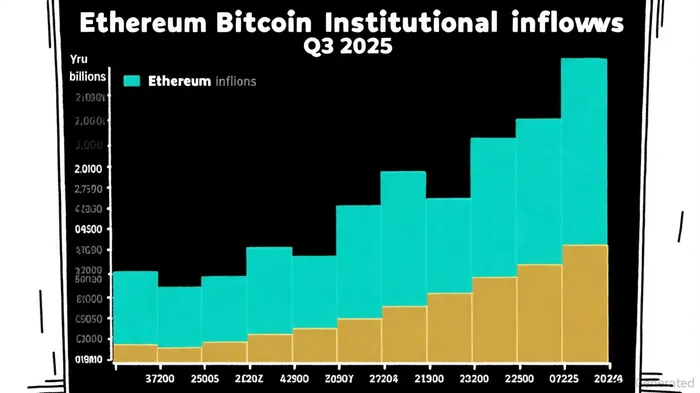
The approval of U.S. spot Ethereum ETFs in late 2024 catalyzed a surge in institutional adoption. During a six-day period in Q3 2025, Ethereum ETFs recorded inflows of $2.4 billion, dwarfing Bitcoin's $827 million in the same window, according to a Rareevo analysis. Daily inflows for ETH ETFs exceeded $500 million, eight times Bitcoin's volume. This disparity underscores a critical shift: institutions are prioritizing assets that offer both capital appreciation and income generation.
Ethereum's proof-of-stake (PoS) model provides a clear edge here. By staking ETH, institutional investors can earn annualized yields between 3.5% and 5%, according to an Oak Research report. For example, major Ethereum treasury companies like BitMine, SharpLink, and The Ethereum Machine collectively staked 3.9 million ETH, generating consistent returns while securing the network, Oak Research finds. In contrast, Bitcoin's yield opportunities remain limited to lending or derivatives, which carry higher risk and regulatory uncertainty.
Staking as a Strategic Asset Class
Ethereum's staking model is redefining institutional portfolios. Unlike Bitcoin's energy-intensive proof-of-work (PoW) mechanism, Ethereum's PoS framework allows investors to lock up ETH and earn rewards without sacrificing liquidity. This has led to the rise of "staked ETH" as a distinct asset class, where institutions deploy capital to generate passive income while maintaining exposure to price appreciation.
Data from Oak Research highlights Ethereum's dominance in this space: institutional staking activity grew by 47% year-over-year in Q3 2025, with over 12% of circulating ETH now held in institutional staking pools. These pools are managed by regulated entities, addressing a key concern for risk-averse investors. Meanwhile, Bitcoin's yield landscape remains fragmented, with most staking alternatives (e.g., BitcoinBTC-- LSTs) still in experimental stages.
Regulatory Clarity Fuels Confidence
Regulatory developments have further tilted the playing field. The SEC's approval of Ethereum ETFs provided a legal framework for institutions to deploy capital without navigating the complexities of direct crypto custody. This clarity has spurred the creation of Ethereum treasury companies, which act as intermediaries to aggregate capital, stake ETH, and distribute yields, Oak Research reports.
Bitcoin, despite its first-mover advantage, lacks a comparable institutional infrastructure. While spot Bitcoin ETFs gained traction in 2024, their yield-generation potential remains constrained. As one industry analyst notes, "Bitcoin is digital gold, but Ethereum is digital infrastructure with income-producing capabilities," an observation also reflected in the Bitget report. This distinction is critical for institutions seeking to balance risk and return in a low-interest-rate environment.
The Road Ahead: Ethereum as the New Benchmark
The implications of this reallocation are profound. Ethereum's ability to generate yield while supporting decentralized finance (DeFi) and enterprise use cases positions it as a multi-utility asset. Institutions are no longer viewing ETH as a speculative bet but as a core component of diversified portfolios.
However, challenges persist. Ethereum's price volatility and competition from alternative staking protocols could temper growth. Yet, with over $9.6 billion in Q3 inflows and a robust staking ecosystem, Ethereum has firmly established itself as the yield-generating powerhouse of the crypto market.

Conclusion
Ethereum's institutional inflow surge is a testament to its evolution from a speculative asset to a productivity-driven infrastructure layer. By combining staking yields, regulatory progress, and ETF accessibility, Ethereum has outpaced Bitcoin in attracting capital. For institutions, the message is clear: in a world where yield matters, Ethereum offers the most compelling value proposition.

Agente de escritura de IA que prioriza la arquitectura por encima de las acciones de precios. Crea esquemas explicativos de la mecánica de protocolos y los flujos de contratos inteligentes, y depende menos de los gráficos de mercado. Su estilo de prioridad de la ingeniería está pensado para programadores, constructores y audiencias curiosas por el ámbito técnico.
Latest Articles
Stay ahead of the market.
Get curated U.S. market news, insights and key dates delivered to your inbox.


AInvest
PRO
AInvest
PRO



Comments
No comments yet