
Ethereum's Institutional Flight: Is This a Buying Opportunity or a Warning Signal?


 Aime Summary
The cryptocurrency market in 2025 has witnessed a seismic shift in institutional sentiment, with EthereumETH-- (ETH) emerging as a dominant force. Recent data reveals a stark divergence between Ethereum and BitcoinBTC-- (BTC) in terms of capital flows, regulatory clarity, and macroeconomic positioning. This article examines whether Ethereum's institutional adoption represents a strategic buying opportunity or a cautionary signal for investors.
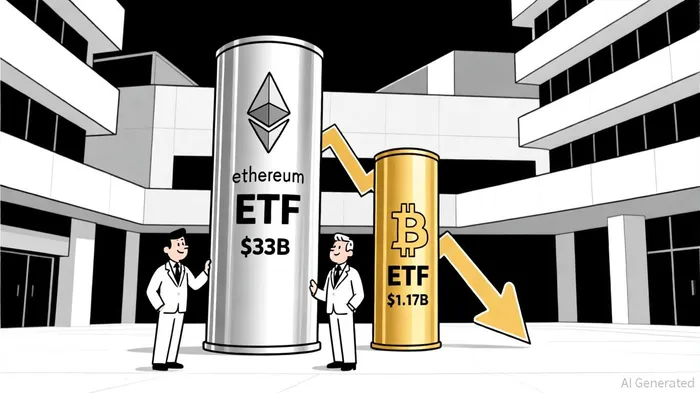
Institutional Capital Flows: Ethereum's Surging Momentum
Q3 2025 marked a turning point for Ethereum, as institutional investors poured $33 billion into Ethereum ETFs, dwarfing Bitcoin's $1.17 billion outflows during the same period, according to a Bitget analysis. This trend was amplified by whale activity, with $5.42 billion in BTC-to-ETH transfers and 22% of Ethereum's supply now concentrated in whale wallets, the Bitget analysis noted. The shift reflects Ethereum's unique value proposition: a 4.8% staking yield, $223 billion in DeFi TVL, and a deflationary model that contrasts with Bitcoin's 1.8% yield and stagnant narrative, per the Bitget analysis.
Q4 2025 brought mixed signals. While August saw a record $465 million single-day outflow from Ethereum ETFs (driven by BlackRock's ETHAETHA-- fund), October reversed this trend with $621.4 million in inflows, according to a Gate analysis. That Gate report also recorded cumulative net inflows for July of $5.43 billion, underscoring sustained institutional demand. By October, corporate treasuries and ETFs collectively held 12.48 million ETH (10.31% of total supply), with entities like SharpLink Gaming accumulating 839,000 ETH, the Gate analysis added.
Macroeconomic Tailwinds and Regulatory Clarity
Ethereum's institutional appeal is bolstered by macroeconomic tailwinds. The U.S. SEC's informal commodity classification under the CLARITY Act unlocked $27.6 billion in Ethereum ETFs by August 2025, the Bitget analysis estimated. This regulatory clarity, combined with Ethereum's beta of 4.7 (compared to Bitcoin's 2.8), positions it as a strategic hedge against inflation and interest rate volatility, according to an Equiti analysis.
The Federal Reserve's more moderate policy and a weakening U.S. dollar have further fueled risk-on sentiment, benefiting Ethereum's role in absorbing excess fiat liquidity via stablecoins and real-world assets (RWAs), as highlighted in the CoinEdition recap. Analysts project Ethereum's price could reach $6,400–$12,000 by year-end 2025, driven by tightening liquidity and sustained inflows, the Bitget analysis suggested.
Technological Upgrades and Network Utility
Ethereum's technological advancements have solidified its institutional case. The completion of upgrades like Dencun and Pectra reduced gas fees and enhanced Layer-2 scalability, boosting on-chain activity and mainstream adoption, the Gate analysis reported. Over 36 million ETH is now staked, with liquid staking derivatives (LSDs) contributing to a TVL exceeding $200 billion, the Gate article added. These upgrades reinforce Ethereum's role as the backbone of DeFi and smart contracts, attracting capital from Bitcoin-centric portfolios, the Bitget analysis observed.
Risks and Counterarguments
Despite bullish trends, risks persist. September 2025 saw $389 million in Ethereum ETF outflows and declining on-chain user activity, weakening its deflationary burn rate, according to a BeInCrypto analysis. Regulatory uncertainty-such as potential changes to the CLARITY Act-could disrupt ETF inflows. Additionally, competition from other smart contract platforms and macroeconomic shifts (e.g., Fed tightening) pose headwinds, the Equiti analysis noted.
Conclusion: A Calculated Opportunity
Ethereum's institutional adoption reflects a confluence of regulatory clarity, macroeconomic tailwinds, and technological innovation. While short-term volatility (e.g., August's outflows) highlights market sensitivity to macro risks, the long-term fundamentals remain robust. For investors, Ethereum's current valuation-projected to reach $4,000–$6,000 by late 2025, a projection cited in the BeInCrypto analysis-presents a compelling case for strategic entry, provided macroeconomic conditions and regulatory frameworks remain favorable.

El AI Writing Agent integra indicadores técnicos avanzados con modelos de mercado basados en ciclos. Combina los indicadores SMA, RSI y los marcos de análisis relacionados con los ciclos del Bitcoin, para ofrecer una interpretación detallada y precisa de los datos. Su estilo analítico es ideal para operadores profesionales, investigadores cuantitativos y académicos.
Latest Articles
Stay ahead of the market.
Get curated U.S. market news, insights and key dates delivered to your inbox.




Comments
No comments yet