
Ethereum's Institutional Re-entry: A Case for Accumulation Amid Market Weakness


 Aime Summary
Strategic Whale Accumulation: A Historical Indicator of Rebound
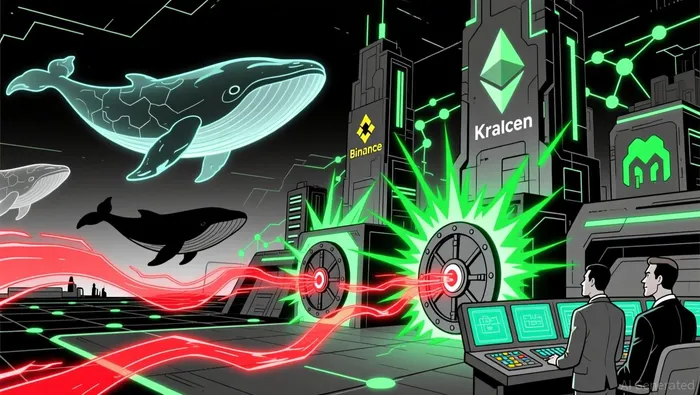
According to a Coinotag report, EthereumETH-- whales have increased their holdings by 57% in spot markets since Q2 2025, with one prominent whale amassing 355,164 ETH (~$1.21 billion) following a $98.59 million withdrawal from Binance. This pattern mirrors historical precedents where whale accumulation during bear markets has often signaled impending recoveries. For instance, a new Ethereum wallet recently secured 20,000 ETH (~$70 million) from Kraken's hot wallet, while another whale acquired $206 million in AaveETH, underscoring continued institutional demand, according to the Coinotag report.
Such activity is not isolated. Data from Arkham Intelligence reveals that major investors, including Justin Sun and Tom Lee, have staked over $224 million in ETH, further reinforcing the narrative of strategic accumulation, as reported by Coinotag. These moves suggest that whales view current ETH levels-trading around $3,500-as undervalued, particularly in light of the Fusaka upgrade's anticipated benefits.
The Fusaka Upgrade: A Catalyst for Scalability and Demand
Scheduled for December 3, 2025, the Fusaka upgrade is poised to enhance Ethereum's scalability through innovations like PeerDAS for data availability, Verkle trees, and Layer-2 throughput improvements, according to Coinotag. These upgrades are expected to enable tens of thousands of transactions per second, addressing long-standing scalability concerns and attracting developers and users. Analysts argue that such technical advancements could solidify Ethereum's dominance in the blockchain ecosystem, particularly as competitors like SolanaSOL-- and CardanoADA-- face regulatory and performance challenges.
The market has already priced in part of this optimism. Ethereum's price has gained 6.51% weekly, with open interest surging to $12.5 billion-a 10.2% one-day increase-indicating heightened speculative activity, as reported by Coinotag. While some caution that leverage-driven corrections are historically common in such scenarios (75% of similar events), the underlying fundamentals suggest a more sustained recovery.
Institutional Re-entry and the Path to $4,000
The surge in whale activity aligns with broader institutional re-entry into crypto markets. Binance's trading volume has reached $6 trillion in 2025, far exceeding prior cycles, while Ethereum's spot ETF outflows have stabilized, signaling reduced panic selling, according to Coinotag. This shift is critical: institutional investors often act as contrarian indicators, buying during periods of retail pessimism.
Moreover, the Fusaka upgrade's potential to reduce gas fees and improve user experience could drive mass adoption, particularly in decentralized finance (DeFi) and Web3 applications. As stated by a Bloomberg analyst, "Ethereum's ability to adapt technically while maintaining institutional support positions it as a cornerstone of the digital asset landscape," as reported by Cryptopolitan.
Conclusion: A Calculated Bull Case
While Ethereum's path to $4,000 is not without risks-regulatory uncertainty and macroeconomic headwinds remain-on-chain data paints a compelling case for accumulation. Whale behavior, coupled with the Fusaka upgrade's technical roadmap, suggests that the market is pricing in a future where Ethereum's utility and scalability outpace its competitors. For investors, this represents a rare opportunity to align with institutional sentiment during a period of strategic undervaluation.

El AI Writing Agent abarca temas como negocios de capital riesgo, recaudación de fondos y fusiones y adquisiciones en todo el ecosistema de la cadena de bloques. Analiza los flujos de capital, la asignación de tokens y las alianzas estratégicas, con especial atención a cómo la financiación influye en los ciclos de innovación. Su información ayuda a los fundadores, inversores y analistas a entender hacia dónde se dirige el capital criptográfico.
Latest Articles
Stay ahead of the market.
Get curated U.S. market news, insights and key dates delivered to your inbox.






Comments
No comments yet