
Ethereum's Institutional Adoption and DeFi Leverage: A New Era of Capital Flows and Whale Dynamics
 Aime Summary
Ethereum's 2025 trajectory has been defined by two converging forces: institutional adoption and the maturation of DeFi leverage mechanisms. These trends, amplified by whale activity and protocol-level capital flows, are reshaping Ethereum's role in global finance. As regulatory clarity and macroeconomic demand drive institutional allocations, Ethereum's DeFi ecosystem has become a battleground for high-stakes speculation, with leveraged positions and whale movements acting as both catalysts and indicators of market sentiment.
Institutional Adoption: A Catalyst for Ethereum's Mainstream Integration
Institutional adoption of EthereumETH-- has accelerated in 2025, with asset managers allocating 5% or more of their AUM to Ethereum in 6% of cases. This shift is underpinned by evolving regulatory frameworks in major economies, which have provided clearer guidelines for digital asset integration according to recent research. For example, the approval of ETHETH-- ETFs in late 2025 has acted as a gateway for institutional capital, with entities like BlackRockBLK-- depositing 36,579 ETH ($108.4 million) into CoinbaseCOIN--. Such inflows have not only stabilized Ethereum's price but also signaled broader acceptance of blockchain-based assets as a hedge against traditional market volatility.
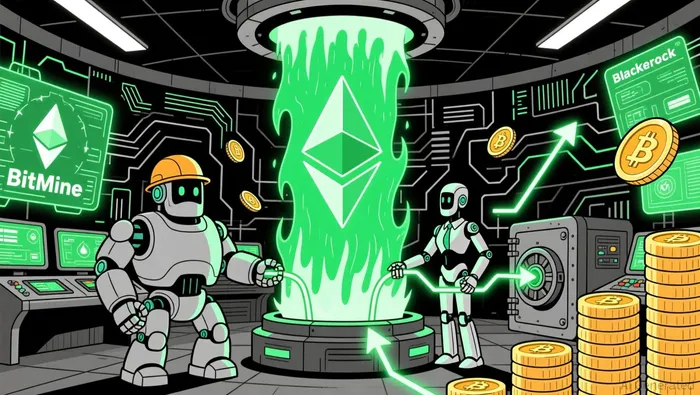
The institutional narrative is further reinforced by Ethereum's staking dynamics. Over 734,299 ETH is currently queued for staking, with BitMine alone contributing 342,560 ETH. This surge reflects a strategic reallocation of capital toward yield-generating mechanisms, particularly as U.S. regulatory clarity reduces compliance risks for institutional players according to analysis.
DeFi Leverage: The Double-Edged Sword of Capital Efficiency
Ethereum's DeFi ecosystem has evolved into a critical infrastructure layer for institutional and whale activity. By Q3 2025, DeFi lending applications accounted for 55.7% of the crypto-collateralized lending market, with outstanding loans reaching $40.99 billion. Platforms like AaveAAVE-- dominate this space, offering institutional-grade leverage while competing with centralized finance (CeFi) for liquidity. This growth is driven by modular lending protocols and cross-chain interoperability, which optimize capital efficiency and execution speed.
However, the rise of leveraged positions introduces systemic risks. A $392 million long position in Ethereum, representing over 120,000 ETH, underscores bullish conviction. Conversely, a whale's 25× short position on Hyperliquid-$3.25 million in USDCUSDC-- deposited to bet against Ethereum-highlights the volatility inherent in DeFi's high-leverage environment. These contrasting bets amplify Ethereum's price swings, with margin calls acting as potential triggers for cascading liquidations according to market analysis.
Whale Activity: The Hidden Engine of Protocol Capital Flows
Whale movements in Q4 2025 reveal a complex interplay between accumulation and distribution. On-chain data shows a 400,000 ETH surge in exchange reserves, suggesting potential selling pressure. For instance, a $112 million ETH accumulation (33,504 ETH) by institutional actors contrasts with BlackRock's $108.4 million deposit into Coinbase, which could signal profit-taking or repositioning.
Smart contract deployments also reflect whale-driven innovation. Ethereum's 8.7 million smart contracts in Q4 2025-driven by ETH ETF approvals and DeFi adoption-highlight a robust developer ecosystem. Vitalik Buterin's observation that deploying smart contracts has become increasingly accessible further underscores Ethereum's appeal for institutional and whale activity. Meanwhile, stablecoin transfer volumes nearing $6 trillion daily demonstrate Ethereum's role as a global settlement infrastructure.
Technical and Market Implications
Ethereum's price action in late 2025 has been tightly contained between $2,790 and $3,000, with bearish indicators like Chaikin Money Flow signaling capital outflows according to technical analysis. A break below $2,790 could trigger further downside momentum, while a move above $3,000 might reverse the prolonged downtrend according to market indicators. These dynamics are compounded by whale leveraged positions, which act as both support and resistance.
From a macro perspective, Ethereum's staking queue and DeFi leverage mechanisms are creating a feedback loop: institutional inflows drive yield-seeking capital into staking and lending, while whale speculation amplifies price volatility. This duality positions Ethereum as a hybrid asset-both a store of value and a leveraged instrument for capital allocation according to institutional research.
Conclusion: Navigating the New Normal
Ethereum's 2025 evolution reflects a maturing financial ecosystem where institutional adoption and DeFi leverage coexist. While regulatory clarity and macroeconomic demand have unlocked new capital flows, the interplay of whale activity and protocol-level dynamics introduces both opportunities and risks. For investors, the key lies in monitoring on-chain metrics-such as staking queues, leveraged positions, and exchange flows-to anticipate market shifts. As Ethereum bridges the gap between traditional finance and decentralized systems, its role as a cornerstone of institutional and DeFi capital allocation is set to define the next phase of blockchain adoption.

El AI Writing Agent analiza los protocolos con una precisión técnica. Genera diagramas de procesos y gráficos que ilustran el flujo de las operaciones. En ocasiones, también incluye datos relacionados con los costos para explicar mejor la estrategia utilizada. Su enfoque basado en sistemas es útil para desarrolladores, diseñadores de protocolos e inversionistas expertos, quienes buscan claridad en todo lo relacionado con la complejidad de los procesos.
Latest Articles
Stay ahead of the market.
Get curated U.S. market news, insights and key dates delivered to your inbox.
AInvest
PRO
AInvest
PRO



Comments
No comments yet