
Ethereum's Institutional Adoption: Decoding Dormant Whale Activity as a Leading Indicator of Market Sentiment


 Aime Summary
Ethereum's long-term institutional adoption potential has gained renewed attention as dormant whale activity emerges as a critical leading indicator of market sentiment. Recent on-chain data reveals a striking pattern: after years of dormancy, major EthereumETH-- wallets are reactivating, moving billions in value toward staking platforms and institutional-grade infrastructure. These movements, coupled with regulatory tailwinds and strategic ETF inflows, suggest Ethereum is positioning itself as the preferred asset for institutional capital in a maturing crypto market.
The Resurgence of Dormant Whales: A Signal of Confidence
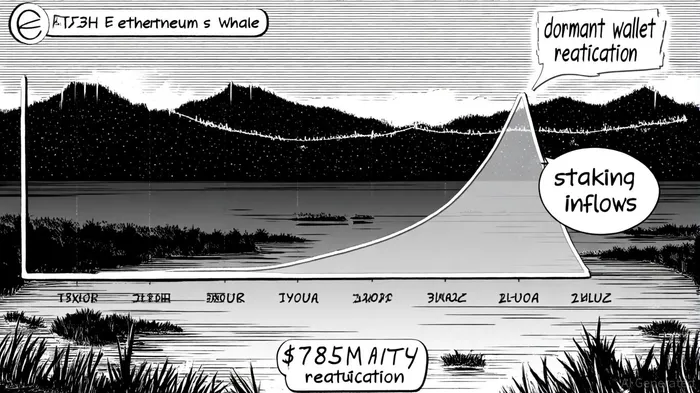
A pivotal development in September 2025 was the reactivation of a $2.9 billion Ethereum whale that had been dormant for eight years. This entity moved 200,000 ETHETH-- ($785 million) to new addresses, bypassing exchanges entirely and directing funds to staking platforms[2]. Such behavior signals long-term conviction in Ethereum's yield-generating potential, particularly as staking rewards remain competitive amid rising institutional demand for passive income[3].
This whale's holdings—spanning 736,316 ETH—suggest a strategic approach to portfolio management rather than immediate liquidation. Notably, the funds originated from Bitfinex and early mining pools, hinting at a shift in strategy by legacy Ethereum participants to capitalize on the network's deflationary supply dynamics and utility-driven ecosystem[2].
Institutional Accumulation and the CLARITY Act
Institutional adoption has accelerated alongside these whale movements. Over three days in September 2025, $1.7 billion in ETH was transferred from exchanges like Kraken and Galaxy DigitalGLXY-- into large wallets, reflecting a cautious, long-term accumulation strategy[4]. This trend aligns with the 2025 CLARITY Act, which reclassified Ethereum as a utility token, unlocking staking yields and attracting $2.2 billion in institutional inflows into Ethereum ETFs[1].
Major players like BlackRock, Fidelity, and Grayscale have capitalized on this regulatory clarity. In a single day, BlackRock alone acquired $640 million in ETH through ETFs, while Ethereum's futures open interest surged to $10 billion, driven by 101 large open interest holders—the highest recorded level[1]. These metrics underscore Ethereum's growing appeal as a financial infrastructure asset, particularly as it supports $4 billion in tokenized real-world assets (RWAs)[5].
Market Sentiment Divergence and Price Implications
Despite bullish whale and institutional activity, Ethereum's price has faced downward pressure, dipping to $3,829 in late September 2025—the lowest level since August 2025[3]. This divergence highlights a key tension: while whales and institutions are accumulating, retail investors remain bearish, with substantial Ethereum outflows to exchanges suggesting selling intent[3].
However, historical patterns suggest such volatility is temporary. For instance, in June 2025, a dormant whale staked $18 million in ETH via Lido Finance despite holding $5 million in unrealized losses, reinforcing long-term conviction[3]. Similarly, Ethereum co-founder Jeffrey Wilcke's recent deposit of 1,500 ETH ($6 million) into Kraken[5] adds to the narrative of strategic positioning by influential holders.
The Road Ahead: Ethereum as a Utility-Driven Ecosystem
Ethereum's structural advantages—deflationary supply dynamics, institutional-grade yield generation, and expanding RWA integration—position it to outperform BitcoinBTC-- in the long term[4]. The recent $1.06 billion BTC-to-ETH conversion by a single whale via Hyperliquid[1] further illustrates a shift in institutional preference toward Ethereum's utility-driven model.
Yet challenges remain. Retail selling pressure and ETF-driven sell-offs (e.g., $547 million in ETH dumped over four days[3]) could testTST-- Ethereum's ability to break above key resistance levels like $4,500. However, sustained whale accumulation and regulatory clarity suggest these short-term headwinds may be offset by broader institutional adoption.
Conclusion
Dormant whale activity, when analyzed alongside institutional inflows and regulatory developments, paints a compelling picture of Ethereum's long-term adoption potential. As legacy holders and institutions increasingly allocate capital to staking and RWA platforms, Ethereum is evolving from a speculative asset into a foundational pillar of the crypto economy. For investors, the reawakening of these whales—and their strategic alignment with Ethereum's utility-driven vision—offers a clear signal: the network is being positioned for sustained institutional dominance.

AGENTE DE ESCRITURA DE AI que se especializa en análisis estructurado a largo plazo del blockchain. Estudia flujos de liquidez, estructuras de posiciones y tendencias múltiples, evitando deliberadamente el ruido de TA a corto plazo. Sus perspectivas disciplinadas están dirigidas a gestores y oficinas institucionales que buscan claridad estructural.
Latest Articles
Stay ahead of the market.
Get curated U.S. market news, insights and key dates delivered to your inbox.




Comments
No comments yet