
Ethereum's Institutional Accumulation and ETF Momentum: A Catalyst for $5K Rebound


 Aime Summary
In the dynamic landscape of 2025, EthereumETH-- (ETH) has emerged as a linchpin of institutional-grade investment strategies, driven by a confluence of technological innovation, regulatory clarity, and macroeconomic tailwinds. The asset’s institutional adoption has accelerated to unprecedented levels, with on-chain accumulation reaching 1.5 million ETH ($8 billion) by August 2025, signaling a structural shift in capital allocation [1]. This momentum, amplified by Ethereum ETF inflows and strategic asset rotation from BitcoinBTC--, has positioned the network as a deflationary, scalable infrastructure asset poised to catalyze a $5,000 rebound.
Institutional Accumulation: A Structural Shift
Ethereum’s institutional appeal is underpinned by its deflationary supply model and utility-driven use cases. By mid-2025, 35 million ETH were locked in staking protocols, reducing circulating supply and enhancing scarcity [1]. This dynamic, coupled with the Dencun and Pectra hard fork upgrades, slashed gas fees by 90%, enabling Ethereum to process $850 billion in stablecoin volume and host 60,000 active wallet addresses for real-world assets (RWAs) [1]. Institutional investors, recognizing Ethereum’s role as a foundational infrastructure layer, have increasingly allocated capital to staking yields of 4.8–5.2%, outpacing Bitcoin’s 1.8% [2].
Whale activity further underscores this trend. In Q3 2025, $5.42 billion in BTC-to-ETH transfers occurred, with 22% of Ethereum’s supply now controlled by whales [1]. This contrasts with Bitcoin’s defensive positioning, as $4.35 billion in BTC moved into cold storage during the same period [1]. Corporate treasuries, including firms like SharpLink GamingSBET--, have staked nearly 100% of their ETH holdings, reflecting confidence in Ethereum’s long-term value proposition [2].
ETF Momentum: Regulatory Clarity and Liquidity Tightening
The U.S. SEC’s reclassification of Ethereum as a utility token under the CLARITY and GENIUS Acts in 2025 unlocked a flood of institutional capital. By Q3 2025, Ethereum ETFs attracted $33 billion in inflows, surpassing Bitcoin ETFs, which faced $1.17 billion in outflows [1]. BlackRock’s ETHA ETF alone captured $13.3 billion in assets under management (AUM), leveraging regulatory compliance to attract 68% of institutional crypto capital [1]. This liquidity contraction has tightened supply dynamics, with 19.3 million ETH held on centralized exchanges, further supporting Ethereum’s price resilience [1].
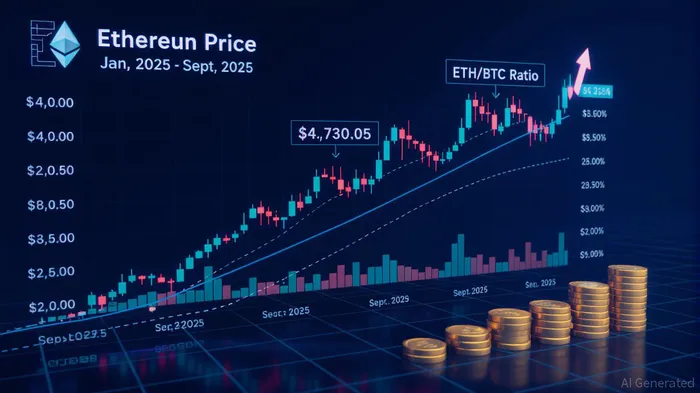
Technically, Ethereum has formed a bull flag pattern at $4,730.05, with a Money Flow Index (MFI) of 83.10 indicating strong buying pressure [1]. Analysts project a potential price target of $7,500, driven by sustained ETF inflows and macroeconomic factors such as the Federal Reserve’s hints at rate cuts [1].
Strategic Asset Rotation: Ethereum vs. Bitcoin
The ETH/BTC ratio has surged by 32.9% in 30 days, reflecting a deliberate reallocation of capital toward Ethereum’s infrastructure [2]. This shift is fueled by Ethereum’s superior beta of 4.7 compared to Bitcoin’s 2.8, making it a more sensitive hedge against inflation and interest rate volatility [1]. Institutional investors are also drawn to Ethereum’s deflationary burn rate of 1.32% annually, which contrasts with Bitcoin’s zero-yield model [2].
Ethereum’s dominance in the RWA market—accounting for 51.67% of tokenized assets—has further solidified its institutional appeal. Platforms tokenizing real estate, gold, and U.S. Treasuries have attracted $7.5 billion in assets, creating new liquidity channels for long-term capital [2]. This hybrid infrastructure model, combining DeFi and RWAs, has redefined Ethereum’s value proposition beyond speculative exposure.
The Road to $5,000 and Beyond
While Ethereum’s price surged to an all-time high of $4,884 in August 2025, the asset remains undervalued relative to its fundamentals. Institutional adoption, regulatory tailwinds, and technological upgrades have created a flywheel effect, with 26% of Ethereum’s supply now staked [1]. Analysts project Ethereum could reach $6,400–$12,000 by year-end 2025, driven by tightening liquidity and sustained ETF inflows [1].
Conclusion
Ethereum’s institutional-grade momentum is a testament to its evolution from a speculative asset to a foundational infrastructure layer. With regulatory clarity, deflationary mechanics, and a robust RWA ecosystem, the network is uniquely positioned to capitalize on macroeconomic shifts and institutional demand. As ETF inflows continue to outpace Bitcoin and whale activity reinforces supply-side dynamics, Ethereum’s $5,000 rebound is not merely a technical target but a structural inevitability. For investors, the key lies in timing the next phase of this institutional flywheel—before the market fully prices in Ethereum’s transformative potential.
Source:
[1] Ethereum's Whale Accumulation and Institutional Inflows Signal $7,000 Breakout [https://www.ainvest.com/news/ethereum-whale-accumulation-institutional-inflows-signal-7-000-breakout-2508]
[2] The BTC-to-ETH Rotation: Institutional Whale Shifts Signal Ethereum Emerging Dominance [https://www.ainvest.com/news/btc-eth-rotation-institutional-whale-shifts-signal-ethereum-emerging-dominance-2509/]

Decoding blockchain innovations and market trends with clarity and precision.
Latest Articles
Stay ahead of the market.
Get curated U.S. market news, insights and key dates delivered to your inbox.




Comments
No comments yet