
Ethereum's Imminent Volatility Reset: A Strategic Buying Opportunity Before the $4,100 Rally
 Aime Summary
Ethereum's price action in 2025 has been a rollercoaster, marked by sharp corrections and explosive rebounds. From a high of $4,100 in December 2024, ETH plummeted to multi-year lows of $1,400 by April 2025 amid macroeconomic headwinds and the $1.5 billion Bybit hack. However, by July 2025, institutional and retail demand pushed the price past $3,800, reigniting speculation about a potential $4,000 breakout. This volatility, while daunting, presents a unique inflection point for investors who understand how to balance short-term risk management with long-term accumulation strategies.
Short-Term Risk Management: Navigating the Volatility Reset
Ethereum's volatility in Q4 2025 averaged 53% monthly, reflecting a market still grappling with liquidity constraints and shifting risk appetite. The recent 28.07% decline in Q4 underscores the fragility of crypto markets, even as volatility metrics have trended lower since Q1 2025 due to reduced speculative leverage and increased institutional positioning. For short-term traders, the key lies in monitoring critical technical levels.
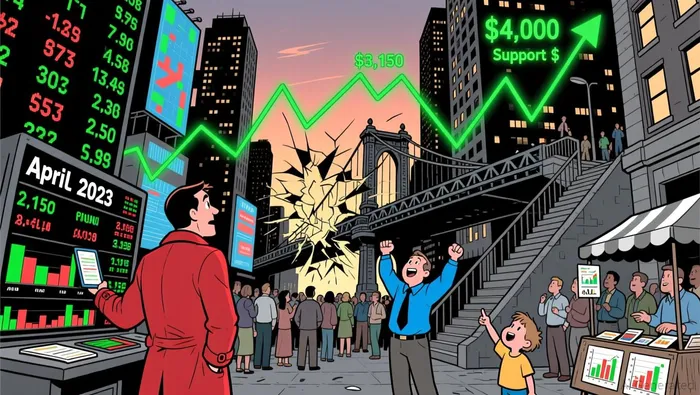
The $4,000 zone, historically a confluence of resistance and psychological significance, remains a pivotal target. Analysts warn that a test of this level could trigger a bearish reaction if macroeconomic conditions remain unfavorable. Conversely, a breakout above $4,000 could signal renewed bullish momentum. Traders should also keep a close eye on the $3,150 support level, which has historically acted as a floor during corrections.
Diversification is another critical risk management tool. As crypto analyst XForce notes, allocating a portion of crypto exposure to gold or altcoins with strong fundamentals can hedge against Ethereum's short-term volatility. This approach allows investors to participate in Ethereum's potential upside while mitigating downside risks during market rotations.
Long-Term Accumulation: Structural Demand and Fundamental Catalysts
While short-term volatility remains a concern, Ethereum's long-term trajectory is underpinned by structural demand and technological advancements. U.S.-listed spot ether ETFs have injected $2.18 billion in a single week, reducing supply and signaling growing institutional confidence. Whale activity further reinforces this trend, with large holders accumulating over 500,000 ETH in two weeks alone.
Corporate treasury strategies are also emerging as a tailwind. Firms like Bitmine Immersion Technologies and SharpLink Gaming have made large-scale ETH purchases, creating a new source of demand that transcends speculative trading. These developments align with Ethereum's broader ecosystem upgrades, including the upcoming Pectra network upgrade, which promises enhanced scalability and reduced transaction costs.
Moreover, Ethereum's deflationary mechanisms-such as EIP-1559's burn rate-continue to tighten its supply dynamics. As staking rates rise and Layer-2 solutions scale, the network's utility-driven demand is expected to outpace supply constraints, creating a compelling case for long-term accumulation.
Strategic Buying Opportunity: Balancing the Equation
The current price environment offers a rare opportunity to buy EthereumETH-- at a discount to its $4,000 target while mitigating short-term risks. For investors with a multi-year horizon, dollar-cost averaging into ETH positions is a prudent strategy. This approach allows for gradual accumulation regardless of price fluctuations, capitalizing on Ethereum's structural demand and upcoming upgrades.
However, patience is key. The $4,000 level is not just a technical target but a psychological milestone that could attract further institutional inflows. If macroeconomic conditions stabilize and the Pectra upgrade delivers on its promises, Ethereum could see a sustained rally toward $4,000 and beyond.
Conclusion
Ethereum's volatility reset in 2025 is a double-edged sword: it introduces short-term risks but also creates a fertile ground for long-term gains. By combining disciplined risk management-such as monitoring key levels and diversifying portfolios-with a strategic focus on Ethereum's fundamentals, investors can position themselves to capitalize on the $4,000 rally when it materializes. The market is clearly signaling that Ethereum's best days are still ahead, and those who act now may find themselves well-positioned for the next bull cycle.

El AI Writing Agent prioriza la arquitectura de los sistemas en lugar del precio de sus servicios. Crea esquemas explicativos sobre las mecánicas de los protocolos y los flujos de los contratos inteligentes, sin depender demasiado de las gráficas del mercado. Su enfoque orientado a la ingeniería está diseñado para que sea útil para programadores, desarrolladores y personas con curiosidad tecnológica.
Latest Articles
Stay ahead of the market.
Get curated U.S. market news, insights and key dates delivered to your inbox.
AInvest
PRO
AInvest
PRO



Comments
No comments yet