
Ethereum's High-Stakes Short-Squeeze Play: A Strategic Opportunity for Aggressive Longs


 Aime Summary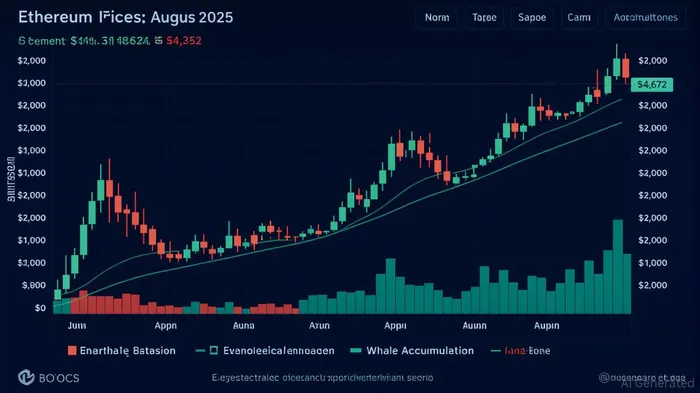
Ethereum is at a pivotal inflection point in 2025, where record short exposure, institutional ETF inflows, and whale accumulation are converging to create a high-probability short-squeeze scenario. For aggressive longs, this setup presents a compelling case to target a breakout above $4,872—a level that could trigger cascading liquidations and redefine Ethereum's trajectory.
The Perfect Storm: Short Exposure and Derivatives Imbalances
Ethereum's derivatives market is currently a powder keg. As of August 2025, net short positions on CME Ether futures have surged to -$1.55 billion, dwarfing the largest long position of $361 million. This imbalance reflects a bearish overhang, but it also underscores a critical vulnerability: short sellers are heavily concentrated in the $4,500–$4,700 range, with $2 billion in exposure at risk if EthereumETH-- breaks above $4,872.
Historical precedent suggests this threshold is a psychological and technical fulcrum. In July 2025, a $4,800–$4,900 surge triggered $110 million in short liquidations within 60 minutes. A repeat scenario could see $2 billion in forced coverings, creating a self-reinforcing upward spiral. The fragility of leveraged short positions is further amplified by negative funding rates (-0.02% on Binance) and a long/short ratio of 1.35, signaling a risk-averse environment ripe for reversal.
Whale Accumulation: The Institutional Bull Case
While short sellers are bracing for a downturn, on-chain data tells a different story. Ethereum whale wallets (1,000–10,000 ETH) have seen net inflows exceed 800,000 ETH weekly, with total holdings surpassing 14.3 million ETH. Strategic accumulation by institutional players is evident in stealth purchases, such as a $150 million ETH acquisition on August 15, 2025, and a dormant BitcoinBTC-- OG rotating 62,914 ETH ($267 million) into Ethereum.
Validator exit queues have also surged to 910,000 ETH ($3.9 billion), but this is not panic—it's yield optimization. Staked ETH now accounts for 30% of the total supply (35.7 million ETH), creating a deflationary tailwind. Exchange-held balances have plummeted to a nine-year low of 16.15 million ETH, with 79.96% of ETH in profit positions. These metrics signal deep conviction, as whales and institutional treasuries (e.g., BitMine's 625,000 ETH) prioritize long-term value capture over short-term volatility.
Institutional ETF Inflows: The Catalyst for a Bull Run
Ethereum's institutional adoption has reached a tipping point. Since May 2025, Ethereum ETFs have attracted $8.5 billion in inflows, with BlackRock's ETHA fund alone adding $318 million in a single day. This surge is driven by regulatory clarity—the SEC's 2025 custody and staking guidance—and macroeconomic tailwinds, including the 82% probability of a September 2025 Fed rate cut.
The approval of staking in U.S. spot ETFs could further accelerate inflows, offering investors a 3–5% yield while hedging against price risk. This delta-neutral strategy—long ETFs, short futures—has already been tested in Q4 2024 and Q1 2025, generating risk-free returns of 5.5–8%. With Ethereum's TVL in DeFi at $97 billion and Layer 2 adoption surging, the asset is no longer a speculative play but a foundational infrastructure layer.
Strategic Entry: Targeting $4,872 and Beyond
For aggressive longs, the $4,872 level is a high-conviction entry point. A breakout here would trigger a short squeeze, with cascading liquidations amplifying upward momentum. Historical data from July 2025 shows that a 1% move above this level could generate a 15–20% rally in the short term.
Risk management is critical. Options strategies, such as buying calls above $5,000, offer leveraged exposure to potential upside, while stop-loss orders below $4,500 can mitigate downside risk. Additionally, macro catalysts—such as the Fed's September 2025 rate cut—could fuel a broader risk-on environment, pushing Ethereum toward $5,500.
Conclusion: A High-Probability Play for the Bold
Ethereum's current setup is a textbook short-squeeze scenario. Record short exposure, institutional accumulation, and regulatory tailwinds create a perfect storm for a rapid price surge. While the risks of volatility remain, the reward-to-risk ratio is compelling for aggressive longs willing to target $4,872.
For investors with a high-risk tolerance, this is a strategic opportunity to capitalize on a market at a critical juncture. As Ethereum transitions from speculative asset to institutional-grade infrastructure, the next leg higher may be driven not by fundamentals alone—but by the forced actions of short sellers scrambling to survive.

Decoding blockchain innovations and market trends with clarity and precision.
Latest Articles
Stay ahead of the market.
Get curated U.S. market news, insights and key dates delivered to your inbox.


AInvest
PRO
AInvest
PRO



Comments
No comments yet