
Ethereum's Growing Fund Flow Advantage Over Bitcoin: A Post-ETF On-Chain Revolution


 Aime Summary
In the wake of 2025's landmark ETF approvals, the crypto market has witnessed a seismic shift in capital reallocation dynamics. EthereumETH-- (ETH) has emerged as the clear winner, outpacing BitcoinBTC-- (BTC) in on-chain activity, institutional adoption, and yield-driven appeal. This divergence is not merely a short-term anomaly but a structural reordering of investor priorities, driven by Ethereum's unique positioning in the post-ETF era.
On-Chain Behavior: A Tale of Two Chains
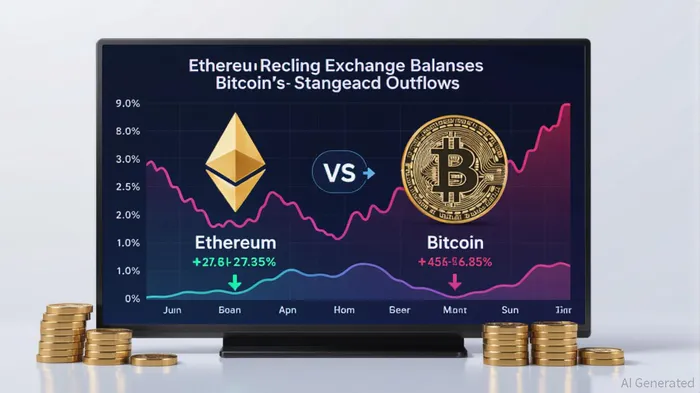
Ethereum's on-chain metrics tell a story of sustained institutional conviction. As of August 2025, Ethereum's exchange-held balances have plummeted to 14.5% of its total supply—the lowest level since November 2020. This “supply shock” narrative is underscored by a net daily outflow of -40,000 ETH from exchanges, signaling a shift from speculative trading to long-term accumulation. Meanwhile, mega whale holdings have surged by 9.31% since October 2024, with large institutional players withdrawing a net -18,650 BTC from exchanges.
Bitcoin, by contrast, faces a paradox. Despite a 14.5% decline in exchange-held balances (mirroring Ethereum's trend), its on-chain activity lacks the yield-generating mechanisms that drive capital retention. The absence of staking or programmable infrastructure leaves Bitcoin vulnerable to outflows during macroeconomic uncertainty.
ETF Inflows: Ethereum's Institutional Edge
Ethereum ETFs have captured $13.3 billion in inflows since May 2025, with BlackRock's ETHAETHA-- and Fidelity's FETHFETH-- leading the charge. On a single day in late August, ETHA absorbed $323 million in inflows, while FETH added $85.5 million—outpacing Bitcoin ETFs' $88 million. This trend is not accidental: 80–90% of Ethereum ETF inflows are genuine institutional allocations, compared to just 3% for Bitcoin.
The data is stark. While Bitcoin ETFs faced over $1 billion in net outflows during the same period, Ethereum ETFs maintained a weekly inflow streak since May 2025. BlackRock's ETHA now holds 3.6 million ETH, surpassing major exchanges like CoinbaseCOIN-- and Binance in custody. This marks a structural shift: institutions are prioritizing regulated ETF structures over traditional exchange custody.
Staking Yields and Regulatory Tailwinds
Ethereum's 12% staking yields (annualized) have become a magnet for capital in a low-interest-rate environment. With 29% of its supply staked or held via ETFs, Ethereum generates $89.25 billion in annualized yields—far outpacing Bitcoin's zero-yield model. The SEC's 2025 reforms, including in-kind redemptions and Ethereum's reclassification as a utility token, have further unlocked institutional participation.
Bitcoin's deflationary model via EIP-1559 burns offers little consolation. While its supply is static, the lack of yield generation leaves it at a disadvantage in a risk-on climate. The ETH/BTC ratio, now at a 14-month high of 0.71, reflects this imbalance. Institutional investors are increasingly allocating 30–40% of their crypto portfolios to Ethereum to leverage staking yields, while Bitcoin serves as a 60–70% “stability” anchor.
Macroeconomic Catalysts and Altcoin Rotation
The U.S. Federal Reserve's dovish pivot, including a potential September 2025 rate cut, has amplified Ethereum's appeal. Yield-seeking strategies are now favoring Ethereum-based ETFs, which offer 3–5% staking returns in a world of near-zero traditional fixed-income yields. Meanwhile, Bitcoin's price action—trading sideways at $111,600 as of August 25—suggests waning institutional interest.
Capital is also rotating into Ethereum's ecosystem. The TVL in Ethereum-based DeFi has hit $100 billion, with $11.2 billion in monthly cross-chain volume. High-utility projects like LILPEPE, combining 0% tax, Layer-2 scaling, and $22.3 million in presale funding, are attracting attention as viable investment vehicles. This altcoin season, driven by Ethereum's infrastructure, contrasts sharply with Bitcoin's role as a macro-correlated asset.
Investment Implications and Strategic Recommendations
For investors, the case for Ethereum is compelling. The asset's combination of regulatory clarity, staking yields, and institutional adoption creates a flywheel effect. ETFs like ETHA and FETH offer direct exposure to this growth, while staking platforms provide additional income. However, risks remain: regulatory shifts or macroeconomic corrections could disrupt the current trajectory.
- ETF Allocation: Prioritize Ethereum ETFs with strong institutional backing (e.g., ETHA, FETH) over Bitcoin ETFs.
- Staking Strategies: Allocate a portion of Ethereum holdings to staking to capitalize on 4.5–5.2% annualized yields.
- Altcoin Diversification: Consider Ethereum-based altcoins with clear utility, such as LILPEPE, to leverage the broader ecosystem's growth.
In conclusion, Ethereum's post-ETF surge is not a fleeting trend but a fundamental reordering of crypto capital flows. As institutional adoption accelerates and yield generation becomes a key differentiator, Ethereum is poised to outperform Bitcoin in the long term. Investors who recognize this shift early stand to benefit from a market that is increasingly favoring innovation over tradition.

Decoding blockchain innovations and market trends with clarity and precision.
Latest Articles
Stay ahead of the market.
Get curated U.S. market news, insights and key dates delivered to your inbox.




Comments
No comments yet