
Ethereum's Great Rotation: Why Unstaking FUD Is Missing the Bigger Picture


 Aime Summary
The narrative around EthereumETH-- has shifted dramatically in 2025. While short-term bearish voices fixate on temporary unstaking activity or leveraged long liquidation risks, the broader picture reveals a structural reallocation of capital from BitcoinBTC-- to Ethereum driven by institutional adoption, staking demand, and technological innovation. This "Great Rotation" is not a speculative bubble but a recalibration of asset allocation in a post-CLARITY Act world, where Ethereum’s role as a high-yield, infrastructure-grade asset is being validated by institutional behemoths and whale accumulators alike.
The ETF Inflow Surge: A New Benchmark for Institutional Adoption
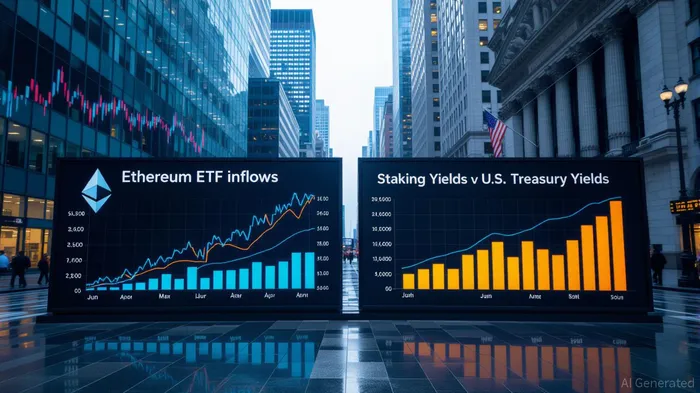
Ethereum ETFs have become the linchpin of this capital reallocation. In Q2 2025, institutional investors added 388,301 ETH to their portfolios, with investment advisors alone acquiring 539,757 ETH valued at $1.35 billion [2]. By Q3, Ethereum ETFs attracted $4 billion in institutional capital—nearly 10 times the inflows into Bitcoin ETFs—highlighting Ethereum’s growing dominance as a staking and infrastructure asset [1]. BlackRock’s ETHA ETF, now managing $13 billion in assets, has captured 90% of these inflows, signaling a clear preference for Ethereum’s yield-driven model [5].
This shift is not merely about price speculation. Ethereum’s staking yields of 3.8–5.5% [1] offer a compelling alternative to traditional fixed-income assets in a low-interest-rate environment. The 2025 CLARITY Act further cemented this by providing regulatory clarity, enabling institutions to treat Ethereum as a commodity rather than a security [4]. As a result, corporate treasuries have staked 36.1 million ETH ($17.6 billion), reducing circulating supply and reinforcing Ethereum’s deflationary narrative [1].
Whale Accumulation and Staking: The Invisible Floor
While ETF inflows capture headlines, whale activity and staking demand are the unsung drivers of Ethereum’s institutionalization. By Q3 2025, 35.7 million ETH (29.6% of total supply) was staked, creating an "invisible floor" that buffers the network against short-term volatility [2]. Corporate entities like BitMine have staked $7.65 billion in ETH, while unknown institutions added $4.16 billion in ETH over 30 days [3]. Meanwhile, large-scale investors accumulated 9.31% more ETH since October 2024 [1], signaling confidence in Ethereum’s long-term value proposition.
This staking surge is not just a liquidity drain—it’s a strategic move to secure Ethereum’s network while earning yields. With Layer 2 networks like Arbitrum and OptimismOP-- processing 2.3 million daily transactions and slashing gas fees by 99% [1], Ethereum is evolving into the backbone of global finance and DeFi. Total Value Locked (TVL) in Ethereum-based protocols has reached $223 billion [2], further entrenching its role as a foundational infrastructure layer.
Technological Upgrades and Regulatory Clarity: The Catalysts
Ethereum’s technological upgrades have been the silent enablers of this institutional shift. The Dencun and Pectra hard forks have not only improved scalability but also reduced transaction costs to levels competitive with traditional payment systems. This has unlocked $42 billion in cross-chain transfers and positioned Ethereum as a viable alternative to legacy financial infrastructure [1].
Regulatory clarity has been equally critical. The U.S. SEC’s informal classification of Ethereum as a commodity removed a major barrier for institutional participation [3]. This, combined with the CLARITY Act, has created a legal framework that allows pension funds, endowments, and hedge funds to allocate capital to Ethereum without fear of regulatory overreach.
Countering the FUD: Strategic Entry Points for Investors
Critics argue that Ethereum’s price surge—now above $4,000—is vulnerable to a correction, citing $2 billion in leveraged longs at risk if prices drop below $4,200 [2]. However, this short-term volatility misses the long-term trend. The convergence of ETF inflows, whale accumulation, and staking demand has created a self-reinforcing cycle of capital reallocation. For investors, the key is to focus on Ethereum’s structural advantages:
- Yield Arbitrage: Ethereum’s staking yields outperform traditional fixed-income assets, making it a strategic reserve asset.
- Network Security: The 29.6% staked supply enhances network security, deterring attacks and reinforcing trust.
- Regulatory Tailwinds: The CLARITY Act and SEC’s commodity classification ensure institutional adoption will continue to accelerate.
Conclusion: The Bigger Picture
Ethereum’s "Great Rotation" is not a flash in the pan. It represents a fundamental shift in how institutions view digital assets—as yield-generating infrastructure rather than speculative gambles. While short-term unstaking activity may create noise, the underlying dynamics of capital reallocation, staking demand, and technological innovation are undeniable. For investors, the question is no longer whether Ethereum will outperform Bitcoin but how to position for a world where Ethereum’s role as a strategic reserve asset is irreversible.
Source:
[1] Ethereum's Institutional Adoption and ETF-Driven Supply Dynamics [https://www.ainvest.com/news/ethereum-institutional-adoption-etf-driven-supply-dynamics-catalyst-7-500-year-2508/]
[2] Ethereum's Institutional Adoption and the 100x ETH Thesis [https://www.ainvest.com/news/ethereum-institutional-adoption-100x-eth-thesis-structural-shift-global-finance-2509/]
[3] Ethereum's Institutional Accumulation and Bullish Price [https://www.bitget.com/news/detail/12560604941869]
[4] Why Institutional Investors Are Shifting to Ethereum ETFs [https://www.bitget.com/news/detail/12560604938519]
[5] Ethereum ETF Inflows Overtake Bitcoin ETFs by Nearly 10x in [https://finance.yahoo.com/news/ethereum-etf-inflows-overtake-bitcoin-110746206.html]

Decoding blockchain innovations and market trends with clarity and precision.
Latest Articles
Stay ahead of the market.
Get curated U.S. market news, insights and key dates delivered to your inbox.
AInvest
PRO
AInvest
PRO



Comments
No comments yet