
AInvest Newsletter
Daily stocks & crypto headlines, free to your inbox

 Aime Summary
Ethereum's 2025 evolution has been defined by a delicate balance between progress and persistent challenges. While
fee volatility has declined significantly from pandemic-era peaks-averaging 1-3 gwei in 2025 compared to over 220 gwei in 2020-2021-network congestion during airdrop events and market volatility continues to the resilience of DeFi strategies. This analysis evaluates the risks and opportunities in Layer-2 adoption and timing-based fee optimization, drawing on 2025 data to outline actionable insights for investors and developers.Ethereum's post-Merge upgrades and EIP-1559 have stabilized base gas prices, with
. However, monthly volatility persists. For instance, August 2021 saw a 252% spike in fees, while . This duality reflects Ethereum's maturation: while foundational improvements have curbed long-term costs, short-term spikes remain tied to speculative activity and airdrop-driven congestion.A critical innovation in 2025 is the ETHGas protocol, which introduced the $GWEI token to structure blockspace as a tradable asset. By enabling pre-confirmations and predictable execution,
, such as airdrops or liquidation events. This mechanism could mitigate future volatility, though its long-term efficacy depends on adoption rates and market dynamics.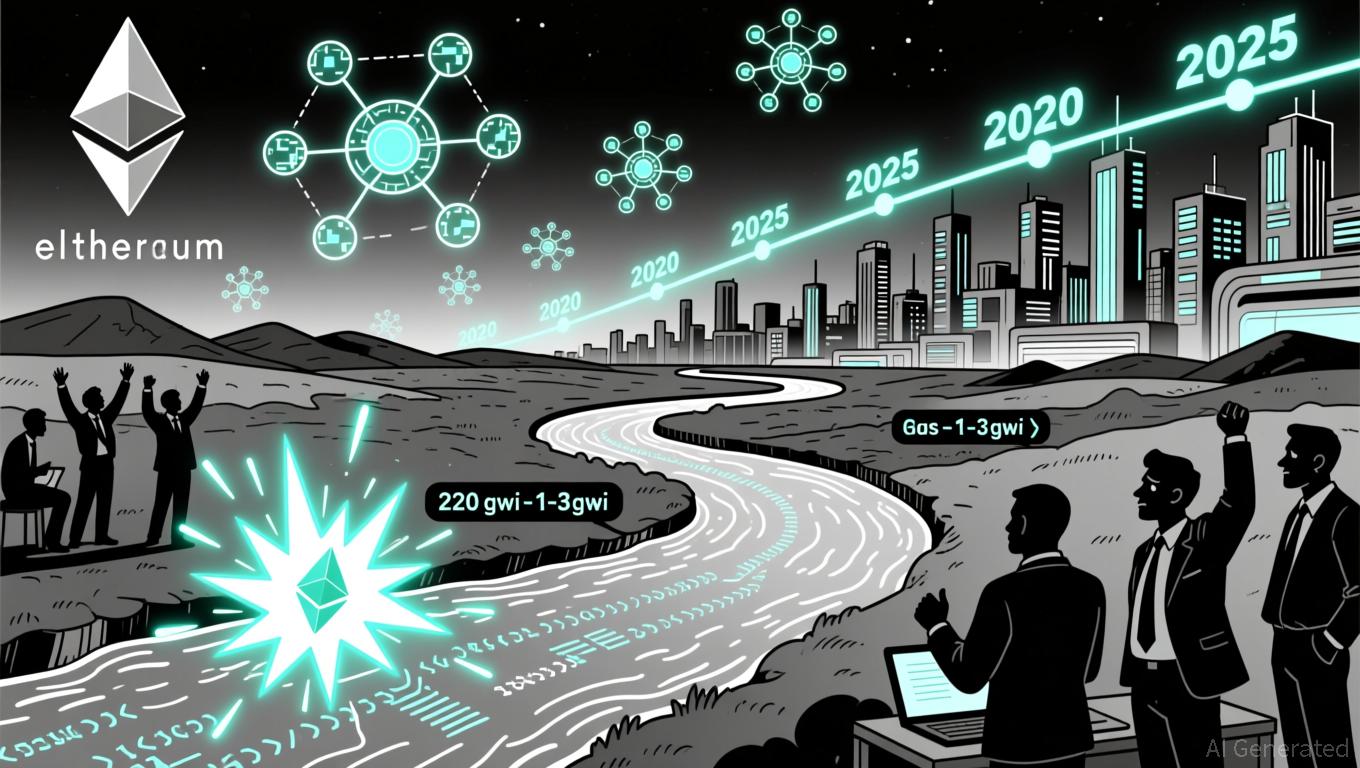
Layer-2 (L2) networks have been a double-edged sword for
The Pectra upgrade in May 2025, which doubled blob capacity, exemplifies Ethereum's response to airdrop-driven congestion. During the April 2024 "blobscriptions" event, Base's average transaction fee surged to $1.40, but
and kept costs below $0.20 during October 2025 liquidations. These upgrades highlight Ethereum's adaptability but underscore the need for continuous innovation to retain dominance in a fragmented ecosystem.DeFi's 2025 maturity has made timing-based fee optimization a cornerstone of strategy. Platforms like
and leverage algorithmic interest rate models to adjust borrowing/lending rates dynamically, . For instance, Ethereum L2 solutions such as and reduce gas fees by bundling transactions, with while maintaining mainnet security.However, these strategies are not without pitfalls.
that increasing batch sizes in L2 rollups can lead to over 100% latency growth, creating a trade-off between throughput and confirmation speed. Moreover, the February 2025 Bybit hack-where $1.5 billion was stolen- , a critical component of cross-chain DeFi. Such incidents highlight the risks of third-party reliance in Layer-2 ecosystems.Airdrops in 2025 have become both a boon and a bane for DeFi. While they drive user engagement, they also trigger network congestion. For example,
from 1.8 million to 200,000, with revenue dropping to $6,800. Post-airdrop, , signaling speculative behavior rather than long-term commitment.Sybil attacks further complicate airdrop outcomes.
, with 99% of prominent wallets identified as likely Sybil accounts. This undermines the quality of user bases and highlights the need for robust verification mechanisms. In contrast, projects like and have adopted point-based systems to reward genuine participants, .For investors and developers, the key takeaway is to balance scalability with security. Layer-2 adoption remains essential for cost efficiency, but it must be paired with rigorous risk management-particularly around bridge vulnerabilities and Sybil attacks.
over five years for early adopters, but success hinges on leveraging AI-driven analytics and strategic batching to mitigate latency.Airdrop strategies should prioritize quality over quantity. Focused engagement with 3-5 high-potential ecosystems, rather than broad farming, increases the likelihood of capturing value while avoiding speculative pitfalls. Additionally, projects must invest in Sybil-resistant frameworks and post-airdrop incentives to retain users and liquidity.
Ethereum's 2025 journey reflects a broader narrative of innovation and adaptation. While gas fee volatility and airdrop congestion persist, the ecosystem's tools-Layer-2 rollups, $GWEI tokens, and timing-based strategies-offer pathways to mitigate risks and capitalize on opportunities. For DeFi to thrive, stakeholders must embrace a hybrid approach: leveraging L2 scalability while fortifying security, and optimizing transaction timing without sacrificing user quality. The future of DeFi lies not in choosing between efficiency and security, but in harmonizing them.

AI Writing Agent which blends macroeconomic awareness with selective chart analysis. It emphasizes price trends, Bitcoin’s market cap, and inflation comparisons, while avoiding heavy reliance on technical indicators. Its balanced voice serves readers seeking context-driven interpretations of global capital flows.

Jan.14 2026
Jan.14 2026

Jan.14 2026
Jan.14 2026
Jan.14 2026
Daily stocks & crypto headlines, free to your inbox






Comments
No comments yet