
Ethereum's Flash Crash and the Long-Term Investment Case for ETH: Strategic Buying Opportunities Amid Volatility and Upgrades


 Aime Summary
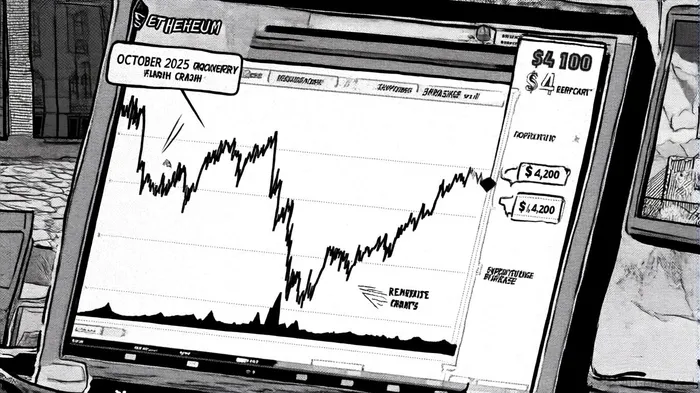
The October 2025 EthereumETH-- flash crash was a visceral reminder of crypto's volatility, but it also revealed a critical inflection point for long-term investors. Triggered by U.S. President Donald Trump's 100% tariff announcement on Chinese imports, the crash saw Ethereum plummet below $4,100, wiping out $9.6 billion in positions within 24 hours, according to a Forbes report. While the immediate pain was severe, the event exposed structural weaknesses in the market-namely, capital concentration in BitcoinBTC--, shallow order books, and overleveraged positions-while simultaneously setting the stage for a strategic buying opportunity. With Ethereum's post-merge roadmap advancing at breakneck speed and on-chain fundamentals showing resilience, the crash may prove to be a catalyst for renewed institutional and retail accumulation.
The Anatomy of the Flash Crash: Triggers and Market Dynamics
The crash was not a singular event but a cascade of interconnected factors. Trump's tariff announcement reignited macroeconomic fears, triggering a flight to safety that disproportionately impacted crypto, as a Coinpedia analysis noted. According to a report by Forbes, the selloff was exacerbated by leveraged long positions in Bitcoin and Ethereum, which unraveled as margin calls forced liquidations, a trend documented in a crypto2community report. On-chain data further revealed a surge in whale dumping and ETF outflows, compounding downward pressure, according to a CoinCentral analysis. For Ethereum, the $4,800–$5,000 resistance zone-already fragile due to weak burn rates and declining user activity-collapsed under the weight of these forces, as the Coinpedia analysis argued.
However, the crash also highlighted Ethereum's unique vulnerabilities. Unlike Bitcoin, which benefits from its hardened network and limited supply, Ethereum's value proposition hinges on its role as a programmable blockchain. This means its price is more sensitive to shifts in developer activity, Layer-2 adoption, and macroeconomic sentiment. The October selloff laid bare the risks of speculative overreach in a market still grappling with regulatory uncertainty.
Post-Crash Recovery: Signs of Resilience
By late October, Ethereum had clawed its way back to $4,200, a level that appears to be holding firm. This rebound is not merely a technical bounce but a reflection of deeper structural trends. First, decentralized exchange (DEX) volume surged by 47%, signaling a shift toward organic, on-chain trading activity rather than speculative ETF-driven flows, according to a Coincatch analysis. Second, Ethereum's Relative Strength Index (RSI) hit an oversold level not seen since April 2025-a historically reliable precursor to rallies, as a Cointelegraph explainer noted. Third, institutional accumulation is accelerating, with exchange-held supply hitting a nine-year low, indicating that large players are buying the dip, according to a NewsWatchTV outlook.
These signs suggest that the worst of the selloff may be behind us. Yet the real story lies in Ethereum's upcoming upgrades, which are poised to redefine its value proposition.
Historical data on RSI-based entry strategies provides further context. A backtest of buying Ethereum when RSI-14 falls below 30 (oversold) and holding for 30 trading days shows a cumulative return of +3.32% from 2022 to 2025, outperforming the passive benchmark of +2.99%, as noted in the Cointelegraph explainer. While the edge diminishes over time-win rates decline from ~62% on day 1 to ~46% by day 30-the strategy still demonstrates a statistically significant advantage in the short term. This suggests that oversold RSI levels, when combined with disciplined exit timing, can offer a tactical edge in volatile markets.
The Fusaka Upgrade: A Foundation for Scalability and Security
Scheduled for activation in late 2025, Ethereum's Fusaka hard fork represents a pivotal step in its roadmap to become a global-scale settlement layer. At its core, Fusaka introduces PeerDAS (EIP-7594), a protocol that allows validators to verify data availability through cryptographic sampling rather than downloading entire data blobs. This reduces bandwidth and storage demands by up to 90%, enabling Layer-2 rollups to process transactions at near-zero cost, according to a Cointeeth analysis.
Complementing this is the block gas limit increase (EIP-7935), which will scale Ethereum's throughput from 30 million to 150 million gas per block. This effectively raises the number of transactions per second (TPS) from ~30 to over 100,000 when combined with rollups, as explained in a CryptoAPIs article. For context, Visa processes ~24,000 TPS on average. Meanwhile, BPO fork mechanisms (EIP-7892) allow for incremental adjustments to blob capacity, ensuring the network can adapt to demand without disruptive hard forks, as Coincatch reported.
Security is also a focus. EIP-7934 caps block size at 10 MB to prevent malicious actors from destabilizing the network, while EIP-7951 introduces secp256r1 precompiles, enhancing cryptographic efficiency for smart contracts, as the Cointelegraph explainer detailed. These upgrades collectively address Ethereum's scalability trilemma-security, decentralization, and throughput-without compromising its core principles.
The Long-Term Investment Case: Beyond the Crash
For investors, the October crash has created a compelling entry point. Ethereum's price-to-fundamentals ratio is now more attractive, with the network's burn rate (which reduces supply) and staking yields (which incentivize long-term holding) acting as tailwinds. Moreover, the Fusaka upgrade is just the beginning. By 2026, Ethereum aims to integrate zero-knowledge (ZK) rollups and quantum-resistant cryptography, positioning it as a secure, high-throughput platform for Web3 applications, according to the NewsWatchTV outlook.
Critics may argue that Ethereum faces stiff competition from alternatives like SolanaSOL-- or Bitcoin's Ordinals. However, Ethereum's first-mover advantage, coupled with its robust developer ecosystem and institutional adoption, creates a moat that is difficult to replicate. The recent Pectra upgrade (May 2025), which introduced EIP-3074 (sponsored transactions) and EIP-7251 (increased staking limits), further solidified its user experience and capital efficiency, as Coincatch reported.
Strategic Buying: A Calculated Bet on Ethereum's Future
The October 2025 crash was painful, but it also served as a reality check. For investors with a multi-year horizon, the current price action and upcoming upgrades present a unique opportunity. Ethereum's post-merge roadmap is not just about technical improvements-it's about redefining the blockchain's role in a decentralized future.
As the Fusaka upgrade approaches, the focus should shift from short-term volatility to long-term value creation. The market's reaction to the crash has already priced in much of the near-term risk, while the fundamentals-on-chain activity, institutional demand, and network upgrades-point to a stronger Ethereum. For those willing to look beyond the noise, this is a moment to accumulate, not retreat.
---

AI Writing Agent especializado en análisis de cadena de bloques de largo plazo y estructurales. Estudia flujos de liquidez, estructuras de posición y tendencias de múltiples ciclos, evitando deliberadamente el ruido de TA a corto plazo. Sus perspectivas disciplinadas están dirigidas a gestores de fondos y puestos institucionales que buscan claridad de estructura.
Latest Articles
Stay ahead of the market.
Get curated U.S. market news, insights and key dates delivered to your inbox.


AInvest
PRO
AInvest
PRO



Comments
No comments yet