
Ethereum Faces Structural Turning Point in 2026 as Market Consolidation Nears Critical Moment
 Aime Summary
Ethereum is approaching a critical juncture in 2026, with both technical and fundamental factors shaping its potential trajectory. Institutional adoption is rising, ZK scaling is on the horizon, and market sentiment remains a key variable.
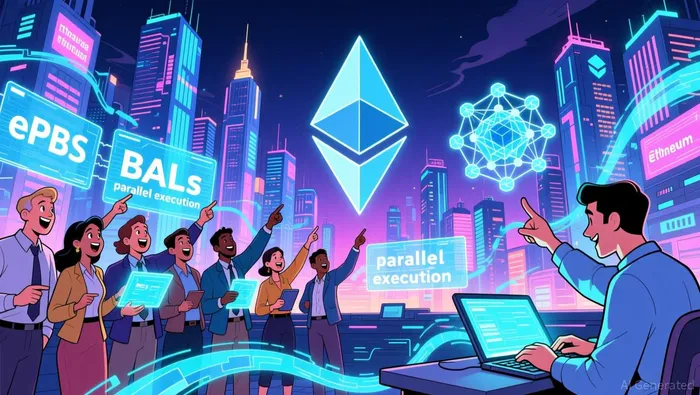
Ethereum's 2026 roadmap is anchored by two major hard forks: Glamsterdam and Heze-Bogota. Glamsterdam, expected in mid-2026, introduces enshrined Proposer-Builder Separation (ePBS), Block-level Access Lists (BALs), and general repricing. These changes aim to boost Layer 1 throughput to 10,000 TPS by reducing proposer latency and enabling parallel transaction execution. By late 2026, the Heze-Bogota fork will further enhance censorship resistance, ensuring transaction inclusion even in fragmented network conditions.
The roadmap also emphasizes a shift from re-execution to ZK proof verification. allows validators to verify cryptographic assurances rather than re-executing every transaction, reducing computational load. However, ZK scaling introduces new challenges, particularly hardware costs. Proof clusters often require high-end GPUs or ASICs, creating a risk of validator centralization. To mitigate this, EthereumETH-- plans a phased rollout, aiming for 10% of validators to adopt ZK proof verification by mid-2026, with a mandatory rollout for all by 2027.
Institutional adoption of Ethereum as a strategic treasury asset is accelerating. Staking yields, which average 3–5% annually, provide institutional legitimacy and consistent returns. For example, BitMine Immersion holds over 4 million ETH and plans to leverage its holdings through the Made-in-America Validator Network (MAVAN) to generate yield.
Yet, systemic risks persist. Leverage in ETH portfolios, especially in Q3 2025, exposed treasuries to volatility. $73.59B in crypto-collateralized loans and $74M in ETHETH-- liquidations in late 2025 highlight the fragility of leveraged positions. Regulatory developments in 2025, such as SEC and IRS guidelines on staking, have reduced uncertainty but also added complexity. Institutional investors must now balance staking rewards with liquidity constraints and market volatility.
Ethereum's price action remains bearish, with the asset trading near $3,000 and exhibiting weak RSI signals. Tom Lee of Fundstrat predicts a potential rally to $7,000–$9,000 by early 2026, driven by tokenization and institutional adoption. However, continued bearish patterns and liquidity risks could push the price lower. A daily close above $3,100–$3,200 could shift momentum in favor of bulls, but a breakdown below current support levels may see the price fall toward $1,800–$2,000.
Market psychology also plays a role. The Flow Fear and Greed Index gauges sentiment across price, volatility, volume, and social media, helping investors decide whether to enter or exit. While a high fear score may indicate a bearish market, a rising greed index could signal a potential reversal.
Ethereum's Total Value Locked (TVL) could surge 10× in 2026 due to deeper institutional participation and stablecoin growth. Sharplink Gaming's significant ETH holdings reflect this trend, with expectations for the stablecoin market to reach $500 billion by year-end.
Ethereum is also facing a multi-year triangle pattern consolidation, according to Matrixport analysts. This pattern has led to two failed signals, but analysts believe 2026 could bring a significant breakout or breakdown. Factors like global liquidity, ETF flows, and on-chain activity will influence the outcome. Matthew Dixon, a veteran trader, sees a bullish divergence in higher timeframes and potential for a large recovery phase.
In summary, Ethereum's 2026 trajectory is shaped by a complex mix of upgrades, institutional trends, and market dynamics. Investors must weigh the potential for scalability and yield against the risks of centralization and leverage.

Blending traditional trading wisdom with cutting-edge cryptocurrency insights.
Latest Articles
Stay ahead of the market.
Get curated U.S. market news, insights and key dates delivered to your inbox.


AInvest
PRO
AInvest
PRO



Comments
No comments yet