
Ethereum (ETH) Gains Momentum as Upgrades and ETFs Drive Institutional Interest
 Aime Summary
Ethereum's 2026 upgrades, including Glamsterdam and Hegotá, are expected to improve throughput and reduce gas fees, supporting broader adoption and scalability . - Institutional flows into EthereumENS-- ETFs have risen, with ETHETH-- ETFs recording inflows as investors seek exposure to crypto's macro-sensitive assets. - Regulatory clarity, including the potential passage of the CLARITY Act, could reduce burdens and encourage institutional and sovereign participation in the market.
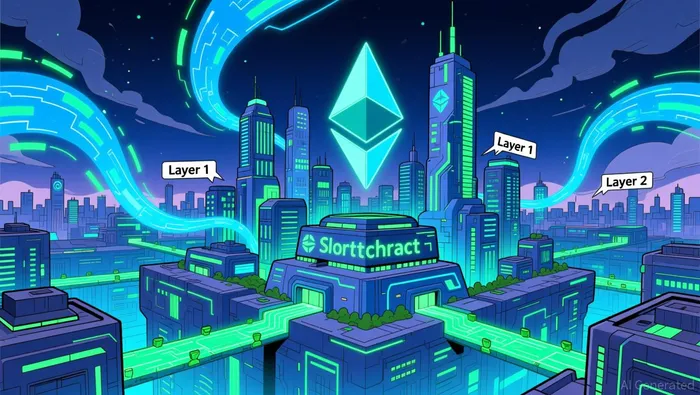
Ethereum's 2026 roadmap is focused on scaling and user experience improvements. Two major hard forks—Glamsterdam and Hegotá—are planned to enhance Layer 1 throughput and integrate more tightly with Layer 2 solutions . These upgrades are designed to scale Ethereum's execution capacity and data availability, which are key for long-term decentralization. The Glamsterdam update includes up to 22 Ethereum Improvement Proposals (EIPs) that aim to optimize how the network processes transactions and manages its database . The Hegotá upgrade is expected to introduce Verkle Trees, a data structure that will reduce node storage requirements and enable stateless clients.
Ethereum's network speed is also a focus for developers, with efforts being made to shorten slot times gradually. This approach allows for continuous performance improvements without requiring large, disruptive changes. The platform QuickSlots highlights how faster processing could reduce delays and improve efficiency. By adjusting slot times incrementally, Ethereum aims to maintain stability while progressing toward faster transaction finality.
Institutional adoption of Ethereum is also accelerating. Spot ETFs have seen inflows, with Ethereum ETFs attracting capital from traditional finance firms entering the crypto space. This trend aligns with broader institutional interest in crypto, driven by macroeconomic indicators, interest rates, and regulatory clarity. ETFs have also introduced new volatility patterns, where large outflows can lead to downward pressure.
The potential passage of the CLARITY Act could have a significant impact on Ethereum and other digital assets by reclassifying them as commodities rather than securities. This reclassification could reduce regulatory burdens and encourage more institutional and sovereign participation. The SEC's Generic Listings Standards have already streamlined ETF listings and triggered a wave of applications for altcoins like DogeBabyDoge-- and CardanoADA--.
Ethereum's price trajectory for 2026 remains uncertain, with analysts projecting a range of outcomes. A bearish scenario sees ETH trading around $1,800–$2,200, while a base case estimates $3,500–$5,000. A bullish scenario could see ETH reaching $7,500, depending on macroeconomic conditions, regulatory developments, and the success of upcoming upgrades.
Ethereum's Layer 2 ecosystem is also playing a role in its long-term growth. Layer 2s, such as rollups, bundle multiple transactions together and post them to Ethereum as a single batch, reducing the load on the base layer . This allows Ethereum to support more activity without having to process every transaction on the base layer. As a result, much of Ethereum's development now focuses on making it cheaper and easier for rollups to use the network .
Looking further ahead, analysts project that Ethereum could reach $10,000+ by 2030 if it maintains its dominance in DeFi and successfully handles global-scale applications. However, Ethereum faces competition from other chains like SolanaSOL--, which could affect its long-term prospects.
The Ethereum community is also exploring new structures to improve yield distribution. Taur0x IO, for example, introduces txTokens to eliminate staking friction and enable automatic compounding of profits. This model allows smaller stakers to benefit from AI-driven trading across exchanges without the need for manual claiming or paying gas fees. The protocol also enforces a high-water mark mechanism to prevent profit fees from recovery cycles.
Ethereum's roadmap includes roughly two major upgrades per year, with the next two scheduled for 2026 . These updates are designed to support Ethereum's long-term growth and scalability. The Ethereum community is working to ensure that these upgrades are well-researched and tested before deployment .

Blending traditional trading wisdom with cutting-edge cryptocurrency insights.
Latest Articles
Stay ahead of the market.
Get curated U.S. market news, insights and key dates delivered to your inbox.
AInvest
PRO
AInvest
PRO



Comments
No comments yet