
Ethereum ETFs Overtaking Bitcoin: A Structural Shift in Institutional Crypto Allocation


 Aime Summary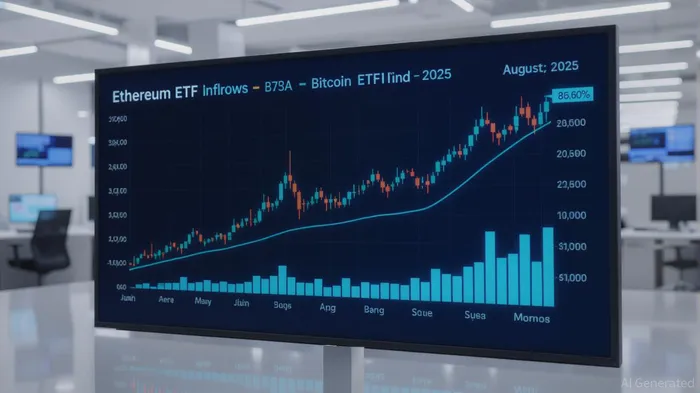
The crypto market is undergoing a seismic shift. For years, BitcoinBTC-- reigned supreme as the default digital asset for institutional investors, but the second quarter of 2025 has rewritten the playbook. EthereumETH-- ETFs are now outpacing Bitcoin in institutional adoption, driven by a confluence of on-chain accumulation, utility-driven demand, and strategic reallocation of capital. This isn't just a short-term trend—it's a structural reordering of how institutional money views crypto. Let's break down why this matters for investors and how to position your portfolio for the next phase of the bull run.
Institutional Capital: From Bitcoin to Ethereum
The numbers tell a compelling story. While Bitcoin ETFs still hold $143.6 billion in assets, Ethereum ETFs have surged to $28.8 billion in just six months, with Ethereum's inflows outpacing Bitcoin's in key weeks. On August 25, Ethereum ETFs raked in $443.9 million in a single day—nearly double Bitcoin's $219 million. BlackRock's ETHA fund alone accounted for 70% of that inflow, signaling a clear preference for Ethereum among institutional players.
This shift isn't random. Ethereum's deflationary supply model (a 0.1% reduction in Q2 2025) and its 3–5% staking yield offer a tangible return that Bitcoin's non-yielding model can't match. Meanwhile, Ethereum's dominance in decentralized finance (DeFi) and real-world asset tokenization—powering 53% of such initiatives—has made it the backbone of the digital economy. As James Seyffart of Bloomberg ETF notes, the 25% of Ethereum ETF shares held by institutional filers (like Brevan Howard and Harvard Management) are just the tip of the iceberg. The remaining 75% is a retail-driven tailwind that's hard to ignore.
On-Chain Accumulation: BitMine's $6.6 Billion ETH Treasury
One of the most striking developments in 2025 is BitMine ImmersionBMNR-- Technologies' (BMNR) aggressive accumulation of Ethereum. The company now holds 1.52 million ETH, valued at $6.6 billion, making it the second-largest institutional holder of crypto assets globally—trailing only MicroStrategy's Bitcoin hoard. BitMine's stock has become a proxy for Ethereum exposure, with an average daily trading volume of $6.4 billion, outpacing JPMorganJPM-- and Alphabet.
Tom Lee, BitMine's chairman, argues that Ethereum is the “code-based infrastructure” replacing traditional finance. He draws parallels to the 1970s shift from gold-backed money to fiat, positioning Ethereum as the next pillar of tokenized finance, AI-powered markets, and on-chain capital. BitMine's strategy isn't just about holding ETH—it's about betting on Ethereum's role in reshaping the financial system.
Ethereum's Utility-Driven Outperformance
While Bitcoin's appeal as a store of value remains intact, Ethereum's utility is winning the hearts of investors. Consider Remittix (RTX), a project leveraging Ethereum's smart contracts to revolutionize cross-border payments. With a presale raising $20.8 million and a projected 7,500% ROI, Remittix is outpacing even SolanaSOL-- in real-world adoption. Its beta wallet, launching in September 2025, allows users to convert crypto to fiat and send money to 30+ countries—solving a $190 trillion pain point in the global payments sector.
Ethereum's role here is critical. Unlike Bitcoin, which struggles with microtransactions due to high gas fees, Ethereum's infrastructure enables scalable, low-cost solutions. Remittix's deflationary tokenomics and CertiK audit further bolster institutional confidence, making it a prime beneficiary of Ethereum's momentum. As Ethereum ETF outflows accelerate, investors are reallocating to projects like Remittix that deliver tangible use cases.
The Road Ahead: Why This Matters for Investors
The structural shift from Bitcoin to Ethereum isn't a zero-sum game. Both assets have room to grow, but the dynamics are changing. For investors, this means:
- Diversify into Ethereum-based projects: Look beyond ETFs to utility-driven tokens like RTXRTX--, which are solving real-world problems and leveraging Ethereum's infrastructure.
- Monitor institutional allocations: Track inflows into Ethereum ETFs (e.g., ETHA, FETH) and on-chain accumulation by companies like BitMineBMNR--. These are leading indicators of broader market sentiment.
- Rebalance portfolios for yield: Ethereum's staking rewards and deflationary supply model offer a compelling edge over Bitcoin's static model, especially in a high-inflation environment.
The bottom line? Ethereum isn't just competing with Bitcoin—it's outperforming it in the metrics that matter most to institutional investors. As BlackRockBLK--, BitMine, and projects like Remittix gain traction, the crypto landscape is becoming more nuanced. For those willing to adapt, the rewards could be substantial.
Final Call to Action:
The institutionalization of crypto is accelerating, and Ethereum is at the forefront. Whether through ETFs, staking, or utility-driven projects, now is the time to position for Ethereum's next leg higher. Don't let Bitcoin's shadow blind you—this is a market where innovation and utility are winning.

Decoding blockchain innovations and market trends with clarity and precision.
Latest Articles
Stay ahead of the market.
Get curated U.S. market news, insights and key dates delivered to your inbox.


AInvest
PRO
AInvest
PRO



Comments
No comments yet