
Ethereum ETFs: A New Era of Institutional Adoption and Regulatory Clarity


 Aime Summary
The approval of EthereumETH-- exchange-traded funds (ETFs) in the United States marks a watershed moment in the evolution of crypto assets. By August 2025, the Securities and Exchange Commission (SEC) had finalized in-kind creation and redemption mechanisms for Ethereum ETFs, mirroring the regulatory breakthroughs that enabled Bitcoin's ETF debut in 2024. This development, coupled with the passage of the CLARITY Act and the GENIUS Act, has reclassified Ethereum as a utility token and established a 100% reserve-backed stablecoin framework. Together, these milestones have transformed Ethereum from a speculative asset into a regulated, institutional-grade investment vehicle.
Regulatory Progress: A Framework for Institutional Trust
The SEC's approval of in-kind mechanisms for Ethereum ETFs has addressed critical inefficiencies in the crypto market. Unlike traditional ETFs that rely on cash-based creation/redemption processes, in-kind mechanisms allow institutional investors to swap Ethereum directly for ETF shares, reducing transaction costs and enhancing liquidity. This innovation aligns Ethereum ETFs with gold or oil ETFs, where physical assets underpin the product.
The CLARITY Act's reclassification of Ethereum as a utility token resolved a long-standing jurisdictional conflict between the SEC and the Commodity Futures Trading Commission (CFTC). By defining Ethereum's primary purpose as enabling decentralized applications and smart contracts rather than speculative trading, the act created a regulatory sandbox that prioritizes innovation while safeguarding investor interests. Meanwhile, the GENIUS Act's stablecoin framework has further legitimized Ethereum's infrastructure role, ensuring that stablecoins used in Ethereum-based transactions are fully backed by reserves.
Institutional Inflows: A Surge in Capital Allocation
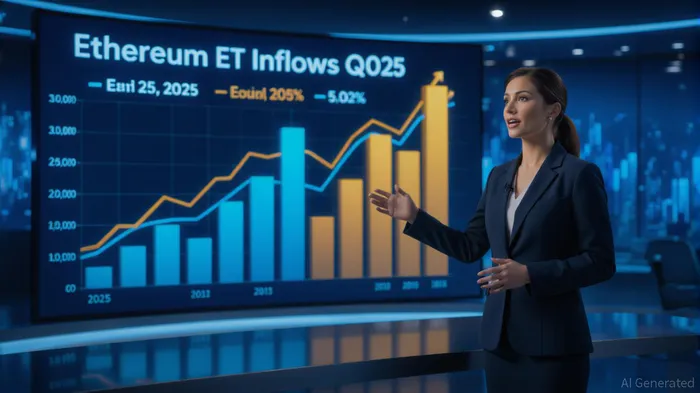
The regulatory clarity has catalyzed a flood of institutional capital into Ethereum ETFs. By August 2025, these products had attracted $9.4 billion in inflows, with BlackRock's ETHA ETF alone drawing $266 million in a single day. This momentum is driven by Ethereum's unique value proposition: annualized staking yields of 29.4%, dominance in decentralized finance (DeFi), and leadership in real-world asset (RWA) tokenization.
Ethereum ETFs have outpaced BitcoinBTC-- ETFs in institutional adoption, capturing 63% more inflows in Q2 2025. This shift reflects a strategic reallocation of capital from Bitcoin's store-of-value narrative to Ethereum's utility-driven model. Hedge funds and investment advisors now account for 80% of Ethereum ETF growth, signaling a broader acceptance of crypto as an infrastructure asset.
Technological Innovation: The Dencun and Pectra Upgrades
Ethereum's institutional appeal is further bolstered by its technological advancements. The Dencun and Pectra hard forks, implemented in 2025, have enhanced scalability and reduced transaction costs by 40%, making the network more efficient for institutional-grade applications. These upgrades have also enabled seamless integration with real-world assets, such as tokenized real estate and carbon credits, expanding Ethereum's use cases beyond speculative trading.
The Road Ahead: Generic Listing Standards and Market Expansion
The SEC's “Project Crypto,” launched in July 2025, has accelerated the standardization of crypto ETF disclosures, including custody practices, staking risks, and fraud mitigation. By late September 2025, Nasdaq, NYSE Arca, and CboeCBOE-- are expected to finalize generic listing standards, which will streamline the approval process for Ethereum and altcoin ETFs. This could unlock billions in institutional capital, particularly as 92 crypto ETF applications—including those for SolanaSOL-- and XRP—are under review.
Investment Implications: A Strategic Opportunity
For investors, Ethereum ETFs represent a compelling entry point into the next phase of crypto adoption. The asset's combination of regulatory clarity, yield generation, and technological innovation positions it as a core component of diversified portfolios. Historical parallels suggest that Ethereum could follow Bitcoin's 2024 trajectory, with a potential 75% price surge in 2025 if institutional inflows continue at current rates.
However, investors should remain cautious about macroeconomic risks, such as interest rate volatility and geopolitical tensions. A prudent strategy would involve allocating a portion of crypto exposure to Ethereum ETFs while maintaining a balanced portfolio that includes traditional assets like equities and bonds.
Conclusion: A Paradigm Shift in Institutional Finance
Ethereum ETFs are no longer a niche product but a cornerstone of institutional capital allocation. The convergence of regulatory progress, technological innovation, and yield generation has redefined Ethereum's value proposition, transforming it from a speculative asset into a strategic infrastructure investment. As the market anticipates streamlined approval frameworks and broader adoption, Ethereum ETFs are poised to unlock a new era of crypto integration in institutional portfolios.

Blending traditional trading wisdom with cutting-edge cryptocurrency insights.
Latest Articles
Stay ahead of the market.
Get curated U.S. market news, insights and key dates delivered to your inbox.
AInvest
PRO
AInvest
PRO



Comments
No comments yet