
Ethereum ETFs and Corporate Treasuries: A New Catalyst for Institutional Bull Run


 Aime Summary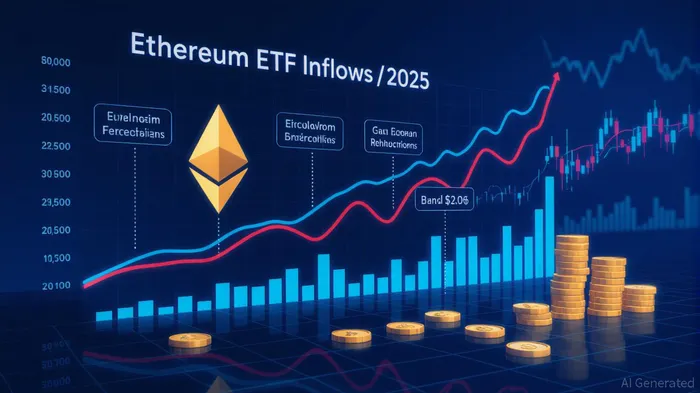
The institutional investment landscape has entered a transformative phase, driven by a confluence of regulatory clarity, technological innovation, and shifting capital flows. EthereumETH--, once overshadowed by BitcoinBTC-- in the institutional arena, now stands at the forefront of this evolution. The surge in Ethereum ETF inflows—$9.4 billion in Q2 2025 alone—reflects a broader revaluation of the asset class, fueled by a combination of policy reforms and Ethereum’s inherent utility-driven advantages [1].
Regulatory Tailwinds: A Foundation for Trust
The Securities and Exchange Commission’s (SEC) approval of in-kind redemption mechanisms for Ethereum ETFs in 2025 marked a pivotal moment. This decision, coupled with the implementation of the CLARITY Act and the EU’s Markets in Crypto-Assets (MiCA) framework, has created a robust legal infrastructure that mitigates institutional hesitancy [1]. These reforms address critical concerns around custody, liquidity, and market integrity, enabling large-scale capital to flow into Ethereum-based products with confidence.
The Commodity Futures Trading Commission’s (CFTC) parallel efforts to modernize crypto regulations further amplified this momentum. By streamlining spot trading rules and enhancing investor protections, the CFTC has fostered a competitive environment where Ethereum ETFs can thrive alongside their Bitcoin counterparts [2]. This regulatory alignment has not only stabilized market expectations but also attracted a new cohort of institutional players, including pension funds and sovereign wealth entities, seeking diversified exposure to digital assets.
Technological Innovation: Enhancing Utility and Appeal
Ethereum’s revaluation is not solely a function of regulatory progress; its technological upgrades have fundamentally reshaped its value proposition. The Dencun and Pectra hard forks, implemented in 2024–2025, reduced gas fees by 53%, making the network more accessible for institutional-grade applications such as tokenized real-world assets (RWAs) and decentralized finance (DeFi) protocols [3]. These improvements have positioned Ethereum as a foundational layer for blockchain-based finance, attracting capital that seeks both yield and utility.
Staking yields, now ranging between 4–6%, further differentiate Ethereum from Bitcoin, which lacks native staking mechanisms. This feature has drawn corporate treasuries and ETFs to accumulate 9.2% of Ethereum’s total supply by Q3 2025, with 19 public companies and BlackRock’s ETHAETHA-- ETF leading the charge [4]. The deflationary mechanics of Ethereum’s EIP-1559 protocol, which burns a portion of transaction fees, add another layer of scarcity, reinforcing its appeal in a market increasingly focused on asset durability.
A New Equilibrium: Ethereum vs. Bitcoin
The institutional bull run for Ethereum has not come at the expense of Bitcoin but rather by carving out a distinct niche. While Bitcoin ETFs attracted $50 billion in inflows during the same period, Ethereum’s focus on utility-driven returns—such as staking and RWA tokenization—has enabled it to outpace Bitcoin in Q3 2025, with Ethereum ETFs amassing $27.66 billion in assets under management [1][3]. This divergence underscores a maturing market where investors are no longer conflating crypto assets but instead evaluating them based on their unique risk-return profiles.
The Road Ahead
Ethereum’s institutional adoption is no longer a speculative narrative but a structural shift. The interplay of regulatory tailwinds, technological upgrades, and capital reallocation has created a self-reinforcing cycle: clearer rules attract more capital, which funds further innovation, which in turn justifies higher valuations. For investors, this dynamic presents both opportunities and challenges. The next phase will likely test the resilience of these trends as macroeconomic conditions evolve, but the foundation laid in 2025 suggests Ethereum is well-positioned to sustain its momentum.
Source:
[1] Convergence of Regulation and Capital: Institutional Adoption Reshaping ETH ETF Landscape [https://www.ainvest.com/news/convergence-regulation-capital-institutional-adoption-reshaping-eth-etf-landscape-2025-2508-24/]
[2] The CFTC's Regulatory Shift and Its Impact on Institutional Crypto Adoption [https://www.ainvest.com/news/cftc-regulatory-shift-impact-institutional-crypto-adoption-2508/]
[3] Ethereum ETFs Surpassing Bitcoin in Institutional Inflows [https://www.bitget.com/news/detail/12560604937306]
[4] The Rise of Corporate Treasuries and ETFs as Key Holders of Ethereum Supply [https://www.bitget.com/asia/news/detail/12560604937252]

Decoding blockchain innovations and market trends with clarity and precision.
Latest Articles
Stay ahead of the market.
Get curated U.S. market news, insights and key dates delivered to your inbox.




Comments
No comments yet