
Ethereum ETF Outflows and the Shifting Sentiment in Crypto Markets
 Aime Summary
The Magnitude of Ethereum ETF Outflows
Ethereum spot ETFs have experienced a prolonged period of net outflows since mid-December 2025, with nearly $854 million in redemptions recorded during this stretch according to data. This follows a particularly volatile November, which saw $1.42 billion in outflows, further compounding the liquidity contraction in the crypto market. While a brief $84.6 million inflow on December 24 offered a temporary reprieve, it failed to reverse the broader trend, as cumulative inflows for Ethereum ETFs remain at approximately $12.5 billion.
The sustained selling pressure has had a direct impact on Ethereum's price action. The cryptocurrency has remained trapped below critical resistance levels, including the descending trendline and the 50-day exponential moving average (EMA) near $3,160 according to market analysis.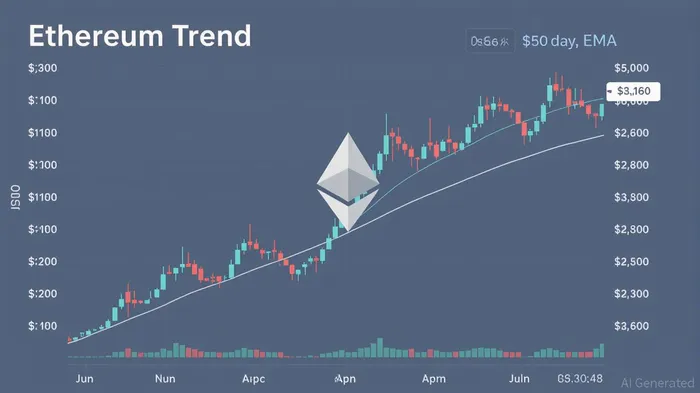 Institutional disengagement, as highlighted by the negative 30-day simple moving average (SMA) of net flows, underscores a phase of muted participation and partial withdrawal from the asset class according to financial data.
Capital Reallocation: From Ethereum to BitcoinBTC--, DeFi, and Traditional Assets
The outflows from Ethereum ETFs have coincided with a strategic reallocation of capital toward Bitcoin, DeFi, staking opportunities, and traditional safe-haven assets.
Bitcoin's Resurgence as "Digital Gold"
While Ethereum ETFs outperformed Bitcoin in Q3 2025-recording inflows nearly tripling those of Bitcoin-this dynamic reversed in late 2025. By December, Bitcoin spot ETFs posted $175 million in net outflows, while Ethereum ETFs saw $57 million in redemptions according to institutional data. Despite this, Bitcoin's dominance as a store-of-value asset persisted, with 94% of institutional investors expressing long-term confidence in blockchain technology and 68% planning or already investing in Bitcoin ETPs according to market research.
DeFi and Staking Yields Attract Institutional Capital
Ethereum's role as a programmable blockchain platform has drawn renewed interest in its DeFi and staking ecosystems. Staking yields of 3–5% annual returns have become a key draw for income-focused investors, diverting capital from speculative Ethereum positions to yield-generating mechanisms. Additionally, advancements in DeFi infrastructure-such as solver-based trading systems and intent-based routing-have enhanced the efficiency of decentralized platforms, making them more attractive for capital allocation.
Traditional Assets Outperform Crypto
In parallel, investors have increasingly favored traditional assets like gold and silver, which rose by 70% and 140%, respectively in 2025 according to asset allocation data. This shift reflects a broader appetite for liquidity and regulatory clarity, with Ethereum's lack of a robust growth catalyst-compared to Bitcoin's ETF-driven inflows-leaving it vulnerable to macroeconomic headwinds.
Drivers of Sentiment Shifts: Regulatory and Technological Catalysts
The reallocation of capital has been influenced by a confluence of regulatory and technological developments.
Regulatory Clarity Fuels Institutional Adoption
The approval of U.S. spot Bitcoin and Ethereum ETFs, coupled with the implementation of the EU's Markets in Crypto-Assets (MiCA) regulation and the U.S. GENIUS Act, has provided a clearer framework for institutional participation. These developments have accelerated the adoption of digital assets in traditional financial systems, particularly in jurisdictions like the U.S., EU, and Singapore.
Technological Innovation Diversifies Institutional Strategies
Tokenization of real-world assets and advancements in blockchain infrastructure have diversified institutional interest beyond Bitcoin's store-of-value narrative. For instance, stablecoins now serve as a core layer for DeFi activities like lending and yield generation, while solver-based trading systems have improved the scalability of decentralized platforms.
Conclusion: A New Era of Institutional Prudence
The Ethereum ETF outflows of late 2025 reflect a broader recalibration of investor sentiment, driven by macroeconomic caution, regulatory maturation, and technological innovation. While Ethereum's price struggles and liquidity pressures highlight its vulnerability, the asset's role in DeFi and staking ecosystems continues to attract capital. Meanwhile, Bitcoin's dominance as a safe-haven asset and the rise of traditional markets underscore a shift toward risk mitigation and yield generation. As the crypto market navigates this transition, the interplay between regulatory clarity, technological progress, and macroeconomic dynamics will remain pivotal in shaping future trends.

Combina la sabiduría tradicional en el comercio con las perspectivas más avanzadas sobre las criptomonedas.
Latest Articles
Stay ahead of the market.
Get curated U.S. market news, insights and key dates delivered to your inbox.






Comments
No comments yet