
Ethereum ETF Outflows: A Market Correction or a Selloff?
 Aime Summary
Institutional Adoption: A Foundation of Resilience
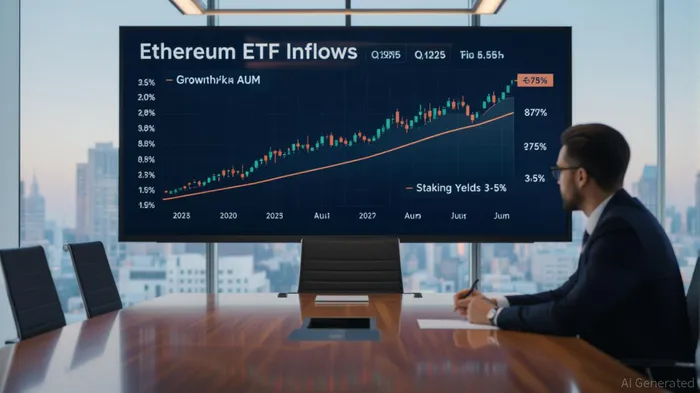
Ethereum's institutional adoption in 2025 has been nothing short of transformative. In Q3 2025, Ethereum ETFs outperformed Bitcoin counterparts with record inflows of $9.6 billion, marking a 177% quarterly growth in assets under management (AUM). This surge was driven by Ethereum's unique utility-smart contracts, decentralized finance (DeFi), and staking yields-which positioned it as a preferred asset for institutional portfolios seeking both yield and innovation.
Even amid December's outflows, Ethereum's institutional ecosystem demonstrated resilience. For instance, Bitmine's $219 million staking commitment and 4 million ETH treasury holdings underscored Ethereum's role as a core balance-sheet asset, with staking yields of 3–5% providing a buffer against price volatility. Additionally, regulatory clarity and layer-2 scaling solutions further solidified Ethereum's appeal, enabling enterprises to tokenize assets and settle transactions on-chain.
However, December 2025 brought a reversal. Spot Ethereum ETFs recorded $564 million in outflows during the month, pushing total assets to a 37.5% decline from recent peaks. This contraction, while significant, must be contextualized within broader macroeconomic uncertainty and holiday-driven liquidity constraints.
Price Resilience: Navigating Volatility
Ethereum's price resilience in 2025 has been a double-edged sword. While Q3 inflows supported a robust market structure, December's outflows coincided with a 10% year-to-date decline in ETH prices. Yet, this drop does not necessarily signal a selloff.
Data from on-chain metrics reveals a nuanced picture. Despite elevated exchange reserves and a deeply negative Coinbase Premium, Ethereum's derivatives markets showed controlled position unwinding, suggesting a correction rather than panic-driven liquidation. Furthermore, whale activity-such as the accumulation of 138K ETH ($503M) over seven days-indicated bullish sentiment among large holders, who viewed sub-$3K ETH as undervalued.
Tom Lee, a prominent crypto analyst, reinforced this view, calling ETH at $3,000 "severely undervalued" and projecting a $15,000 target by year-end 2025. While short-term indicators like the Estimated Leverage Ratio and ETF outflows remain bearish, Ethereum's Total Value Locked (TVL) trended upward, reflecting confidence in its ecosystem.
Correction or Selloff? A Balanced Perspective
The distinction between correction and selloff hinges on duration and structural factors. A correction is typically a short-term pullback within a longer-term uptrend, whereas a selloff implies a broader breakdown in market fundamentals.
Ethereum's case aligns more closely with a correction. The outflows in December 2025 were concentrated in a single month and occurred against a backdrop of strong institutional inflows in Q3. Moreover, Ethereum's structural advantages-such as no miner-driven sell pressure post-Proof-of-Stake and lower quantum-computing risks-position it to outperform Bitcoin in the second half of 2026.
That said, caution is warranted. Persistent ETF outflows, elevated leverage ratios, and a bearish 2026 outlook from Fundstrat highlight risks. Price stability will depend on Ethereum's ability to hold key support levels, such as $2,920, and sustain whale accumulation.
Conclusion
Ethereum ETF outflows in late 2025 reflect a market correction rather than a selloff. While short-term volatility and liquidity constraints have tested investor confidence, the underlying fundamentals-institutional adoption, staking yields, and ecosystem innovation-remain intact. For investors, the key lies in distinguishing between cyclical pullbacks and structural shifts. As Ethereum's market matures, its resilience will likely be defined by its capacity to adapt to macroeconomic headwinds while maintaining its position as a cornerstone of institutional crypto portfolios.

Blending traditional trading wisdom with cutting-edge cryptocurrency insights.
Latest Articles
Stay ahead of the market.
Get curated U.S. market news, insights and key dates delivered to your inbox.






Comments
No comments yet