
Ethereum ETF Outflows and Crypto Market Sentiment: Implications for Active Fund Management and Investor Confidence
 Aime Summary
Ethereum ETF Outflows: A Barometer of Institutional Disengagement
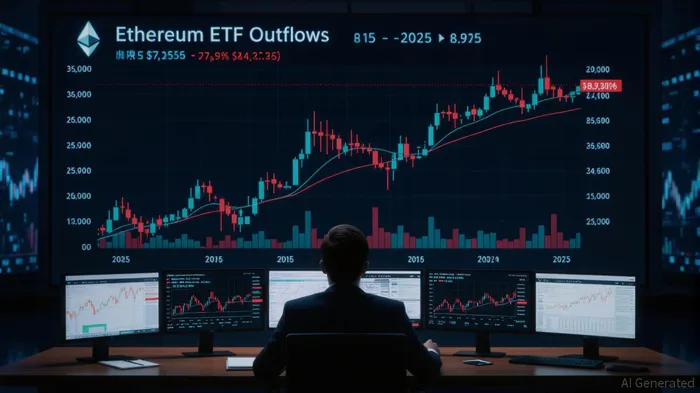
Ethereum ETFs have experienced cumulative outflows of nearly $854 million since mid-December 2025, with Q4 alone witnessing a $6.3 billion exodus of assets under management (AUM) according to data. These outflows have directly correlated with Ethereum's inability to break above critical resistance levels, such as the $3,000–$3,150 range, and have exacerbated bearish technical signals, including a failure to hold above the 50-day exponential moving average (EMA). Derivatives data further underscores this trend, revealing deleveraging and hedging activities by institutional participants, who are increasingly reducing exposure rather than accumulating positions.
The broader market context is equally telling. Rising exchange reserves and elevated leverage in derivatives markets have amplified downside risks, while the Federal Reserve's tightening monetary policy has diverted capital toward safer instruments. This environment suggests that Ethereum's recovery may lag into 2026 unless catalyzed by renewed ETF inflows or macroeconomic shifts.
Active Fund Management Strategies: Hedging, Diversification, and Defensive Positioning
In response to these outflows, active crypto fund managers have adopted a range of strategies to mitigate risk and preserve capital. One key approach has been the reallocation of assets from volatile digital assets to more regulated and utility-driven ecosystems. For instance, institutional investors have increasingly prioritized blockchain projects with active decentralized finance (DeFi) and smart-contract activity over speculative allocations. This shift reflects a maturing institutional-grade approach to crypto, where risk management is structured and defensive.
Hedging has also become a focal point. Derivatives markets have seen heightened activity as investors hedge against further price declines, particularly in Ethereum, where leverage has cooled amid thin liquidity. Additionally, some funds have diversified into altcoin products such as XRPXRP-- and SolanaSOL--, which offer clearer regulatory clarity and utility compared to BitcoinBTC-- and Ethereum. This rotation highlights a strategic repositioning rather than a wholesale exit from crypto, as evidenced by modest inflows into products like BlackRock's IBIT despite broader outflows.
Investor Confidence Metrics: A Risk-Off Narrative
Granular metrics paint a stark picture of declining investor confidence. The crypto Fear and Greed Index hit its lowest point since July 2022 in November 2025, signaling "extreme fear" amid volatility in Federal Reserve rate expectations and old-generation Bitcoin selling. US investors now view cryptocurrency as "extremely or very risky" by 66%, up from 58% in 2021. Despite this, long-term Bitcoin holders-particularly those with positions over seven years old-continue to hold around 5 million coins, suggesting residual confidence in future price appreciation.
Allocation percentages further underscore the risk-off trend. Ethereum ETFs like the iShares Ethereum Trust ETF (ETHA) and Fidelity Ethereum Fund (FETH) attracted $9.1 billion and $1.1 billion in inflows, respectively, but higher-fee products like the Grayscale Ethereum Trust ETF (ETHE) lost $1.4 billion. This divergence mirrors Bitcoin ETF dynamics, where the iShares Bitcoin Trust ETF (IBIT) captured $25.1 billion in inflows, while other spot Bitcoin ETFs collectively saw $3.2 billion in outflows.
Risk appetite indices for crypto ETFs remain volatile. ETHA's max drawdown of 64.02% over five years contrasts with IBIT's 32.73%, reflecting Ethereum's sharper price swings. Meanwhile, Bitcoin's 30-day RSI hit ~32 in November 2025-the lowest since the Lido ETH de-peg in June 2022-highlighting the market's defensive posture.
Conclusion: A Pivotal Moment for Crypto Asset Management
The Ethereum ETF outflows of late 2025 represent more than a technical correction; they signal a pivotal shift in institutional and retail investor behavior. Active fund managers are recalibrating strategies to prioritize risk mitigation, regulatory clarity, and utility-driven assets, while broader market sentiment remains cautiously bearish. For Ethereum, the path to recovery hinges on renewed institutional demand, macroeconomic stability, and the emergence of catalysts that can reignite bullish momentum. As the crypto market navigates this transitional phase, the interplay between ETF flows, investor confidence, and strategic fund management will remain central to its evolution.

Blending traditional trading wisdom with cutting-edge cryptocurrency insights.
Latest Articles
Stay ahead of the market.
Get curated U.S. market news, insights and key dates delivered to your inbox.
AInvest
PRO
AInvest
PRO



Comments
No comments yet