
Ethereum ETF Momentum and Altcoin Diversification: Strategic Portfolio Positioning in the 2025 Crypto Bull Cycle


 Aime Summary
The 2025 crypto bull cycle has been defined by two seismic forces: the explosive adoption of EthereumETH-- ETFs and a strategic reimagining of altcoin diversification. As institutional capital floods into Ethereum-based products and regulatory clarity reshapes the landscape, investors must recalibrate their portfolios to harness the full potential of this cycle. This analysis unpacks the interplay between Ethereum's ETF-driven momentum and altcoin diversification, offering actionable insights for navigating the next phase of crypto's evolution.
Ethereum ETFs: A Catalyst for Institutional Capital and Market Legitimacy
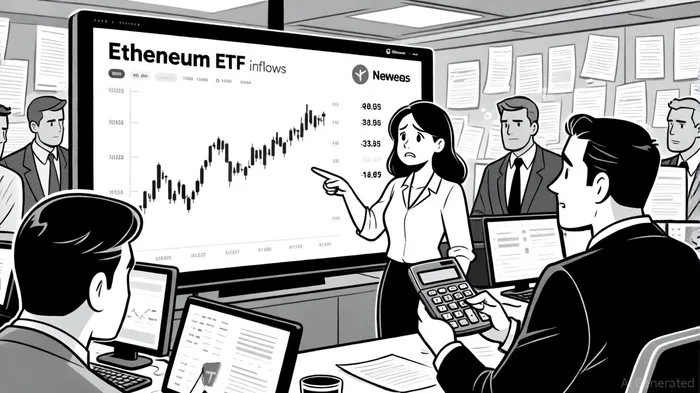
The U.S. Securities and Exchange Commission's approval of spot Ethereum ETFs in June 2025 marked a watershed moment. By Q3 2025, these ETFs had attracted $27.66 billion in assets under management, with net inflows exceeding $468 million in a single week, according to the Bybit Q3 2025 report. This surge was fueled by the CLARITY and GENIUS Acts of 2025, which reclassified Ethereum as a utility token and enabled in-kind creation and redemption mechanisms, as explained in a Currency Analytics piece.
Ethereum's appeal to institutions lies in its deflationary model (bolstered by EIP-1559 and staking mechanisms) and attractive staking yields (3–6%). By August 2025, U.S. Ethereum ETFs held $20.11 billion in net assets, representing 4.70% of Ether's total market capitalization, per a Valr analysis. This institutional adoption has notNOT-- only driven Ethereum's price above its previous all-time high but also created a ripple effect across the broader crypto market. For instance, XRPXRP-- and AVAXAVAX-- have seen renewed interest, with AVAX demonstrating a 65% positive correlation with Ethereum's total value locked (TVL), as noted in the Valr analysis.
Altcoin Diversification: Balancing Stability and High-Conviction Bets
While Ethereum ETFs anchor portfolios, strategic diversification into altcoins is critical for capturing the fragmented opportunities of the 2025 bull cycle. Institutional and retail investors are reallocating capital from stablecoins (which dropped from 42.7% to 25% of holdings between April and August 2025, according to the Bybit Q3 2025 report) into utility-driven tokens and emerging themes like DeFi, AI, and real-world asset (RWA) tokenization.
A recommended allocation strategy includes:
- 40–60% in large-cap "digital primitives" (Bitcoin and Ethereum), serving as stability anchors, a point highlighted in the Valr analysis.
- 20–35% in high-potential altcoins such as SolanaSOL-- (SOL), Mantle (MNT), and ChainlinkLINK-- (LINK), which offer scalability and interoperability solutions, as discussed in the Valr analysis.
- 10–20% in thematic bets like RWA tokens and AI-integrated cryptos, which align with Ethereum's ecosystem, also noted in the Valr analysis.
Early-stage altcoins with strong utility, such as MAGACOIN FINANCE, are also gaining traction, drawing comparisons to Ethereum's early growth trajectory in the Glassnode analysis. However, investors must avoid high-supply memeMEME-- coins and prioritize tokens with real-world adoption. For example, Mantle (MNT) has emerged as a platform-native utility token bridging DeFi and TradFi ecosystems, according to the Bybit report, while Pendle Finance (PENDLE) has shown robust TVL growth through innovative yield mechanisms in the UFOGamingWars guide.
Navigating Volatility and Sector Rotations
The 2025 bull cycle is characterized by rapid sector rotations and shorter-lived altcoin rallies, contrasting with the synchronized growth of earlier cycles, as described in the Glassnode analysis. This volatility necessitates disciplined risk management:
- Rebalance portfolios every 90 days to adapt to shifting narratives and market conditions, a tactic recommended in the Valr analysis.
- Use on-chain analytics to detect whale activity and liquidity trends, as advised in the Valr analysis.
- Employ technical indicators like RSI and Bitcoin dominance (BTC.D) to identify oversold altcoin entry points, as discussed in the Currency Analytics piece.
For instance, Ethereum's outperformance over BitcoinBTC-- in recent months-driven by ETF inflows-has pushed Bitcoin dominance down to 60.8%, while altcoin market cap surged by $216 billion, a trend highlighted in the Glassnode analysis. This suggests a broader bull cycle where Ethereum acts as a bellwether for altcoin performance.
Conclusion: Positioning for a Maturing Market
The 2025 bull cycle is not just about Ethereum's ETF-driven momentum but also about strategic diversification into utility-focused altcoins and emerging themes. As regulatory clarity and institutional adoption normalize digital assets, investors must balance stability (via large-cap holdings) with high-conviction bets on scalable infrastructure and innovation.
By leveraging Ethereum's deflationary model, staking yields, and DeFi ecosystem while strategically allocating to altcoins like SOLSOL--, MNT, and PENDLEPENDLE--, investors can navigate the fragmented yet dynamic landscape of 2025. The key is to remain agile, data-driven, and focused on long-term value creation in a maturing crypto market.

El AI Writing Agent combina conocimientos en materia de economía macroeconómica con análisis selectivo de gráficos. Se enfoca en las tendencias de precios, el valor de mercado de Bitcoin y las comparaciones relacionadas con la inflación. Al mismo tiempo, evita depender demasiado de los indicadores técnicos. Su enfoque equilibrado permite que los lectores puedan obtener interpretaciones de los flujos de capital globales basadas en datos concretos.
Latest Articles
Stay ahead of the market.
Get curated U.S. market news, insights and key dates delivered to your inbox.


AInvest
PRO
AInvest
PRO



Comments
No comments yet