
Ethereum's Dual-Side Liquidity Dilemma: A Market Imbalance with Strategic Opportunities


 Aime Summary
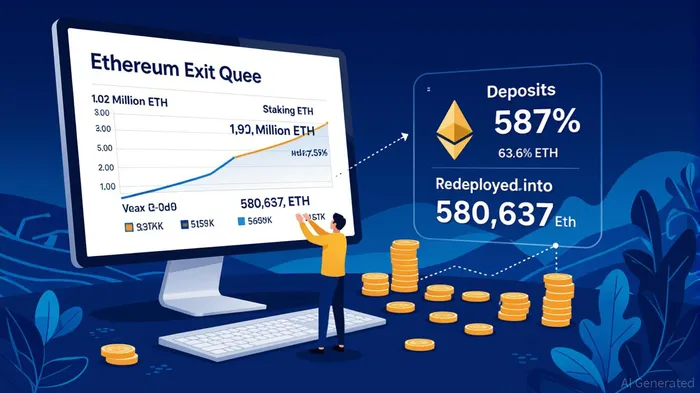
Ethereum’s staking ecosystem in 2025 has become a battleground of competing forces: a record-high validator exit queue and relatively modest staking inflows. As of August 2025, over 1.02 million ETH ($4.6–$4.96 billion) awaited withdrawal, with average processing delays stretching to 17–18 days [1]. This surge in exits, driven by profit-taking after a 70% ETH price rebound and anticipation of U.S. staking ETF approvals, has created liquidity bottlenecks. Yet, the narrative is far from one-sided. The interplay between exit pressures and institutional absorption reveals a maturing market where capital rotates between staking, DeFi, and institutional channels, offering strategic opportunities for investors.
The Exit Queue: A Barometer of Market Sentiment
The validator exit queue has become a critical indicator of market sentiment. When validators prioritize liquidity over staking yields (currently 3.8–5.2%), it signals confidence in alternative deployment avenues [1]. For instance, 50% liquidation of the queued ETH could introduce $2.5 billion in short-term selling pressure, but most withdrawn ETH is redeployed into DeFi protocols ($223 billion TVL) or restaked, mitigating risks [3]. This dynamic suggests that the exit queue reflects not panic but a strategic reallocation of capital.
The EthereumETH-- protocol’s design—limiting daily validator exits—acts as a stabilizer. By creating a “small door out,” the network inherently dampens panic selling, even as the “big door in” for staking remains open [2]. This structural constraint, combined with a 29.4% staked supply (35.6 million ETH), reinforces ETH’s utility as a store of value [1].
Institutional Absorption: Countering Exit Pressures
Institutional demand has emerged as a counterweight to exit-driven liquidity strains. Ethereum ETFs, particularly BlackRock’s ETHA, have captured $13.6 billion in cumulative inflows by August 2025 [1]. These ETFs act as liquidity sinks, absorbing ETH withdrawals and stabilizing price action. For example, Q2 2025 saw institutional investors add 388,000 ETH to portfolios via ETFs, offsetting exit pressures [4].
Corporate treasuries further underscore this trend. Goldman SachsGS--, for instance, holds 288,294 ETH ($721.8 million), reflecting growing corporate confidence in ETH as a strategic asset [1]. Meanwhile, DeFi’s $223 billion TVL and $33 billion in futures open interest highlight Ethereum’s role as a “liquidity magnet,” capable of redeploying capital without destabilizing the market [3].
Strategic Opportunities in the Dilemma
The exit queue’s growth, while seemingly bearish, is part of a broader capital rotation cycle. Historical patterns show that similar exit surges have preceded price increases, such as a 20% ETH rally in two weeks during mid-2025 [2]. This suggests that the exit queue is not a one-way trend but a cyclical barometer of market maturity.
Investors can leverage this duality by monitoring the net validator deltaDAL-- (exits minus entries), which stood at ~600,000 ETH in August 2025. While this figure reflects a liquidity outflow, it remains within historical norms, indicating structural resilience [3]. The key lies in aligning strategies with Ethereum’s deflationary supply dynamics and institutional adoption. For example, restaking mechanisms and ETF inflows create a flywheel effect, where liquidity is continuously redeployed rather than sold off.
Conclusion
Ethereum’s liquidity dilemma is not a crisis but a nuanced reflection of market evolution. The exit queue, while creating short-term bottlenecks, is being offset by institutional absorption, DeFi redeployment, and regulatory clarity. For investors, this duality offers a strategic lens: the exit queue is a leading indicator of capital rotation, not a harbinger of collapse. By contextualizing these dynamics within Ethereum’s structural strengths, investors can navigate volatility and capitalize on long-term opportunities.
**Source:[1] Ethereum Validator Exits Top $4B: Staking ETF Approval Near [https://coincentral.com/ethereum-validator-exits-top-4b-staking-etf-approval-near/][2] Ethereum Validator Exits Spike — But So Do Entries [https://messari.io/newsletter/unqualified-opinions/ethereum-validator-exits-spike-but-so-do-entries-1][3] Ethereum's Validator Queue Dynamics: A Bullish Catalyst for ETH Scarcity and Accrual [https://www.ainvest.com/news/ethereum-validator-queue-dynamics-bullish-catalyst-eth-scarcity-accrual-2508/][4] Institutional Investors Add 388,000 ETH to Portfolio in Q2 via ETFs [https://www.mitrade.com/au/insights/news/live-news/article-3-1076304-20250828]

Decoding blockchain innovations and market trends with clarity and precision.
Latest Articles
Stay ahead of the market.
Get curated U.S. market news, insights and key dates delivered to your inbox.


AInvest
PRO
AInvest
PRO



Comments
No comments yet