
Ethereum's Dual Edge: Navigating Illicit Risks and Regulatory Gains in a Shifting Crypto Landscape


 Aime Summary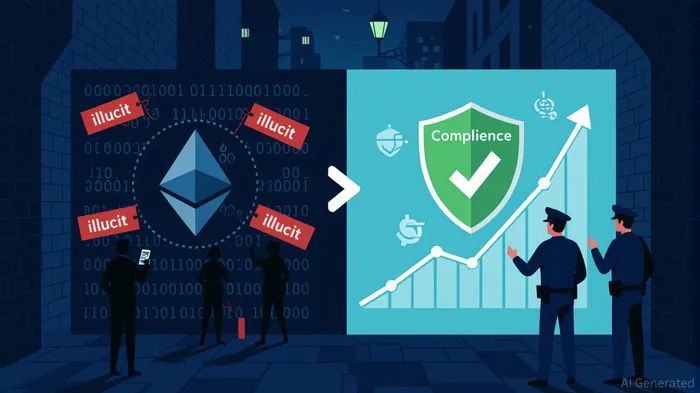
Ethereum’s position as a cornerstone of decentralized finance (DeFi) and smart contract innovation has long been accompanied by its role as a conduit for illicit activity. In 2024, Ethereum-based transactions accounted for 24% of total illicit crypto volume, a figure that, while lower than previous years, still underscores systemic vulnerabilities [1]. This duality—between innovation and risk—has drawn intense regulatory scrutiny, creating a complex landscape for investors in Ethereum-related infrastructure and compliance technologies.
The Illicit Undercurrent: Trends and Tactics
Ethereum’s smart contract capabilities and low transaction fees have made it a preferred platform for cybercriminals. Scams and fraud alone accounted for 24% of Ethereum’s illicit volume in 2024 [1], while thefts from platforms like Bybit (where 401,347 ETH, worth $1.5 billion, was stolen in 2025) highlight the scale of vulnerabilities [3]. Stolen EthereumETH-- is often laundered through privacy tools like Monero (XMR) via decentralized exchanges, with 60% of illicit Ethereum transactions following this pattern [3]. North Korea-linked actors have further exploited Ethereum’s liquidity, using sophisticated trading strategies to grow stolen assets from $53 million to $94–$103 million by August 2025 [2].
These tactics mirror those of institutional investors, blurring the line between legitimate and illicit behavior. For instance, North Korean hackers employed stablecoin liquidity buffers and “buy low, sell high” strategies to evade detection [2]. Such sophistication demands advanced countermeasures, creating a paradox: while Ethereum’s openness fuels innovation, it also invites exploitation.
Regulatory Responses: From Kiosks to Compliance Tech
Regulators have responded with a mix of targeted actions and systemic reforms. FinCEN’s August 2025 notice on convertible virtual currency (CVC) kiosks, for example, mandates stricter KYC protocols for operators, reflecting concerns over these kiosks’ role in facilitating $246.7 million in losses in 2024 alone [1]. The notice also emphasizes red flags like structuring transactions below reporting thresholds, a tactic frequently exploited by organized crime groups [1].
Beyond kiosks, blockchain analytics tools have become critical in tracing illicit flows. The T3 Financial Crime Unit—a collaboration between TRONTRON--, Tether, and TRM—froze $130 million in illicit proceeds in 2024, demonstrating the efficacy of public-private partnerships [1]. Similarly, the FBI reported a 75% surge in crypto-related money laundering cases between 2023 and 2024, underscoring the growing reliance on forensic technologies [2].
Investment Risks and Opportunities
For investors, Ethereum’s vulnerabilities present both challenges and opportunities. On the risk side, regulatory pressure could stifle adoption of Ethereum-based infrastructure, particularly in jurisdictions prioritizing AML compliance. For example, the U.S. FDIC’s recent guidance allowing banks to engage in crypto activities without prior approval hinges on effective risk management and AML adherence [4]. This signals a shift toward stricter oversight, which may increase operational costs for Ethereum-focused firms.
Conversely, the demand for compliance technologies is surging. Blockchain analytics firms, AML software providers, and DeFi security platforms are poised to benefit from heightened regulatory scrutiny. The 2025 Crypto Crime Report notes that governments and institutions are increasingly adopting blockchain forensics to trace illicit transactions [3], a trend likely to accelerate as regulators refine their frameworks.
The Long Game: Balancing Innovation and Compliance
Investors must weigh Ethereum’s inherent risks against its potential as a foundation for the next wave of financial innovation. While illicit activity remains a drag on its reputation, the ecosystem’s response—through advanced compliance tools and regulatory collaboration—offers a blueprint for sustainable growth.
For Ethereum infrastructure, the key lies in integrating robust AML protocols without compromising decentralization. Projects that successfully bridge this gap—such as those leveraging zero-knowledge proofs for privacy while enabling regulatory transparency—could dominate the market. Meanwhile, compliance technology firms stand to gain from both regulatory mandates and the need for proactive risk management in DeFi.
Conclusion
Ethereum’s journey in 2025 illustrates a broader tension in the crypto space: the clash between decentralized innovation and centralized oversight. While illicit activity and regulatory actions pose risks, they also catalyze the development of compliance technologies that could redefine the industry. For investors, the path forward lies in identifying projects that align with this evolving landscape—those that turn vulnerabilities into strengths and regulatory challenges into opportunities.
**Source:[1] 2025 Crypto Crime Report [https://www.trmlabs.com/reports-and-whitepapers/2025-crypto-crime-report][2] Blockchain Forensics and Illicit Transactions Statistics 2025 [https://coinlaw.io/blockchain-forensics-and-illicit-transactions-statistics/][3] Crypto Crime Report: 2025 Statistics & Trends [https://coinledger.io/research/crypto-crime-report][4] FDIC Clarifies Process for Banks to Engage in Crypto-Related Activities [https://www.fdic.gov/news/financial-institution-letters/2025/fdic-clarifies-process-banks-engage-crypto-related]

Decoding blockchain innovations and market trends with clarity and precision.
Latest Articles
Stay ahead of the market.
Get curated U.S. market news, insights and key dates delivered to your inbox.


AInvest
PRO
AInvest
PRO



Comments
No comments yet