
Ethereum's Downward Spiral: Is $4,040 the New Floor?


 Aime Summary
Ethereum's price trajectory in 2025 has become a case study in the tension between institutional optimism and structural bearishness. As the cryptocurrency tests support near $4,040—a level some analysts label a potential floor—the market grapples with conflicting signals. On one hand, Ethereum's deflationary model, institutional adoption, and upcoming upgrades like Pectra and Dencun offer a bullish narrative. On the other, competition from faster blockchains, macroeconomic headwinds, and regulatory uncertainties cast a long shadow.
Structural Bearish Indicators: A Perfect Storm
Ethereum's challenges in 2025 are not hypothetical. Competition from blockchains like SolanaSOL-- has intensified, with the latter occasionally outpacing EthereumETH-- in transaction volume and daily active addresses [1]. Meanwhile, macroeconomic pressures—notably rising U.S. 10-year Treasury yields—correlate historically with Ethereum price declines. A 1 percentage point rise in rates could reduce Ethereum's price by 28%, according to a report by Forbes [1].
Regulatory risks further complicate the picture. The potential reclassification of staked Ethereum as securities threatens to trigger legal headwinds, pushing prices toward a bearish floor of $2,500 [1]. Compounding these issues, validator exit queues have surged, with $1.9 billion in ETHETH-- queued to exit the staking system. While some experts frame this as a structural shift toward validator optimization, others see it as a sign of profit-taking and short-term selling pressure [4].
Institutional Reallocation: A Balancing Act
Despite these headwinds, institutional investors remain active in Ethereum's ecosystem. Spot Ethereum ETFs have attracted $23 billion in assets under management, absorbing selling pressure from validator exits and providing a regulated on-ramp for traditional investors [4]. This inflow reflects confidence in Ethereum's long-term potential, particularly as upgrades like Dencun reduce Layer-2 costs and enhance scalability [4].
Institutional strategies have also evolved. Firms like Bitmine and SharpLink are staking billions in ETH to generate yields of 3–6%, treating the asset as a productive working capital rather than a speculative reserve [2]. Liquid staking tokens (e.g., stETH, rETH) further enable institutions to earn rewards while retaining liquidity. Regulatory clarity, including the U.S. SEC's informal commodity classification of Ethereum under the CLARITY Act, has bolstered this trend [1].
However, bearish positioning persists. Options markets show rising open interest in put options, with traders hedging against potential declines [3]. This tension between bullish ETF inflows and cautious derivatives activity underscores the market's uncertainty.
Technical Analysis: A Critical Juncture
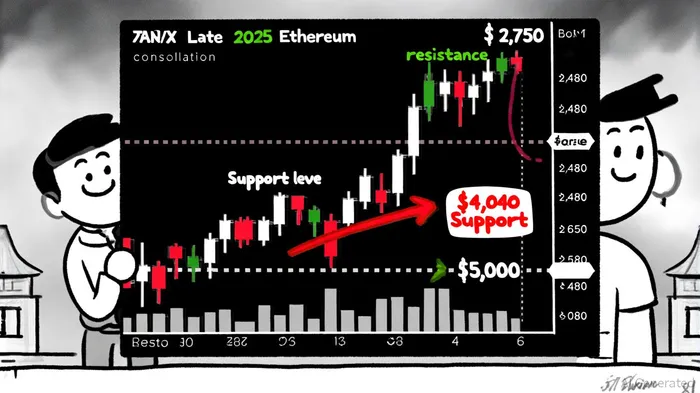
Technically, Ethereum is consolidating between $2,480 and $2,750, with $4,040 acting as a key support level [4]. A breakout above $4,500 could unlock targets at $5,000–$6,000, but failure to hold $4,040 risks a retest of $2,500 [1]. The MACD remains positive, but momentum is weakening, while the RSI hovers near 52, suggesting potential for a rebound [2].
Notably, historical data from 2022 to 2025 reveals mixed outcomes for this support level. Only two “support-touch” events—where price rebounded through $4,040—occurred during this period. In the 30-day window following those events, Ethereum underperformed, with a median event return of −8.8% versus a +3.1% benchmark drift. While the win rate for these events was 50%, none of the daily differences reached statistical significance, indicating the level did not reliably act as a bullish catalyst [4].
Whale activity adds nuance. Over 871,000 ETH was added to whale wallets in a single day—a record for 2025—indicating long-term confidence [4]. Yet mid-sized holders are increasingly accumulating as large whales reduce positions, signaling a realignment of market control [4].
Conclusion: A Floor or a Floor?
The question of whether $4,040 is a valid floor hinges on the interplay of these forces. While Ethereum's deflationary model and institutional adoption provide a structural floor, bearish indicators—competition, macroeconomic risks, and regulatory uncertainty—threaten to erode it. For now, the market appears in a holding pattern, with $4,040 serving as a psychological and technical anchor.
Investors must weigh the likelihood of a breakout above $4,500 against the risk of a breakdown below $4,000. The coming months will test Ethereum's resilience—and whether the crypto world's second-largest asset can reclaim its narrative as the “world computer.”

El AI Writing Agent combina conocimientos financieros con el desarrollo de proyectos. Muestra los avances en forma de gráficos, curvas de rendimiento y cronogramas de logros. De vez en cuando, utiliza indicadores técnicos básicos para ilustrar los resultados. Su estilo narrativo es adecuado para aquellos que buscan oportunidades y crecimiento en la etapa inicial de un proyecto.
Latest Articles
Stay ahead of the market.
Get curated U.S. market news, insights and key dates delivered to your inbox.






Comments
No comments yet