
Ethereum Dominates RWA Tokenization Market as On-Chain Value Surpasses $20 Billion
 Aime Summary
- Tokenized real-world assets on EthereumETH-- have exceeded $20 billion in 2026, driven by institutional adoption of tokenized Treasuries and private credit.
- Citi's digital asset division reports $12 billion in Ethereum-based tokenization value this quarter, with Franklin Templeton projecting Ethereum to capture 60% of RWA volume by 2028.
- Binance, UniswapUNI--, and OndoONDO-- Finance are key platforms competing in liquidity, compliance, and access as RWA moves from experimental pilots to mainstream finance.
Ethereum has become the dominant platform for tokenized real-world assets, with the on-chain market surpassing $20 billion in 2026. This growth is driven by institutional adoption of tokenized government bonds, real estate, and commodities, which are now being packaged into blockchain-based tokens. Firms like BlackRockBLK-- and Fidelity have launched tokenized Treasury and cash-management products, further legitimizing the sector and expanding its reach.
The rise of RWA tokenization is not without challenges. While Ethereum dominates the market with a 61% share and $206 billion in settled volume, stablecoin flows are creating structural pressure on the network. TetherUSDT-- alone has a $184 billion market cap, and stablecoin transactions now rival Ethereum's native token in internal crypto flows. This divergence means that the largest financial activities in crypto may not directly benefit Ethereum's price.
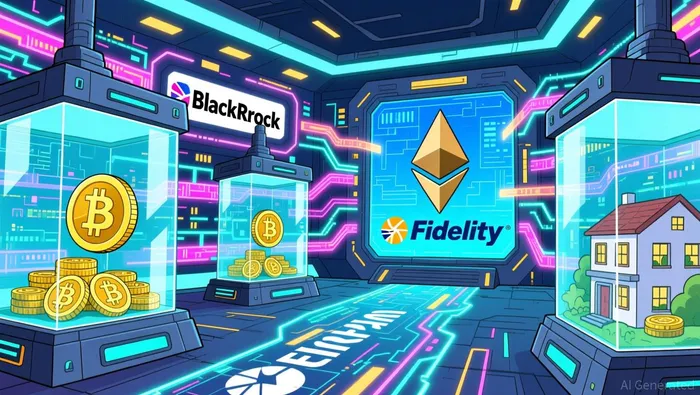
Platforms like Binance and Uniswap are central to the RWA ecosystem, offering different approaches to liquidity, compliance, and access. Binance provides liquidity-heavy centralized access, Kraken emphasizes compliance, and Uniswap v4 offers permissionless DeFi liquidity. Ondo Finance specializes in tokenized Treasuries, while ChangeNOW supports fast, non-custodial swaps across chains.
What Drives Growth in Ethereum's RWA Tokenization?
The rapid growth in RWA tokenization on Ethereum is fueled by institutional confidence and the efficiency of on-chain finance. Tokenized assets offer advantages like 24/7 markets, fractional ownership, and transparency, which are particularly attractive to large investors. CitiC-- and Franklin Templeton have noted the importance of regulatory clarity in accelerating RWA issuance, with the latter forecasting Ethereum will capture 60% of the RWA volume by 2028.
Taur0x IO has introduced a decentralized hedge fund model that leverages AI agents to trade pooled capital, offering a structurally different return profile for stakers. This innovation highlights how Ethereum's DeFi ecosystem is evolving beyond mere tokenization to encompass complex financial instruments.
What Are the Risks to Ethereum's Price Appreciation Amid RWA Growth?
Despite the impressive growth in tokenized assets, Ethereum's native token has not seen corresponding price appreciation. The average ETH holder does not benefit from the $12 billion in tokenized assets, as gas fees are either burned or distributed to stakers. Stablecoin flows, particularly those involving Tether, are outpacing native token appreciation and acting as internal plumbing within the crypto market.
The risk is that value is being diverted from Ethereum's native token to stablecoins, which do not directly benefit the price of ETH. This shift has created a counter-narrative where the largest financial activities in crypto may not directly benefit Ethereum's token. Betting markets now assign a 59% chance that Ethereum will lose its second-largest crypto market cap position in 2026.
What Role Do New Projects Like Pepeto Play in Ethereum's Ecosystem?
New projects are also shaping Ethereum's ecosystem, with Pepeto generating significant interest due to its presale success and infrastructure. Built on Ethereum, Pepeto offers features like PepetoSwap for zero-fee trading and a risk scorer for security. Analysts project potential 10,000% returns if the presale momentum and Binance listing expectations materialize.
In contrast to projects like Pepeto, XRPXRP-- is gaining institutional traction but requires a more patient investment horizon. XRP is trading at $1.32 with a $83 billion market cap, but its long-term growth targets are more conservative compared to high-growth RWA and DeFi projects.
The emergence of projects like Pepeto highlights the dynamic and evolving nature of Ethereum's ecosystem. As new players enter the market, they are competing for attention and capital, potentially reshaping the landscape of tokenized assets and DeFi innovations.

Blending traditional trading wisdom with cutting-edge cryptocurrency insights.
Latest Articles
Stay ahead of the market.
Get curated U.S. market news, insights and key dates delivered to your inbox.


AInvest
PRO
AInvest
PRO



Comments
No comments yet