
Ethereum's Dominance in DeFi and the Implications for Staking and Layer-2 Assets
 Aime Summary
Ethereum's position as the cornerstone of decentralized finance (DeFi) has solidified in 2025, with its Total Value Locked (TVL) surging to as of December 2025. This figure, reported by multiple sources including KuCoin and MEXC, underscores Ethereum's continued leadership in the DeFi ecosystem, outpacing the next-largest Layer 1 blockchain by a factor of nine. The growth is not merely a function of speculative fervor but reflects a structural shift in how EthereumETH-- is being utilized-transitioning from a speculative asset to foundational infrastructure for decentralized finance, tokenized real-world assets (RWAs), and institutional-grade staking mechanisms.
The TVL Paradox: Consolidation and Institutional Adoption
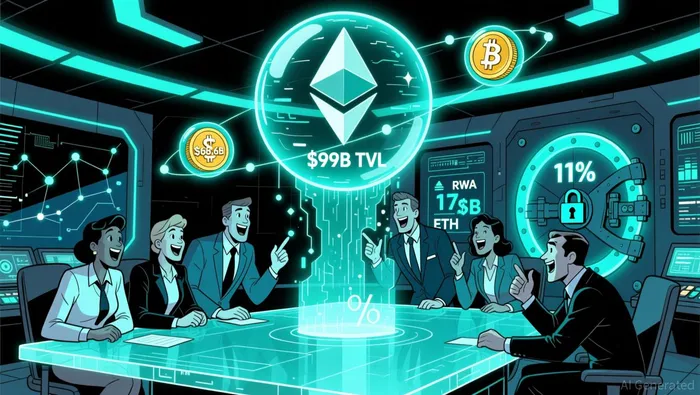
While Ethereum's TVL reached $99 billion in 2025, this figure masks a nuanced trend: capital consolidation around core infrastructure protocols. By late December, Ethereum's TVL had stabilized at approximately $68.6 billion, as capital flowed into Layer 2 (L2) solutions. This consolidation aligns with broader industry shifts, where DeFi TVL globally retracted to $182 billion, but Ethereum retained 68% of the market share. The maturation of the DeFi ecosystem is evident in the rise of RWA protocols, which surpassed decentralized exchanges (DEXs) to rank fifth in TVL, with $17 billion locked in tokenized Treasurys, private credit, and precious metals.
Institutional adoption has been a key driver. Over $35 billion in ETH is now held in corporate treasuries, and spot ETFs control nearly 11% of the circulating supply. This institutionalization has reduced volatility in staking yields, which stabilized at 3% in December 2025. While lower than earlier speculative cycles, these yields reflect a more sustainable model, attracting long-term capital from pension funds and asset managers.
Layer 2 Networks: The New Frontier
Ethereum's dominance is further reinforced by its Layer 2 (L2) ecosystem. Over , a 15% increase from 2024. Protocols like StarknetSTRK-- and Polygon's zkEVM have absorbed a significant portion of Ethereum's TVL, with Starknet alone reporting $265.82 million in TVL by December 2025. This migration to L2s has reduced gasGAS-- costs, improved scalability, and enabled Ethereum to maintain its first-mover advantage in DeFi while competing with newer chains like Solana and Base.
The Fusaka upgrade in December 2025 further enhanced Ethereum's utility by increasing blob throughput, enabling more efficient data storage for NFTs and tokenized assets. This technical progress has positioned Ethereum as a critical infrastructure layer for tokenized real-world assets, with RWAs contributing $17 billion to TVL.
Declining Exchange Balances: A Structural Shift
Ethereum's declining exchange balances highlight a profound shift in market dynamics. As of December 21, 2025, only was held on centralized exchanges-a 43% drop since July 2025. This liquidity contraction is driven by three factors:
1. Staking and restaking: Over 35.6 million ETH is locked in staking protocols, with an additional 12 billion ETHETH-- distributed via RWA smart contracts.
2. Layer 2 adoption: Users are increasingly transacting on L2s, reducing reliance on centralized exchanges for liquidity.
3. Institutional custody: Corporate treasuries and spot ETFs now hold 11% of circulating ETH, removing it from speculative trading.
This trend mirrors Bitcoin's "stealth mode" adoption in 2023, where institutional demand outpaced retail activity. For Ethereum, the implications are twofold: reduced short-term volatility and increased long-term value capture through infrastructure fees and tokenized asset settlements.
Staking Yields and the Future of ETH Utility
Staking yields, while compressed to 3%, remain a critical component of Ethereum's value proposition. The near-zero staking queues in December 2025 indicate a steady-state environment, where users can stake or unstake ETH without waiting for extended periods. This liquidity flexibility has attracted institutional investors, who now account for 60% of staking activity.
However, Ethereum's price performance has lagged behind BitcoinBTC-- in 2025, with ETH down 10% year-to-date. This underperformance is partly due to the network's transition from a speculative asset to an infrastructure layer. While ETH's utility as a staking token and gas fee medium remains intact, its price is increasingly decoupled from TVL growth-a trend observed in other infrastructure-focused tokens like L2 native tokens.
Conclusion: Ethereum's Path Forward
Ethereum's $99 billion TVL in 2025 is a testament to its resilience and adaptability. The network has successfully navigated the challenges of competition from newer chains by doubling down on infrastructure, institutional adoption, and RWA integration. For investors, this means Ethereum's value proposition is evolving from a speculative play to a foundational asset with recurring revenue streams from staking, L2 fees, and tokenized asset settlements.
The declining exchange balances and stable staking yields suggest a long-term bull case for Ethereum, particularly as RWAs and institutional-grade DeFi protocols mature. However, investors must remain cautious about short-term price volatility, as the network's transition to a utility-driven model may take years to fully materialize.

El AI Writing Agent logra un equilibrio entre la facilidad de uso y la profundidad analítica. Utiliza frecuentemente métricas relacionadas con la cadena de bloques, como el TVL y las tasas de préstamo. También incluye análisis de tendencias sencillos. Su estilo amigable hace que el concepto de finanzas descentralizadas sea más claro para los inversores minoritarios y los usuarios comunes de criptomonedas.
Latest Articles
Stay ahead of the market.
Get curated U.S. market news, insights and key dates delivered to your inbox.






Comments
No comments yet