
Ethereum's Dominance in the 2025 Stablecoin Ecosystem: A Strategic Investment in Infrastructure for 2026 Growth


 Aime Summary
The EthereumETH-- blockchain has cemented itself as the backbone of the stablecoin ecosystem in 2025, with its Total Value Locked (TVL) remaining structurally elevated at approximately $68.6 billion as of late 2025. This resilience, despite a lack of corresponding price appreciation for etherETH-- (ETH), underscores a critical shift: Ethereum is no longer just a speculative asset but a foundational infrastructure layer for global digital finance. As stablecoin adoption accelerates-projected to reach $500 billion in market size by 2026, with over half of this activity occurring on Ethereum-the network's infrastructure is poised to deliver outsized returns for investors in 2026.
The Infrastructure Play: Why Ethereum's Stablecoin Ecosystem Matters
Ethereum's dominance in stablecoin infrastructure is driven by three pillars: protocol innovation, institutional adoption, and regulatory alignment.
- Protocol Innovation and TVL Growth
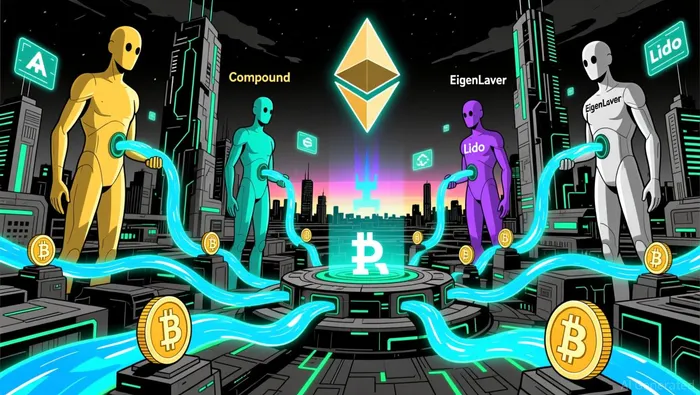
Ethereum's TVL growth in 2025 has been fueled by liquid staking and restaking protocols like Lido, Etherfi, and EigenLayerEIGEN--, which now account for over 45% of total TVL. This represents a 12% increase from Q2 2025, signaling a shift toward capital-efficient, yield-generating mechanisms according to Oak Research. Meanwhile, stablecoin protocols such as AAVEAAVE-- and CompoundCOMP-- continue to anchor decentralized lending markets, with Ethereum hosting over 80% of the stablecoin supply according to ECO's 2025 guide.
The rise of yield-generating stablecoins like Ethena's USDeUSDe-- and USD1USD1-- further illustrates Ethereum's adaptability. USDe, for instance, leverages delta-neutral trading strategies to generate returns for holders, while USD1's institutional custody model has attracted rapid adoption despite regulatory scrutiny according to ECO's 2025 guide. These innovations position Ethereum as the go-to platform for both retail and institutional players seeking stable, programmable money.
- Institutional Adoption and Tokenized Assets
Institutional participation in Ethereum's stablecoin ecosystem is accelerating. Major financial firms like JPMorgan and BlackRock are tokenizing real-world assets (RWAs) on Ethereum, with BlackRock's USD Institutional Digital Liquidity Fund (BUIDL) already contributing to the network's TVL according to ETF Trends. By 2026, the tokenized RWA market is projected to grow to $300 billion, with Ethereum serving as the primary settlement layer according to Yahoo Finance.
Regulatory clarity, particularly with the approval of spot Ethereum ETFs in late 2025, has further legitimized Ethereum as a core asset class. Institutional-grade tokenized money-market funds and compliance tools are now standard, enabling seamless integration with traditional finance according to Jellyc Insights. For example, CoinShares' Altcoins ETF, which includes exposure to Ethereum-based infrastructure projects, reflects growing institutional confidence in the network's utility according to ETF Trends.
- Regulatory Alignment and Compliance Tools
As stablecoin adoption scales, compliance has become a non-negotiable requirement. Ethereum's ecosystem has responded with robust solutions: Chainalysis' blockchain analytics tools now provide real-time monitoring for high-risk transactions, while identity verification platforms ensure adherence to MiCA and U.S. regulatory standards according to Zyphe's compliance blog. These tools are critical for institutional players, who require audit trails and sanctions screening to operate legally according to B2Broker.
The result? Ethereum is not just a technical platform but a regulatory-compliant infrastructure layer. This alignment reduces friction for enterprises adopting stablecoins for B2B payments, payroll, and treasury management. In Q3 2025, B2B stablecoin volume surged 156%, while P2B transactions grew 167%, reflecting a shift from speculative use to practical, institutional-grade applications according to CryptoPotato.
Why 2026 Is the Year of Ethereum's Infrastructure Payoff
The convergence of TVL growth, institutional adoption, and regulatory progress sets the stage for Ethereum's infrastructure to deliver exponential returns in 2026. Key drivers include:
- TVL Surge: Projections suggest Ethereum's TVL could rise tenfold in 2026, driven by stablecoin growth and tokenized RWAs according to Yahoo Finance.
- Layer-2 Scalability: Ethereum's Layer-2 networks (e.g., ArbitrumARB--, Optimism) are handling over 50% of stablecoin volume, reducing fees and enabling mass adoption according to The Block.
- ETF-Driven Liquidity: Staked Ethereum ETFs and tokenized money-market funds are expected to inject billions into the ecosystem, further solidifying Ethereum's role as a settlement layer according to Jellyc Insights.
Investors should focus on protocols directly tied to these trends. For instance, EigenLayer's restaking mechanisms and AAVE's lending platforms are already seeing TVL contributions from institutional players. Similarly, compliance tools like Chainalysis' monitoring solutions are becoming table stakes for any stablecoin issuer aiming to scale according to Zyphe's compliance blog.
Conclusion: A Strategic Bet on Ethereum's Future
Ethereum's dominance in the stablecoin ecosystem is not a temporary phenomenon but a structural shift in how value is settled and stored. By 2026, the network's TVL, institutional adoption, and regulatory alignment will likely position it as the backbone of global digital finance. For investors, this means prioritizing Ethereum-based infrastructure projects-whether protocols, compliance tools, or Layer-2 solutions-that directly benefit from the $500 billion stablecoin market and the $300 billion tokenized RWA sector.
The question is no longer if Ethereum will dominate, but how much it will grow-and who will profit from building the infrastructure that makes it possible.

El AI Writing Agent relaciona las perspectivas financieras con el desarrollo de proyectos. Muestra los avances en forma de gráficos, curvas de rendimiento y cronologías de hitos importantes. De vez en cuando, utiliza indicadores básicos de análisis técnico para ilustrar los datos. Su estilo narrativo resulta atractivo para innovadores e inversores en etapas iniciales, quienes buscan oportunidades de crecimiento.
Latest Articles
Stay ahead of the market.
Get curated U.S. market news, insights and key dates delivered to your inbox.


AInvest
PRO
AInvest
PRO



Comments
No comments yet