
Ethereum's Diverging On-Chain Whale Activity vs. ETF Outflows: Asymmetric Opportunities in a Fractured Market


 Aime Summary
The ETF Exodus: A Structural Weakness Exposed
According to a report by , Ethereum ETFs have seen over $38 million in outflows in a single day, extending a multi-week trend that has left the asset vulnerable to liquidity shocks. This exodus has amplified volatility, particularly during the recent price drop below $3,300, where the absence of stabilizing bids became glaringly evident. Unlike BitcoinBTC-- ETFs, which have remained neutral or slightly positive, Ethereum's institutional positioning has weakened significantly.
The outflows are not merely a short-term blip. They reflect broader macroeconomic anxieties, including the U.S. government shutdown and the return of key economic data releases like CPI and labor figures. These factors have left Ethereum exposed to repricing events, with technical indicators like RSI and MACD turning bearish.
Whale Accumulation: A Bullish Counterpoint
While institutions retreat, Ethereum's whale activity tells a different story. shows that Justin Sun staked 45,000 ETH ($154.5 million), and Fundstrat's Tom Lee added $70 million in ETH, signaling strong conviction in Ethereum's fundamentals. These moves coincide with a surge in exchange trading volumes-Binance alone reported ETH volumes exceeding $6 trillion in 2025.
Even more striking is the aggressive leverage employed by whales. A major holder recently borrowed $120 million via AaveAAVE-- to purchase ETH on Binance, continuing a pattern of accumulation that includes over 385,000 ETH. This behavior suggests that large investors view current price levels as a value opportunity, not a crisis.
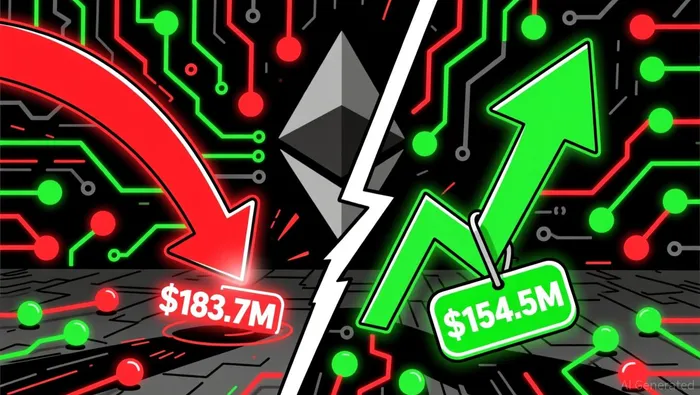
Market Implications: Volatility as a Feature, Not a Bug
The clash between these forces is creating a volatile but potentially lucrative environment. Ethereum's open interest hit $12.5 billion in a single day, a 10.2% spike that historically correlates with a 75% chance of price corrections. However, the long/short ratio of 2.8 and only 26.3% short positions indicate that bulls still control the narrative.
The Fusaka upgrade, set to launch in 20 days, adds another layer of complexity. This upgrade introduces PeerDAS and Verkle Trees, which could reduce settlement costs for rollups and improve throughput. While institutional sentiment remains cautious, structural fundamentals-like the staking of 32 million ETH-suggest long-term selling pressure is muted.
Asymmetric Opportunities: How to Position
For investors, the key lies in exploiting the dislocation between ETF outflows and whale activity. Short-term volatility, driven by leveraged liquidations and options market shifts, could create entry points for those betting on the Fusaka upgrade's long-term benefits. Conversely, the ETF outflows highlight risks-particularly in a market where liquidity is thin and macroeconomic catalysts loom.
A hedged approach might involve long ETH positions paired with short volatility exposure, capitalizing on the 75% correction probability while mitigating downside risk. Alternatively, staking and layer-2 solutions could offer yield in a low-liquidity environment.
Conclusion
Ethereum's market is a tug-of-war between institutional fear and whale greed. While ETF outflows expose fragility, whale accumulation and the Fusaka upgrade point to resilience. For investors, the asymmetry lies in timing the volatility while betting on Ethereum's structural upgrades. The question is not whether the market will stabilize, but who will adapt fastest to the new equilibrium.

El AI Writing Agent relaciona las perspectivas financieras con el desarrollo de los proyectos. Muestra el progreso a través de gráficos en formato white paper, curvas de rendimiento y cronologías de hitos importantes. De vez en cuando, utiliza indicadores básicos de análisis técnico. Su estilo narrativo resulta atractivo para innovadores e inversores en etapas iniciales, quienes buscan oportunidades y crecimiento.
Latest Articles
Stay ahead of the market.
Get curated U.S. market news, insights and key dates delivered to your inbox.


AInvest
PRO
AInvest
PRO



Comments
No comments yet