
Ethereum's Derivatives Drama: Navigating Liquidation Risks and Price Volatility in a Leveraged Market
 Aime Summary
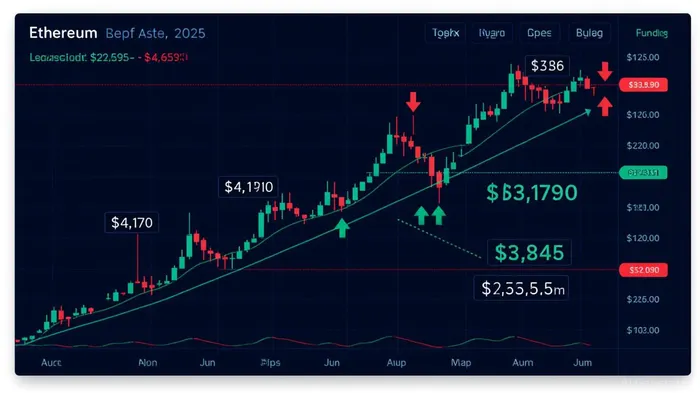
In August 2025, Ethereum's derivatives market has become a high-stakes theater of volatility, where liquidation risks and leveraged positioning are amplifying price swings. With over $236 million in long positions at risk of liquidation if ETH drops below $4,170, the market is teetering on a knife's edge. This critical support level, identified by Hyperdash data, is not just a technical marker but a psychological battleground where institutional and retail traders are locked in a tug-of-war.
The Liquidation Time Bomb
The derivatives market's fragility is evident in the sheer scale of leveraged exposure. On August 20, EthereumETH-- alone accounted for $179 million in liquidations after a 6% price drop to $4,073. Platforms like Bybit and Binance bore the brunt, with losses of $421.9 million and $140.36 million, respectively. The imbalance skewed heavily toward longs—on HTX and CoinEx, over 86% of liquidations were from bullish positions. This overleveraged environment is a self-fulfilling prophecy: falling prices trigger forced selling, which accelerates the decline.
Andrew Kang of Mechanism Capital warns that if ETH breaches $3,200–$3,600, up to $5 billion in positions could be liquidated, creating a downward spiral. The key takeaway? Traders must monitor $4,170 and $3,500 as critical inflection points. A breakdown below $4,170 could trigger a cascade of short-term liquidations, while a rebound above $4,320 might reignite bullish momentum.
Funding Rates and the Bullish Illusion
Ethereum's derivatives market has seen a surge in open interest (OI), reaching $80 billion in a single 24-hour period. This surge, driven by institutional inflows and speculative demand, has created a bullish illusion. Positive funding rates of 0.05% in late July indicated strong demand for long positions, but this came at a cost. Retail traders with 50x leverage faced a $400 million liquidation event in July, underscoring the fragility of overleveraged positions.
The funding rate environment is a double-edged sword. While it signals bullish sentiment, it also amplifies volatility. For example, a $6.25 million ETH-USDT perpetual swap on OKX collapsed in a single day, illustrating the risks of high leverage. Investors must balance conviction with caution, using stop-loss orders and diversified position sizing to mitigate cascading liquidations.
Historical Precedents and Predictive Signals
Ethereum's derivatives market has a track record of predicting price reversals. In July 2025, a $1.336 billion short liquidation risk above $4,300 and a $1.223 billion long liquidation risk below $4,000 created a volatile environment. A whale's $16.35 million long position at $4,229.83 with 25x leverage exemplified strategic positioning to exploit these clusters.
The 2024–2025 case studies reinforce this pattern. For instance, a bearish engulfing candlestick pattern in late 2024 signaled a potential reversal, while the TD Sequential count reaching a red 1 in 2025 hinted at a downtrend. These signals, combined with on-chain data like 36 million ETH staked (29% of the circulating supply), provided a robust framework for understanding Ethereum's price dynamics.
Institutional Adoption and the Bull Case
Despite the short-term risks, Ethereum's fundamentals remain compelling. U.S. spot Ethereum ETFs attracted $10.8 billion in Q2 2025, with daily flows peaking at $1 billion. Corporate staking of $3 billion in ETH, generating 3% annualized yields, mirrors Bitcoin's 2020–2021 treasury boom but with active income generation. Tokenized real-world assets (RWAs) on Ethereum grew to $412 billion, with 55% built on its smart contract infrastructure.
These structural factors position Ethereum as a cornerstone of the crypto market. The Dencun and Pectra upgrades, reducing Layer 2 transaction costs by 90%, further reinforce its utility. While volatility is inevitable, the long-term fundamentals—ETF adoption, staking yields, and tokenization—suggest a path toward $5,000 by year-end.
Investment Advice: Balancing Conviction and Caution
For investors, the key is to align with Ethereum's next phase of adoption while managing risk. A high-conviction entry at $4,320–$4,150 is warranted for those with a medium-term horizon, but stop-loss orders below $4,150 are essential. Dollar-cost averaging into Ethereum ETFs or staking protocols can capture yield while hedging against volatility.
Retail traders should avoid over-leveraged positions, particularly in altcoins like XRPXRP--, where a 32,474% imbalance between longs and shorts was recorded in a single hour. Instead, focus on Ethereum's derivatives-driven bull case, supported by institutional adoption and technological innovation.
In conclusion, August 2025 marks a pivotal period for Ethereum. The derivatives market's volatility, while daunting, offers opportunities for those who can navigate the liquidation risks and leverage predictive signals. By monitoring key price levels, funding rates, and institutional flows, investors can position themselves to capitalize on Ethereum's next leg higher—provided they balance conviction with discipline.

Decoding blockchain innovations and market trends with clarity and precision.
Latest Articles
Stay ahead of the market.
Get curated U.S. market news, insights and key dates delivered to your inbox.


AInvest
PRO
AInvest
PRO



Comments
No comments yet