
Ethereum at the Crossroads: Short-Term Pressure vs. Long-Term Institutional Tailwinds
 Aime Summary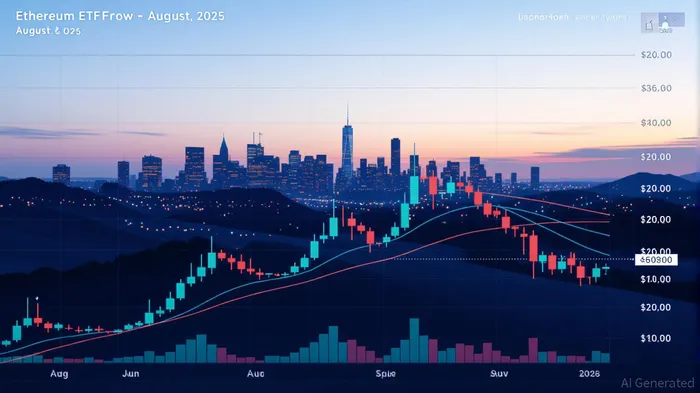
Ethereum's price action in late August 2025 paints a picture of a market at a critical inflection pointIPCX--. After a 215% surge from $1,350 in early July to $4,600 by mid-August, the asset has entered a consolidation phase, trading around $4,259 as of August 20. This pullback—6.5% from its peak—has reignited debates about whether EthereumETH-- is overbought, oversold, or simply resetting for a new leg higher. For contrarian investors, the current environment offers a compelling case: short-term volatility and derivatives-driven sell pressure are being counterbalanced by a structural shift in institutional demand, ETF adoption, and tokenization growth.
Short-Term Vulnerability: Futures Sell Pressure and Exchange Dynamics
Ethereum's futures market in Q2 2025 revealed a tug-of-war between bearish positioning and bullish fundamentals. Open interest on Binance peaked at $12 billion before retreating to $10.3 billion, signaling traders scaling back exposure amid heightened volatility. Negative perpetual futures funding rates in late July and August indicated a bearish tilt, with short positions dominating as Ethereum's price fell from $4,700 to $4,400. Meanwhile, the taker buy/sell ratio on Binance remained below 1, a bearish signal in futures markets.
Yet these derivatives signals must be contextualized. While the open interest decline suggests caution, the flat funding rates (unlike the 0.05–0.10 spikes in prior bull cycles) indicate the rally was driven by spot buying rather than leveraged speculation. This is a healthier dynamic, reducing the risk of cascading liquidations. On-chain data further complicates the narrative: massive Ethereum outflows from exchanges like CoinbaseCOIN-- and Binance—$888 million in Q2—suggest investors are moving ETH into cold storage or staking, not selling.
Long-Term Tailwinds: ETFs, Treasuries, and Tokenization
The short-term bearish signals are being overshadowed by a seismic shift in Ethereum's institutional narrative. U.S. spot Ethereum ETFs, launched in July 2024, have become a cornerstone of this transformation. In Q2 2025, Ethereum ETFs saw $10.8 billion in inflows, with BlackRock's ETHA and Fidelity's FETH leading the charge. By August 13, ETFs attracted a record $1 billion in a single day, outpacing Bitcoin's ETF flows by a 3.5:1 margin. This capital influx is not speculative—it reflects a strategic reallocation of institutional portfolios toward yield-generating and programmable assets.
Corporate treasuries are also reshaping Ethereum's demand profile. Public companies like SharpLink GamingSBET--, Bit DigitalBTBT--, and BitMine ImmersionBMNR-- have allocated over $3 billion to Ethereum, staking 95% of their holdings for ~3% annualized yields. This trend mirrors the 2020–2021 BitcoinBTC-- treasury boom but with a critical difference: Ethereum's proof-of-stake model allows for active income generation, whereas Bitcoin remains a passive store of value.
Tokenization is the third pillar of Ethereum's long-term case. In 2025, the tokenized real-world asset (RWA) market reached $412 billion, with Ethereum capturing 55% of the total. From real estate to private equity, institutions are leveraging Ethereum's smart contract infrastructure to tokenize assets, enabling fractional ownership and global liquidity. BlackRock's BUIDL fund, now integrated with DeFi protocols like Euler Finance, exemplifies this shift. Regulatory clarity in the U.S. and EU (via MiCA) is accelerating adoption, with Deloitte projecting the tokenized real estate market alone could hit $4 trillion by 2035.
Strategic Entry: Consolidation as a Catalyst
Ethereum's current consolidation near $4,200–$4,300 is not a bearish signal—it's a setup for a potential breakout. Technical indicators like the RSI (overbought at 70) and BollingerBINI-- Bands (widening after a breakout) suggest short-term volatility, but the 50- and 200-day moving averages remain bullish. The key resistance level at $4,700, if breached, could trigger a retest of the $4,878 all-time high.
For investors, the current pullback offers a high-conviction entry point. Institutional ETF inflows, which have historically correlated with Ethereum's price trajectory, remain a critical catalyst. If ETF flows stabilize and macroeconomic conditions (e.g., Fed rate cuts) improve, Ethereum could retest $4,800 by late 2025. A breakdown below $4,200 would test deeper support at $4,000, but the structural demand from treasuries and tokenization would likely prevent a prolonged bearish move.
Conclusion: A Contrarian's Playbook
Ethereum's crossroads moment is defined by a clash between short-term derivatives-driven sell pressure and long-term institutional tailwinds. While the near-term volatility is real, the fundamentals—ETF adoption, treasury allocations, and tokenization growth—paint a bullish picture. For investors willing to ride out the noise, Ethereum's consolidation phase is a strategic opportunity to position for a potential $4,800+ retest. The key is to balance risk with conviction: use stop-loss orders below $4,200 and monitor ETF flows for signs of stabilization. In a market where patience is a virtue, Ethereum's next chapter may be its most transformative yet.

Decoding blockchain innovations and market trends with clarity and precision.
Latest Articles
Stay ahead of the market.
Get curated U.S. market news, insights and key dates delivered to your inbox.




Comments
No comments yet