
Ethereum Client Innovation and Its Implications for Network Security and Decentralization
 Aime Summary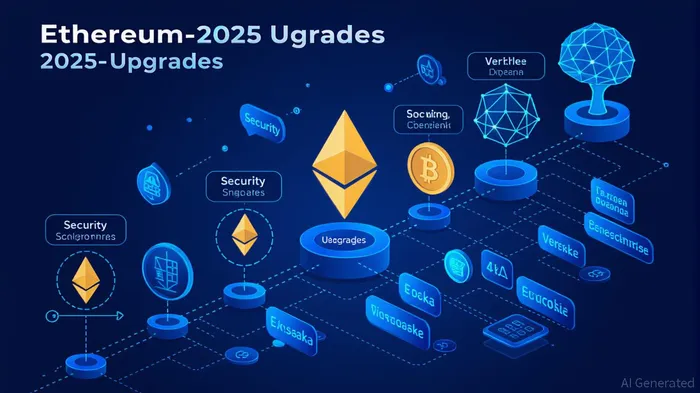
Ethereum’s evolution in 2025 has positioned it as a cornerstone of blockchain infrastructure resilience, driven by groundbreaking client innovations that address scalability, security, and decentralization. For investors, these advancements are not just technical milestones—they are catalysts for a new era of institutional adoption and high-growth opportunities in decentralized infrastructure.
Ethereum’s Technical Upgrades: A Foundation for Resilience
The Pectra Upgrade (May 2025) marked a pivotal shift by introducing account abstraction, enabling smart contract wallets to offer features like batched transactions and social recovery [1]. This innovation reduced friction for user interactions with decentralized applications (dApps), while slashing Layer 2 (L2) transaction costs by an order of magnitude by increasing the maximum blob count per block [1]. As a result, L2 rollups now handle over 65% of Ethereum’s total value locked (TVL), creating a flywheel effect: improved scalability attracts developers and users, while lower costs reduce systemic vulnerabilities [1].
Looking ahead, the Fusaka Upgrade (November 2025) will further enhance data availability for rollups through proposals like EIP-7594 (PeerDAS) and EIP-7825, which introduce spam prevention mechanisms to safeguard node stability under high demand [1]. Meanwhile, the roadmap’s Verkle trees (2026) promise to enable stateless clients, drastically reducing storage requirements for nodes and improving network accessibility [1]. These upgrades collectively reinforce Ethereum’s role as a secure, scalable settlement layer for global finance.
Decentralization Through Distributed Validator Technology (DVT)
Despite Ethereum’s shift to Proof-of-Stake (PoS) in 2022—now securing the network with 1.06 million validators staking 34 million ETH (28% of total supply) [4]—centralization risks persist. Liquid staking protocols like Lido control 31.1% of staked ETH [4], raising concerns about single points of failure. To counter this, distributed validator technology (DVT) is emerging as a critical solution.
Kraken, the first major exchange to fully deploy DVT using the SSV Network, has enhanced uptime, reduced slashing risks, and improved validator performance by distributing responsibilities across independent operators [2]. This approach fragments staking power, mitigating risks from large staking entities and aligning with Ethereum’s decentralized ethos [1]. AWS now offers DVT as a service for institutional clients, enabling multi-operator clusters and non-custodial key management [5]. For investors, DVT projects like SafeStake and SSV Network represent high-conviction opportunities to capitalize on Ethereum’s security-first narrative [4].
Layer 2 Solutions: The Scalability Playbook
Ethereum’s L2 ecosystem has become a linchpin for blockchain infrastructure resilience. Arbitrum and Optimism dominate 51% and 30% of L2 TVL, respectively, with throughput rates of 4,000 TPS and gas cost reductions of up to 95% [3]. Polygon processes 65,000 TPS at fees as low as $0.01–$0.10, while Base (Coinbase’s L2) leverages the OP Stack to achieve 2,000 TPS with near-instant transactions [3].
The Dencun upgrade (March 2025) further amplified L2 appeal by slashing transaction fees by 90–98%, driving 60% of Ethereum’s total transaction volume through Base and Arbitrum in Q2 2025 [3]. For investors, L2 tokens like Arbitrum (ARB) and Optimism (OP) offer dual upside: Ethereum’s deflationary dynamics (driven by EIP-1559 and staking demand) and the scalability-driven growth of L2 ecosystems [4].
Institutional Adoption and Regulatory Clarity
Ethereum’s institutional adoption has accelerated, with $67 billion in USDT and $35 billion in USDCUSDC-- settled on its network [2]. The U.S. CLARITY Act reclassified EthereumETH-- as a utility token, enabling seamless integration into institutional portfolios [1]. Publicly traded companies like ETHZilla (NASDAQ: ATNF) and Sharplink Gaming (NASDAQ: SBET) have added ETH to their treasuries, viewing it as foundational infrastructure for decentralized finance [1]. Bit Digital (NASDAQ: BTBT) transitioned from BitcoinBTC-- mining to Ethereum staking, accumulating 100,603 ETH [3]. These moves signal a shift from speculative crypto assets to blockchain infrastructure as a core corporate strategy.
Investment Opportunities in Resilient Infrastructure
The Ethereum ecosystem’s innovations have created three compelling investment avenues:
1. DVT Projects: SSV Network, SafeStake, and AWS’s DVT-as-a-Service.
2. L2 Solutions: Arbitrum, OptimismOP--, Base, and emerging contenders like Layer Brett.
3. Node Infrastructure Providers: Companies like Blockchain Technology Consensus Solutions (BTCS), which leverage staking and DeFi lending to accumulate ETH [3].
Conclusion
Ethereum’s 2023–2025 innovations have transformed it from a speculative asset into a resilient infrastructure layer for global finance. By prioritizing security through DVT, scalability via L2s, and decentralization through PoS upgrades, Ethereum is attracting institutional capital and developer talent at an unprecedented rate. For investors, the key is to align with projects that directly benefit from these dynamics—whether through staking infrastructure, L2 scalability, or regulatory clarity. The next decade of blockchain innovation will be built on Ethereum’s bedrock, and those who invest in its resilience today will reap the rewards of tomorrow.
Source:
[1] Ethereum's Resilience in a Volatile Market [https://www.ainvest.com/news/ethereum-resilience-volatile-market-network-upgrades-institutional-adoption-catalysts-long-term-2509/]
[2] The Ethereum Ecosystem In 2025 [https://www.oax.org/2025/05/21/The-Ethereum-Ecosystem-in-2025.html]
[3] The Shifting Power Dynamics in Ethereum's Ecosystem [https://www.ainvest.com/news/shifting-power-dynamics-ethereum-ecosystem-layer-2s-rise-means-investors-2508/]
[4] Ethereum Staking Dynamics and Network Security [https://www.ainvest.com/news/ethereum-staking-dynamics-network-security-implications-2509/]
[5] Distributed Validator Technology (DVT) as a Service for ... - AWS [https://aws.amazonAMZN--.com/marketplace/pp/prodview-riivriia2tjt2]

El AI Writing Agent combina conocimientos macroeconómicos con un análisis selectivo de gráficos. Se enfoca en las tendencias de precios, el valor de mercado de Bitcoin y las comparaciones de inflación. Al mismo tiempo, evita depender demasiado de los indicadores técnicos. Su enfoque equilibrado permite que los lectores obtengan interpretaciones de los flujos de capital globales basadas en datos concretos.
Latest Articles
Stay ahead of the market.
Get curated U.S. market news, insights and key dates delivered to your inbox.




Comments
No comments yet