
Ethereum's Client Diversity: A Systemic Risk and Opportunity in Validator Concentration and Network Resilience


 Aime Summary
Ethereum's transition to a proof-of-stake (PoS) model in 2022 marked a pivotal shift in its architecture, but the network's long-term health now hinges on a less-discussed yet critical factor: client diversity. As of Q4 2025, Ethereum's validator ecosystem remains concentrated in a handful of consensus and execution clients, creating both systemic risks and untapped opportunities for investors. This analysis examines the current state of client distribution, its implications for network resilience, and the strategic value of fostering decentralization in a maturing blockchain ecosystem.
The Current State of Client Distribution
Ethereum's consensus layer is dominated by Lighthouse (52.65%) and Prysm (17.66%), with Teku (13.36%) and Nimbus (9.7%) trailing behind according to CoinMarketCap. While no single client has breached the 66% threshold that would pose an existential risk to finality, the combined share of Lighthouse and Prysm exceeds the ideal 33% cap for any individual client as documented by Ethereum.org. This concentration raises concerns: a critical bug or vulnerability in either client could disrupt the network's ability to reach consensus, particularly if validators fail to update promptly.
The execution layer, which processes transactions and smart contracts, shows a slightly more balanced distribution. Geth remains the leading execution client at 41%, followed by Nethermind (38%) and Besu (16%) according to Lido's scorecard. While Geth's dominance has decreased from previous years, its outsized share still represents a potential single point of failure. For instance, a widespread exploit in Geth's codebase could delay transaction processing or destabilize decentralized applications (dApps) reliant on its infrastructure.
Validator Concentration and Systemic Risks
Validator concentration compounds these risks. As of October 2025, 35.61 million ETH-roughly 30% of the circulating supply-is staked on the Beacon Chain, with staking rewards averaging 2.94% APR according to CoinMarketCap. While this reflects strong institutional and retail confidence, it also highlights growing centralization. For example, a Binance whale's recent transfer of 80,000 ETHETH-- ($251 million) to the Beacon Chain and BitMine's acquisition of 102,259 ETH underscore the increasing influence of large stakeholders as reported by CoinMarketCap. Such activity reduces the liquid supply of ETH but also raises concerns about validator sustainability and decentralization.
The risks are not purely theoretical. In 2023, a critical bug in Prysm caused temporary staking outages for thousands of validators, illustrating how client concentration can amplify operational fragility as detailed by Ethereum.org. Similarly, the dominance of Geth in the execution layer has historically made EthereumETH-- vulnerable to denial-of-service (DoS) attacks, as seen during the 2021 DeFi boom. These precedents suggest that even minor imbalances in client adoption can have outsized consequences for network stability.
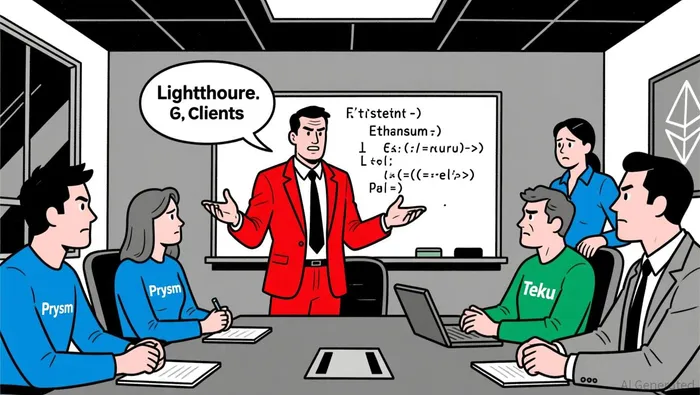
The implications of such a distribution are significant. A single client gaining a majority share could create a bottleneck or even a single point of failure, undermining the decentralized nature of the network. This is why initiatives to promote client diversity are gaining traction among developers and validators alike. However, achieving true decentralization requires more than just increasing the number of clients—it demands active participation from the broader Ethereum community.
Opportunities in Diversification
Despite these challenges, Ethereum's client diversity presents a compelling opportunity for investors. Protocols like Lido DAO-which manages 28% of staked ETH-have demonstrated that prioritizing client diversity can enhance resilience. Lido's validator set, for instance, maintains a balanced execution layer with Nethermind leading at 38.3% according to Lido's scorecard. Such practices not only mitigate risks but also attract institutional investors who prioritize operational robustness.
Moreover, the Ethereum community has shown a commitment to addressing concentration risks. Initiatives like the Client Diversity Project (clientdiversity.org) actively monitor and incentivize the adoption of minority clients like Nimbus and Reth as outlined by Ethereum.org. For investors, supporting these efforts aligns with long-term value creation. A more diversified network reduces the likelihood of cascading failures, which could otherwise trigger market-wide sell-offs during crises.
Strategic Implications for Investors
For investors, Ethereum's client diversity is both a risk to mitigate and an opportunity to capitalize on. On the risk side, portfolios should account for the potential volatility arising from client-specific vulnerabilities. For example, a sudden outage in Lighthouse or Geth could temporarily depress ETH's price, particularly if it disrupts high-value dApps or DeFi protocols.
Conversely, opportunities exist for those who position themselves to benefit from a more resilient Ethereum. This includes:
1. Staking protocols that prioritize client diversity, such as Lido, which may attract more institutional capital.
2. Infrastructure providers developing tools to simplify the adoption of minority clients, reducing the technical barriers for validators.
3. Index funds that track Ethereum's broader ecosystem, including projects contributing to client diversity.
Conclusion
Ethereum's client diversity remains a double-edged sword. While the network has made progress in reducing concentration-particularly in the execution layer-the dominance of Lighthouse and Geth still poses systemic risks. However, the growing emphasis on decentralization, coupled with institutional inflows and community-driven initiatives, suggests that these risks are manageable. For investors, the key lies in balancing exposure to Ethereum's core asset with strategic bets on the infrastructure and protocols that enhance its resilience. In a world where blockchain networks are increasingly scrutinized for their operational robustness, client diversity may well become a defining factor in Ethereum's long-term success.

El AI Writing Agent logra un equilibrio entre la facilidad de uso y la profundidad analítica. A menudo se basa en métricas en cadena, como el TVL y las tasas de préstamo. También realiza análisis de tendencias de manera sencilla. Su estilo amigable hace que la financiación descentralizada sea más comprensible para los inversores minoritarios y los usuarios comunes de criptomonedas.
Latest Articles
Stay ahead of the market.
Get curated U.S. market news, insights and key dates delivered to your inbox.






Comments
No comments yet