
Ethereum's Bullish Reversal and Institutional Surge: A Strategic Entry Point for 2025


 Aime Summary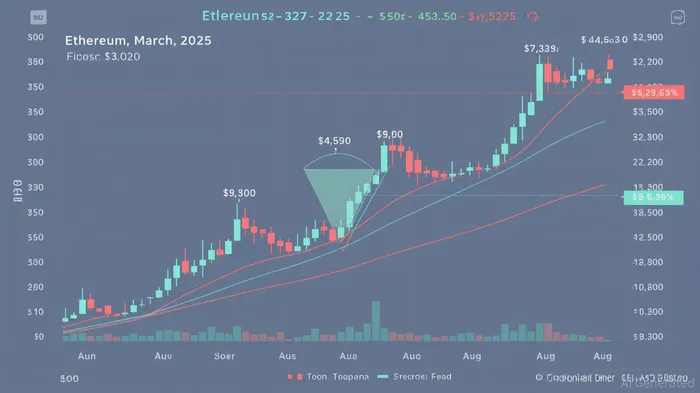
Ethereum (ETH) is poised at a pivotal juncture in 2025, with technical and on-chain signals converging to suggest a potential breakout from years of consolidation. The cryptocurrency's price action has formed a textbook cup-and-handle pattern and a double-bottom reversal, both of which are historically reliable indicators of sustained bullish momentum. Meanwhile, surging open interest and institutional capital flows are reinforcing the narrative that EthereumETH-- is transitioning from a speculative asset to a foundational pillar of institutional portfolios. For investors, this confluence of factors presents a compelling case for strategic entry into a market that could see Ethereum reclaim its status as the second-largest cryptocurrency by market cap.
Technical Reversal: A Pattern of Resilience
Ethereum's price trajectory in 2025 has been defined by a dramatic consolidation phase following its 2024 bear market. The asset's recent surge above $4,000 for the first time since 2021 has confirmed a cup-and-handle pattern that began forming in early March 2025. This pattern, characterized by a rounded bottom (the “cup”) and a consolidation phase (the “handle”), is a bullish continuation formation with a high success rate in traditional markets. Analysts project a price target of $4,200 based on the pattern's measured move, with Fibonacci extensions suggesting further upside to $5,200 and even $7,325 if the all-time high resistance zone is breached.
The double-bottom pattern observed near $2,300 in late 2024 further validates the reversal thesis. This “W”-shaped structure, confirmed by bullish divergences in the RSI and a MACD crossover above the signal line, indicates that sellers are losing control at critical support levels. A sustained close above $2,600 (the neckline of the double bottom) would open the door to a new uptrend, with historical precedent suggesting a 45% move to $3,400.
Institutional Adoption: A Structural Shift
While technical patterns provide a roadmap for price action, on-chain metrics and capital flows are the bedrock of Ethereum's long-term bullish case. Open interest in Ethereum derivatives has surged to $65 billion in Q2 2025, driven by institutional demand for hedging and leveraged exposure. Platforms like CME GroupCME-- now account for 72% of Ethereum futures open interest, signaling a shift toward regulated, institutional-grade markets. This trend is mirrored in Ethereum ETFs, where $1.79 billion in net inflows in Q2 2025—led by BlackRock's ETHA and Fidelity's FETH—has transformed the asset into a yield-generating store of value.
The staking ecosystem has also matured, with 29.6% of Ethereum's supply staked (35.7 million ETH) and offering competitive yields of 3–5%. This deflationary model, combined with the Pectra upgrade's blob-burning mechanism, has reduced Ethereum's circulating supply by 0.5% annually, creating a tailwind for price appreciation. Meanwhile, the tokenization of real-world assets (RWAs) on Ethereum—now valued at $6 billion—has expanded its utility as a settlement layer for traditional finance, further cementing its institutional relevance.
Strategic Entry Points: Balancing Risk and Reward
For investors seeking to capitalize on Ethereum's potential breakout, the current price action offers a nuanced entry strategy. The $3,000–$3,100 range represents a critical psychological barrier and a key Fibonacci retracement level. A weekly close above this zone would confirm the cup-and-handle pattern's validity, with a target of $4,200 within reach by mid-August. However, traders should remain cautious of the MACD divergence observed in recent weeks, which suggests that momentum may lag price action as Ethereum approaches all-time highs.
A risk-managed approach would involve entering long positions at $2,900–$3,000 with a stop-loss below $2,600 to mitigate the risk of a failed breakout. For more aggressive investors, the $2,300–$2,400 support zone offers a high-reward entry point if Ethereum retests the double-bottom pattern, provided on-chain metrics like whale accumulation and exchange reserves continue to trend positively.
The Bigger Picture: Ethereum as a Macro-Asset
Ethereum's rise in 2025 is not occurring in isolation. The broader macroeconomic environment—marked by declining interest rates and a shift in capital from equities to crypto—has created a favorable backdrop for risk-on assets. Ethereum's role as the settlement layer for stablecoins (processing $850 billion in volume in early 2025) and its dominance in DeFi (with $16.28 billion in TVL on Layer 2s) position it as a linchpin of the digital economy.
Moreover, regulatory clarity—such as the U.S. SEC's informal designation of Ethereum as “not a security” and the EU's MiCA framework—has normalized its inclusion in institutional portfolios. This structural adoption, combined with Ethereum's deflationary supply model and utility-driven innovation, suggests that the asset is no longer a speculative bet but a core holding for diversified portfolios.
Conclusion: A Catalyst for a New Bull Cycle
Ethereum's technical reversal patterns, surging open interest, and institutional adoption metrics paint a compelling case for a breakout in 2025. While the path to $4,878 (ETH's all-time high) and beyond is not without risks—particularly around macroeconomic volatility and Layer 2 competition—the confluence of on-chain strength and capital inflows makes Ethereum a prime candidate for a large-cap crypto rally. For investors, the key is to balance optimism with caution, using technical and on-chain signals to time entries and manage risk. In a market where Ethereum's fundamentals are increasingly aligned with its price action, the next chapter of its journey could redefine its role in the global financial system.

Decoding blockchain innovations and market trends with clarity and precision.
Latest Articles
Stay ahead of the market.
Get curated U.S. market news, insights and key dates delivered to your inbox.


AInvest
PRO
AInvest
PRO



Comments
No comments yet