
Ethereum's Bullish Ascension: Technical Momentum and Institutional Onslaught
Ethereum (ETH) has entered a new phase of its evolution, driven by a confluence of technical momentum, institutional capital inflows, and ecosystem innovation. As the second-largest cryptocurrency by market cap, Ethereum's trajectory in Q2 2025 signals a paradigm shift from speculative asset to institutional staple. Let's dissect the data to uncover why this is a pivotal moment for long-term investors.
Technical Analysis: A Golden Cross and the Path to $8,000
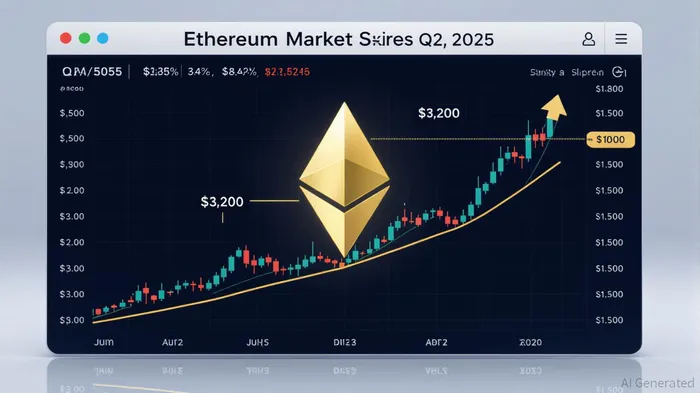
Ethereum's price action in Q2 2025 has been nothing short of explosive. After bottoming near $2,100 in June, ETH surged 36% by mid-July, reclaiming the $3,000 milestone. The golden cross—where the 50-day moving average crossed above the 200-day—marked a critical technical inflection point. This bullish signal historically precedes multi-month rallies, as seen in Ethereum's 2020 rebound.
Key technical indicators reinforce the bullish case:
- Resistance Levels: A breakout above $3,200 could unlock a 2025 target of $8,000, with the Fibonacci 161.8% extension at $3,323 acting as a near-term hurdle.
- RSI and MACD: Both show sustained buying pressure, with the MACD generating a buy signal.
- On-Chain Metrics: Whales accumulated 1.49 million ETH in July, while daily active addresses hit a 12-month high of 356,000.
Institutional Adoption: ETFs Lead the Charge
Institutional capital is no longer a sideshow in Ethereum's story—it's the main event. The record-breaking $907 million weekly inflow into EthereumETH-- ETFs in Q2 shattered previous records, with BlackRock's iShares Ethereum Trust (ETHA) now holding over 2 million ETH ($300 million). This dwarfs Bitcoin's ETF inflows, which averaged just 0.8% of AUM versus Ethereum's 1.6%.
Why institutions are buying:
1. Yield Advantage: Ethereum's 3–4% annualized staking yield outperforms U.S. Treasury bills.
2. Regulatory Clarity: The SEC's May 2025 ruling that staking is not a security removed a major legal hurdle.
3. Corporate Treasury Allocations: Firms like GameSquareGAME-- ($100 million ETH treasury) and SharpLink (270,000 ETH held) are treating ETH as a strategic reserve asset.
The GENIUS Act, expected to pass by late July, will further institutionalize Ethereum by enabling banks to issue USD-backed stablecoins on its network. With Ethereum already hosting $150 billion in USDC/USDT reserves, this could supercharge its role as a global settlement layer.
Layer-2 Scaling and Ecosystem Growth: The Foundation for Dominance
Ethereum's technical upgrades are not just theoretical—they're driving real-world adoption. The Pectra upgrade (May 2025) and EIP-4844 slashed gas fees by 80%, while Layer-2 networks like Arbitrum and Optimism now process more transactions than Ethereum's mainnet. This scalability is attracting developers and users alike, with DeFi TVL hitting $90 billion and NFT sales surging 300% year-on-year.
Risks and Considerations
No investment is without risk. Ethereum faces headwinds like:
- Regulatory Uncertainty: Ongoing SEC scrutiny of other blockchains (e.g., Solana) could create spillover effects.
- Security Exploits: Over $38 million lost to DeFi hacks in H1 2025 highlight vulnerabilities.
- Macroeconomic Downturns: Fed rate hikes could compress risk assets broadly.
However, these risks are outweighed by Ethereum's structural tailwinds: ETF liquidity, staking yield, and its role as the DeFi backbone.
Investment Strategy: Buy the Dip, Hold the Trend
For investors, the path forward is clear:
- Entry Points: Use dips below $2,500 as buying opportunities. The golden cross and whale accumulation signal strong support here.
- Long-Term Horizon: Ethereum's multi-year roadmap (zkEVM integration, modular scaling) justifies a 2–3 year holding period.
- ETF Exposure: The iShares Ethereum Trust (ETHA) offers low-cost, regulated access with $4.8 billion in AUM.
Conclusion: Ethereum's Institutional Inflection Point
Ethereum's Q2 2025 performance has been defined by a confluence of forces—technical breakout, ETF dominance, and ecosystem innovation—that position it for long-term appreciation. With $8,000 on the horizon and institutions pouring in, this is no longer a bet on crypto hype—it's an investment in the infrastructure of the next financial system.
For investors, the message is straightforward: position now or risk missing the train. The technicals are aligned, the institutions are committed, and the ecosystem is firing on all cylinders. This isn't just another crypto rally—it's a structural shift.

Delivering real-time insights and analysis on emerging financial trends and market movements.
Latest Articles
Stay ahead of the market.
Get curated U.S. market news, insights and key dates delivered to your inbox.


AInvest
PRO
AInvest
PRO



Comments
No comments yet