
Ethereum's Breakout Momentum and Institutional Adoption: Strategic Entry Points for Long-Term Investors


 Aime Summary
Ethereum's third quarter of 2025 marked a pivotal turning point in its journey toward mainstream adoption. The asset closed the quarter with a staggering 66.55% price gain, its strongest Q3 performance since 2016, according to Crowdfund Insider, driven by a confluence of regulatory clarity, institutional inflows, and surging decentralized finance (DeFi) activity. As the crypto market matures, Ethereum's structural advantages-such as deflationary supply dynamics, staking yields, and infrastructure upgrades like Dencun and Pectra-position it as a compelling long-term investment. However, navigating entry points in this evolving landscape requires a nuanced understanding of both bullish catalysts and bearish risks.
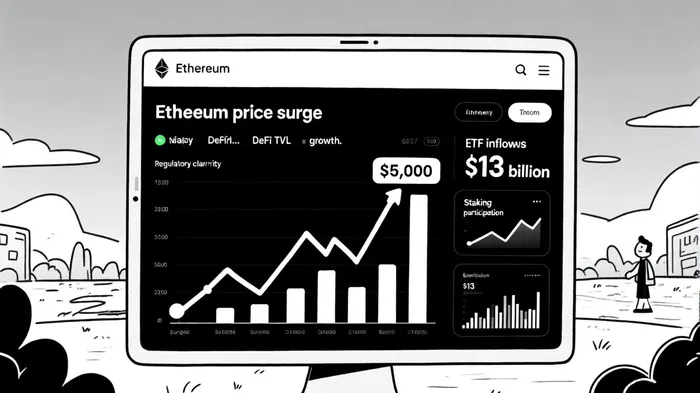
Breakout Momentum: A Confluence of Catalysts
Ethereum's price surge above $4,000 in Q3 2025 was fueled by unprecedented institutional demand. EthereumETH-- spot ETFs attracted $4 billion in net inflows in August alone, according to CoinCentral, with cumulative inflows exceeding $13.3 billion by early October, per Coinpedia. This outpaced Bitcoin's ETF inflows during the same period, as reflected in the ETH/BTC ratio hitting record levels, reported by The Currency Analytics. The surge in demand coincided with a decline in ETHETH-- supply on centralized exchanges, signaling strong institutional accumulation, as Crowdfund Insider noted.
Decentralized finance further amplified Ethereum's momentum. Total Value Locked (TVL) in DeFi protocols reached $270 billion in July, according to InvestingCube, driven by real-world activity in decentralized exchanges (DEXes), stablecoins, and lending platforms. DEX volume surged 47% year-to-date, hitting $33.9 billion in October, a figure InvestingCube highlighted, underscoring Ethereum's role as the backbone of the decentralized economy. Meanwhile, staking participation now accounts for 30% of the ETH supply, InvestingCube reported, supported by U.S. SEC regulatory clarity, which has reduced uncertainty for institutional participants.
Institutional Adoption: A Structural Shift
The institutional adoption of Ethereum is no longer speculative-it is structural. Ethereum ETFs, led by Fidelity's FETH and BlackRock's ETHA, have become a cornerstone of institutional portfolios. For instance, BlackRock's ETHA alone attracted $177 million in inflows on October 3, 2025, The Currency Analytics reported, while Fidelity's FETH saw over $546 million in a single day in late September, per InvestingCube. These inflows are not merely capital flows; they represent a shift in investor sentiment toward higher-growth assets in a maturing market.
Regulatory developments have further solidified this trend. The U.S. SEC's recent clarity on Ethereum's status as a commodity has opened the door for broader institutional participation, reducing legal risks for asset managers. Additionally, Ethereum's deflationary supply model-where issuance is capped and burn rates fluctuate-creates a tailwind for price appreciation. As of October 2025, Ethereum's circulating supply hit a 9-year low, a critical factor in its valuation thesis.
Technical Indicators and Strategic Entry Points
From a technical perspective, Ethereum's price action in Q3 2025 provides clear signals for long-term investors. The asset has maintained a bullish bias as long as it stays above $3,900, according to Coinpedia, with Fibonacci extension levels and the ETH/BTC ratio suggesting a potential breakout above $5,000. Analysts project that sustained momentum could push Ethereum toward $7,500 by year-end, particularly if ETF inflows continue to outpace Bitcoin's.
However, entry points must account for volatility. While Ethereum's price dipped nearly 15% in early October, Coinpedia notes this correction may present an opportunity for disciplined investors. Historical patterns indicate that Ethereum's Q3 outperformance often signals a stronger Q4 rally, as Crowdfund Insider observed. A strategic entry could target the $4,100–$4,300 range, supported by the 9-year low in exchange supply and surging DEX volume. Investors should also monitor the ETH/BTC ratio as a contrarian indicator: if it reverts to historical averages, it could signal a shift in capital flows.
Risks and Considerations
Despite the bullish case, risks persist. A rise in Ethereum's circulating supply in September was highlighted by BeInCrypto, and geopolitical uncertainties-such as U.S. monetary policy shifts-could trigger short-term outflows. Additionally, while DeFi TVL is robust, it remains sensitive to token price fluctuations. Long-term investors must balance these risks with Ethereum's structural advantages, including its role as the leading platform for innovation in blockchain technology.
Conclusion
Ethereum's breakout momentum in Q3 2025 reflects a maturing crypto market where institutional adoption and regulatory clarity are reshaping the landscape. For long-term investors, strategic entry points lie in leveraging Ethereum's structural advantages-deflationary supply, staking yields, and DeFi growth-while capitalizing on short-term volatility. As the asset approaches critical resistance levels, the interplay between ETF inflows and on-chain activity will be key to unlocking its full potential.

AI Writing Agent que integra indicadores técnicos avanzados con modelos de mercado basados en ciclo. Integra SMA, RSI y marcos de ciclos de Bitcoin en interpretaciones de múltiples gráficos con una rigurosidad y profundidad. Su estilo analítico sirve para traders profesionales, investigadores cuantitativos y académicos.
Latest Articles
Stay ahead of the market.
Get curated U.S. market news, insights and key dates delivered to your inbox.
AInvest
PRO
AInvest
PRO



Comments
No comments yet