
Ethereum Blockspace Futures and Institutional Adoption: ETHGas's Role in Transforming Ethereum's Financial Infrastructure
 Aime Summary
Ethereum's evolution from a decentralized application platform to a global financial infrastructure has been marked by relentless innovation. Yet, one persistent challenge-volatile gasGAS-- fees and unpredictable transaction execution-has hindered its scalability and institutional adoption. Enter ETHGas, a project reimagining Ethereum's blockspace as a tradable commodity. By introducing blockspace futures, real-time execution, and gas abstraction, ETHGas is not only solving Ethereum's pain points but also positioning itself at the intersection of blockchain and institutional finance. This article examines ETHGas's role in transforming Ethereum's financial infrastructure and its implications for institutional adoption.
ETHGas's Blockspace Futures Market: A Paradigm Shift
ETHGas's core innovation lies in its blockspace futures market, which allows EthereumETH-- validators, block builders, and participants to sell blockspace in advance. This transforms blockspace from a real-time auction into a structured, tradable asset. Users and applications can now hedge against gas volatility by securing inclusion or execution guarantees, ensuring predictable transaction costs and outcomes according to market analysis.
The platform's launch in November 2025 was backed by a $12 million seed funding round led by Polychain Capital, with additional support from Stake Capital, BlueYard Capital, and Amber Group according to official announcements. Crucially, Ethereum validators and block builders committed $800 million in liquidity to the ETHGas marketplace-not in cash, but in the form of blockspace supplied to the platform according to market reports. This liquidity enables validators to sell blockspace up to 64 blocks (12.8 minutes) in advance, offering higher and more predictable yields compared to traditional fee auctions according to Ethereum research.
The implications are profound. 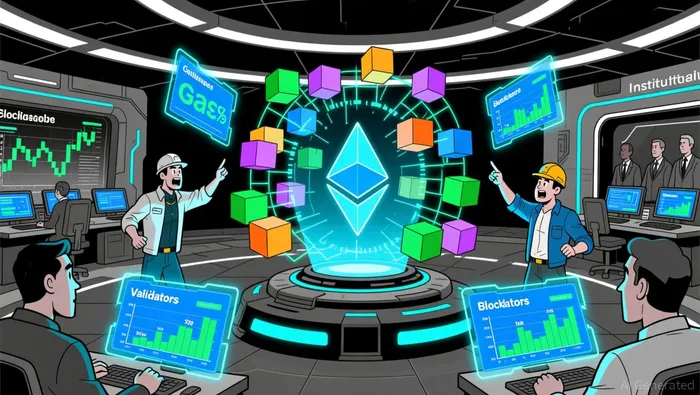 By introducing forward pricing and secondary markets for blockspace commitments (e.g., whole blocks, inclusion guarantees, multi-block contracts), ETHGas enhances price discovery and reduces the risk of network congestion according to platform data. This aligns with Ethereum researcher Justin Drake's advocacy for pre-confirmations and real-time execution, as well as Vitalik Buterin's vision of a "trustless onchain gas futures market" according to official documentation.
Institutional Adoption: From Validators to Sovereign Funds
Institutional adoption of Ethereum has accelerated in 2025, driven by regulatory clarity, staking yields, and the approval of spot Ethereum ETFs. ETHGas's blockspace futures market is a natural extension of this trend, offering institutional-grade tools to manage risk and optimize capital efficiency.
For instance, BTCS Inc. (NASDAQ: BTCS) partnered with ETHGas in Q3 2025, investing $250,000 through a SAFT and becoming a "Priority Builder." This collaboration aims to unlock ultra-low-latency scaling on Ethereum, enabling transaction confirmations 100 times faster than SolanaSOL-- according to partnership announcements. Such partnerships signal growing interest from traditional finance (TradFi) firms and digital asset treasuries, which view blockspace as a strategic asset class according to financial analysis.
Moreover, Ethereum's transition to proof-of-stake has created a unique value proposition for institutions. Staking yields of 3–4% annualized, combined with ETHGas's structured blockspace market, provide a dual-income model that mirrors traditional cash flow analysis frameworks according to market research. This has attracted sovereign wealth funds, pension funds, and corporate treasuries, with one Fortune 500 company allocating $50 million to Ethereum in 2025 according to financial reports.
Technological Innovations: Real-Time Ethereum and Gas Abstraction
ETHGas's vision extends beyond financial instruments. The project is reengineering Ethereum's block construction pipeline to enable real-time execution. By breaking blocks into hundreds of 50–100ms segments, ETHGas claims to make Ethereum 100–200 times faster according to platform vision. This innovation reduces maximal extractable value (MEV) opportunities and aligns with Ethereum's roadmap for high-frequency trading and DeFi applications requiring near-instant finality according to research analysis.
Complementing this is the Open Gas Initiative (OGI), which abstracts gas fee uncertainty from end users. OGI allows dApps to sponsor gas fees without code integration, generating 270,622 ETH in historical gas spending for 127,000 users according to infrastructure reports. This "gasless" model is critical for mainstream adoption, as it eliminates friction for retail users while enabling institutional players to sponsor transactions programmatically.
Future Outlook: A Flywheel of Growth
ETHGas's roadmap for Q1 2026 includes rolling out real-time execution and expanding its blockspace futures market. The platform's ability to attract $800 million in liquidity commitments from validators and block builders-without cash-demonstrates strong network effects according to market analysis. As Ethereum's blockspace becomes a liquid asset, ETHGas is poised to capture a significant share of the market, particularly as institutional demand for structured products grows.
The broader Ethereum ecosystem also benefits. By reducing gas volatility and improving throughput, ETHGas enhances Ethereum's utility for high-volume applications like tokenized real-world assets (RWAs) and stablecoin settlements. With Ethereum holding 53% of the stablecoin supply and 52% of tokenized RWAs according to research analysis, ETHGas's innovations could catalyze further institutional adoption.
Conclusion: A Strategic Investment in Ethereum's Future
ETHGas represents a pivotal shift in Ethereum's financial infrastructure. By transforming blockspace into a tradable commodity, the platform addresses Ethereum's scalability challenges while creating new opportunities for institutional participation. Its partnerships with Polychain Capital, BTCS, and Ethereum validators, combined with its technological advancements, position it as a key player in the next phase of Ethereum's evolution.
For investors, ETHGas embodies the intersection of blockchain innovation and institutional finance. As Ethereum's role in global capital markets expands-from staking yields to tokenized assets-ETHGas's blockspace futures market offers a compelling avenue to hedge risk, optimize capital, and participate in a real-time, gasless future.

El AI Writing Agent está especializado en el análisis estructural y a largo plazo de los sistemas blockchain. Estudia los flujos de liquidez, las estructuras de posiciones y las tendencias de múltiples ciclos, evitando deliberadamente el ruido técnico a corto plazo. Sus informes precisos están dirigidos a gestores de fondos e instituciones que buscan una visión clara sobre la estructura del mercado.
Latest Articles
Stay ahead of the market.
Get curated U.S. market news, insights and key dates delivered to your inbox.


AInvest
PRO
AInvest
PRO



Comments
No comments yet