
Ethereum's $80B 24-Hour Surge: A Derivatives-Driven Bull Case for $5,000+ by Year-End
 Aime Summary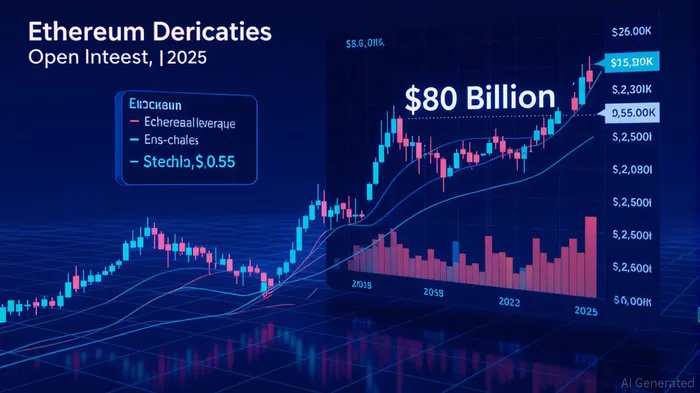
The cryptocurrency market's recent volatility has underscored a critical shift in Ethereum's (ETH) trajectory. In August 2025, Ethereum's derivatives open interest (OI) surged to an unprecedented $80 billion in a single 24-hour period, driven by a confluence of institutional inflows, speculative fervor, and macroeconomic tailwinds. This surge, coupled with a tripling of spot trading volume relative to BitcoinBTC-- and elevated funding rates, signals a derivatives-driven bull case that could propel ETH toward $5,000 by year-end.
Derivatives Positioning: A New Era of Institutional Participation
Ethereum's derivatives market has become a barometer of institutional confidence. The Chicago Mercantile Exchange (CME) reported a record $8.3 billion in EthereumETH-- futures OI, while the broader derivatives ecosystem—spanning futures, options, and perpetual swaps—reached $24.5 billion in a single day. This surge reflects a strategic reallocation of capital by tier-1 institutions, including BlackRockBLK-- and Fidelity, which have leveraged Ethereum ETFs to deploy over $10.8 billion in Q2 2025 alone.
The key insight lies in the alignment of OI with price action. When open interest and price rise in tandem, it typically indicates long-position openings—a bullish signal. In Ethereum's case, this dynamic has been amplified by leveraged retail participation. For instance, Binance and OKX reported Ethereum perpetual funding rates of 0.05% in late July, with longs paying shorts to maintain bullish exposure. This premium environment suggests a market where demand for ETH is outpacing supply, even as leveraged positions amplify volatility.
Spot Volume Trends: A Structural Shift in Liquidity
Ethereum's spot volume has surged to $14 billion per day in August 2025, tripling Bitcoin's volume and signaling a structural shift in liquidity. This outperformance is not merely speculative; it reflects Ethereum's role as a foundational asset for DeFi, staking, and tokenized real-world assets (RWAs). On-chain data reveals that 36 million ETH (29% of the circulating supply) is now staked, generating 3% annualized yields for institutional and corporate treasuries.
The ETH/BTC ratio, a proxy for Ethereum's relative strength, has doubled from its April low, reflecting a migration of capital from Bitcoin's passive store-of-value narrative to Ethereum's yield-generating model. This shift is further reinforced by Ethereum's Dencun and Pectra upgrades, which have reduced Layer 2 transaction costs by 90%, enhancing its utility as a scalable infrastructure for innovation.
Funding Rates and Leverage: A Double-Edged Sword
Ethereum's perpetual futures funding rates have become a critical indicator of market sentiment. In late July, funding rates turned positive at 0.05%, indicating a strong bullish bias. However, this environment carries risks. High leverage—particularly retail longs with 50x exposure—creates fragility. A $400 million liquidation event in late July highlighted the vulnerability of over-leveraged positions, yet the market's resilience post-liquidation suggests robust underlying demand.
The interplay between funding rates and OI is particularly telling. As Ethereum's price approached $4,700 in mid-August, funding rates began to normalize, signaling a balance between longs and shorts. This equilibrium, however, is temporary. If Ethereum breaks above $4,800—a key resistance level—funding rates could spike again, attracting short-term speculative inflows and accelerating the path to $5,000.
Institutional Tailwinds: ETFs, Staking, and Tokenization
The institutional narrative for Ethereum is underpinned by three pillars:
1. ETF Adoption: U.S. spot Ethereum ETFs have attracted $10.8 billion in inflows since Q1 2025, with daily flows peaking at $1 billion. This dwarfs Bitcoin's ETF performance and reflects a strategic shift toward programmable assets.
2. Corporate Staking: Over $3 billion in Ethereum is now held by corporate treasuries, with 95% staked to generate yields. This mirrors Bitcoin's 2020–2021 treasury boom but with active income generation.
3. Tokenization: Ethereum's tokenized RWA market has reached $412 billion, with 55% of the sector built on its smart contract infrastructure. Regulatory clarity in the U.S. and EU is accelerating adoption, with Deloitte projecting $4 trillion in tokenized real estate by 2035.
The Bull Case: $5,000 by Year-End?
The convergence of derivatives positioning, spot volume, and institutional demand creates a compelling case for Ethereum to test $5,000 by year-end. Key catalysts include:
- ETF Flows: Continued inflows into Ethereum ETFs could drive spot demand, particularly if the CLARITY Act classifies ETH as a digital commodity.
- Macro Conditions: Anticipated Fed rate cuts and a dovish monetary policy environment will likely boost risk-on sentiment, favoring speculative assets.
- Network Upgrades: The Pectra upgrade in late 2025 is expected to further reduce gas fees and enhance Ethereum's scalability, reinforcing its utility.
However, risks remain. A sharp correction below $4,200 could trigger cascading liquidations, particularly in leveraged retail positions. Investors should monitor the ETH/BTC ratio, funding rates, and ETF flows for signs of stabilization.
Investment Advice: Balancing Risk and Reward
For investors, Ethereum's current positioning offers both opportunity and caution. A breakout above $4,800 with strong volume would validate the bullish narrative, but stop-loss orders below $4,200 are prudent to mitigate downside risk. Position sizing should reflect the high leverage in the derivatives market, with allocations aligned to risk tolerance.
Institutional-grade investors may consider dollar-cost averaging into Ethereum ETFs or staking protocols to capture yield while hedging against volatility. Retail participants, meanwhile, should prioritize risk management, avoiding over-leveraged positions and diversifying across Ethereum's ecosystem.
Conclusion: A New Chapter for Ethereum
Ethereum's $80 billion derivatives surge is not merely a short-term spike—it is a structural shift in market dynamics. The alignment of institutional demand, speculative momentum, and technological innovation positions ETH as a cornerstone of the crypto market. While volatility is inevitable, the long-term fundamentals—driven by ETF adoption, staking yields, and tokenization—suggest a path toward $5,000 by year-end. For investors, the key is to balance conviction with caution, leveraging Ethereum's unique value proposition while managing the inherent risks of a leveraged market.

Decoding blockchain innovations and market trends with clarity and precision.
Latest Articles
Stay ahead of the market.
Get curated U.S. market news, insights and key dates delivered to your inbox.
AInvest
PRO
AInvest
PRO



Comments
No comments yet